QUESTION IMAGE
Question
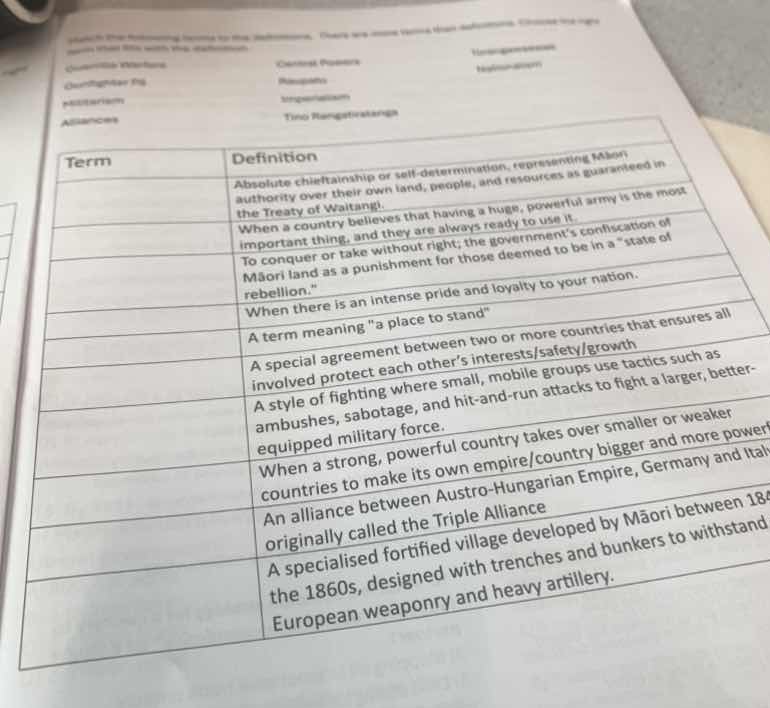
match the following terms to the definitions. there are more terms than definitions. choose the right term that fits with the definition.
terms:
guerrilla warfare
central powers
tūrangawaewae
gunfighter pā
raupatu
nationalism
militarism
imperialism
alliances
tino rangatiratanga
table:
term | definition
--- | ---
| absolute chieftainship or self-determination, representing māori authority over their own land, people, and resources as guaranteed in the treaty of waitangi.
| when a country believes that having a huge, powerful army is the most important thing, and they are always ready to use it.
| to conquer or take without right; the governments confiscation of māori land as a punishment for those deemed to be in a \state of rebellion.\
| when there is an intense pride and loyalty to your nation.
| a term meaning \a place to stand\
| a special agreement between two or more countries that ensures all involved protect each others interests/safety/growth
| a style of fighting where small, mobile groups use tactics such as ambushes, sabotage, and hit-and-run attacks to fight a larger, better-equipped military force.
| when a strong, powerful country takes over smaller or weaker countries to make its own empire/country bigger and more powerful
| an alliance between austro-hungarian empire, germany and italy, originally called the triple alliance
| a specialised fortified village developed by māori between 1840 and the 1860s, designed with trenches and bunkers to withstand european weaponry and heavy artillery.
Match Māori sovereignty and self-determination
The first definition describes "Absolute chieftainship or self-determination, representing Māori authority over their own land, people, and resources as guaranteed in the Treaty of Waitangi." This matches the term Tino Rangatiratanga.
Match military build-up and ideology
The second definition describes "When a country believes that having a huge, powerful army is the most important thing, and they are always ready to use it." This matches the term Militarism.
Match land confiscation history
Using the Raupatu Land Confiscations knowledge point
The third definition describes "To conquer or take without right; the government's confiscation of Māori land as a punishment for those deemed to be in a 'state of rebellion.'" This matches the term Raupatu.
Match national pride and loyalty
The fourth definition describes "When there is an intense pride and loyalty to your nation." This matches the term Nationalism.
Match connection to land
The fifth definition describes "A term meaning 'a place to stand'." This matches the term Tūrangawaewae (spelled "Turangawaewae" in the word bank).
Match international agreements
Using the WWI Alliance Systems knowledge point
The sixth definition describes "A special agreement between two or more countries that ensures all involved protect each other's interests/safety/growth." This matches the term Alliances.
Match irregular combat tactics
The seventh definition describes "A style of fighting where small, mobile groups use tactics such as ambushes, sabotage, and hit-and-run attacks to fight a larger, better-equipped military force." This matches the term Guerrilla Warfare.
Match empire expansion
The eighth definition describes "When a strong, powerful country takes over smaller or weaker countries to make its own empire/country bigger and more powerful." This matches the term Imperialism.
Match historical wartime coalitions
The ninth definition describes "An alliance between Austro-Hungarian Empire, Germany and Italy, originally called the Triple Alliance." This matches the term Central Powers (which formed the core of this alliance system during WWI).
Match defensive fortifications
The tenth definition describes "A specialised fortified village developed by Māori between 1845 and the 1860s, designed with trenches and bunkers to withstand European weaponry and heavy artillery." This matches the term Gunfighter Pā (spelled "Gunfighter Pa" in the word bank).

Snap & solve any problem in the app
Get step-by-step solutions on Sovi AI
Photo-based solutions with guided steps
Explore more problems and detailed explanations
| No. | Definition | Term |
|---|---|---|
| 2 | When a country believes that having a huge, powerful army is the most important thing, and they are always ready to use it. | Militarism |
| 3 | To conquer or take without right; the government's confiscation of Māori land as a punishment for those deemed to be in a "state of rebellion." | Raupatu |
| 4 | When there is an intense pride and loyalty to your nation. | Nationalism |
| 5 | A term meaning "a place to stand" | Turangawaewae |
| 6 | A special agreement between two or more countries that ensures all involved protect each other's interests/safety/growth | Alliances |
| 7 | A style of fighting where small, mobile groups use tactics such as ambushes, sabotage, and hit-and-run attacks to fight a larger, better-equipped military force. | Guerrilla Warfare |
| 8 | When a strong, powerful country takes over smaller or weaker countries to make its own empire/country bigger and more powerful. | Imperialism |
| 9 | An alliance between Austro-Hungarian Empire, Germany and Italy, originally called the Triple Alliance | Central Powers |
| 10 | A specialised fortified village developed by Māori between 1845 and the 1860s, designed with trenches and bunkers to withstand European weaponry and heavy artillery. | Gunfighter Pa |