QUESTION IMAGE
Question
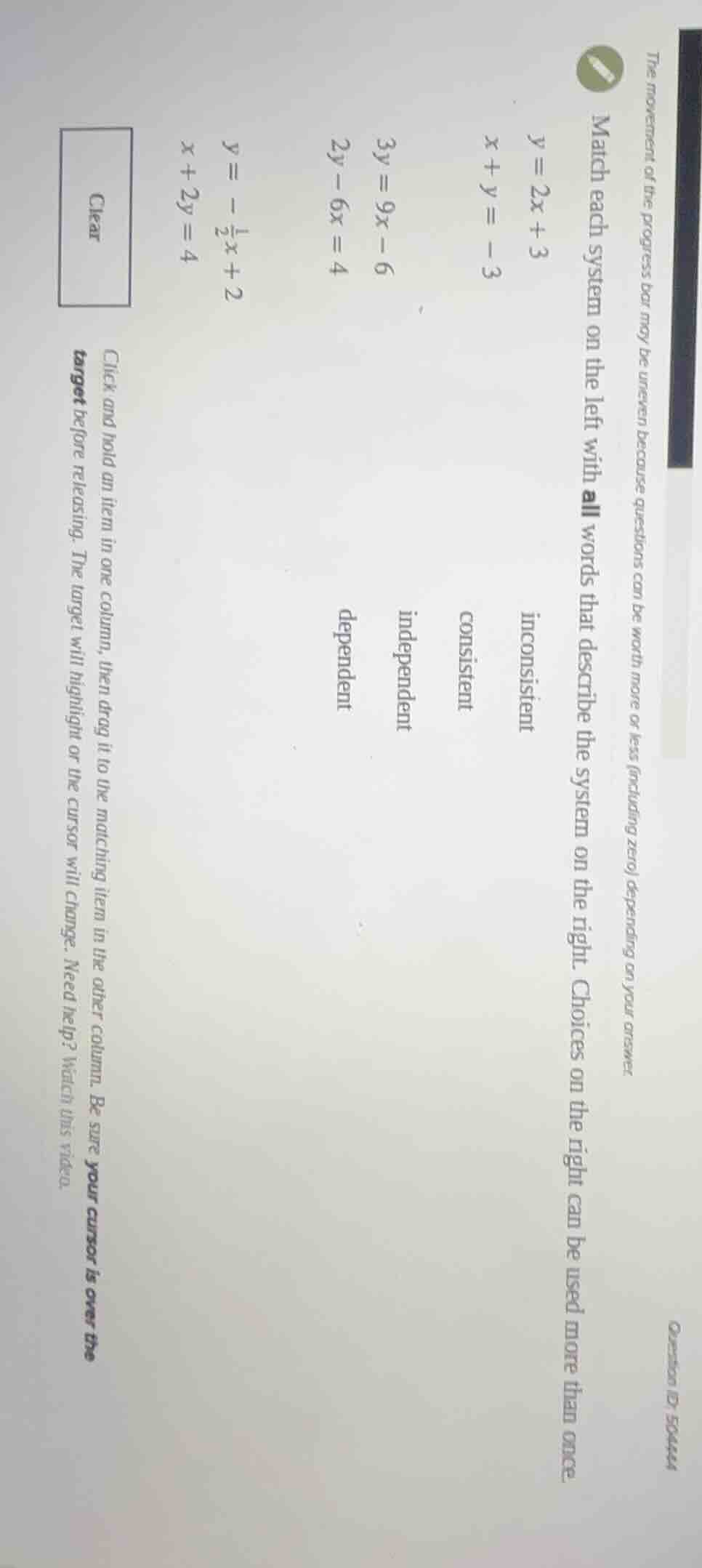
match each system on the left with all words that describe the system on the right. choices on the right can be used more than once.
$y = 2x + 3$
$x + y = -3$
$3y = 9x - 6$
$2y - 6x = 4$
$y = -\frac{1}{2}x + 2$
$x + 2y = 4$
inconsistent
consistent
independent
dependent
click and hold an item in one column, then drag it to the matching item in the other column. be sure your cursor is over the target before releasing. the target will highlight or the cursor will change. need help? watch this video.
clear
To solve this, we analyze each system of linear equations by converting them to slope - intercept form ($y = mx + b$, where $m$ is the slope and $b$ is the y - intercept) and then determine the relationship between the lines (parallel, intersecting, coinciding) to classify the system.
System 1: $\boldsymbol{y = 2x + 3}$ and $\boldsymbol{x + y=-3}$
- First, rewrite the second equation in slope - intercept form:
- Start with $x + y=-3$.
- Subtract $x$ from both sides: $y=-x - 3$.
- The first equation $y = 2x+3$ has a slope $m_1 = 2$ and y - intercept $b_1 = 3$. The second equation $y=-x - 3$ has a slope $m_2=-1$ and y - intercept $b_2=-3$.
- Since the slopes are different ($m_1
eq m_2$), the two lines intersect at exactly one point. A system of linear equations with exactly one solution is consistent (because there is a solution) and the equations are independent (because they represent two different non - parallel lines).
System 2: $\boldsymbol{3y = 9x-6}$ and $\boldsymbol{2y-6x = 4}$
- Rewrite both equations in slope - intercept form:
- For the first equation $3y = 9x-6$, divide both sides by 3: $y = 3x-2$. So, $m_1 = 3$ and $b_1=-2$.
- For the second equation $2y-6x = 4$, add $6x$ to both sides: $2y=6x + 4$. Then divide by 2: $y = 3x+2$. So, $m_2 = 3$ and $b_2 = 2$.
- Since the slopes are equal ($m_1=m_2$) but the y - intercepts are different ($b_1
eq b_2$), the lines are parallel. A system of parallel lines has no solution, so it is inconsistent (no solution exists) and the equations are independent (two different parallel lines).
System 3: $\boldsymbol{y=-\frac{1}{2}x + 2}$ and $\boldsymbol{x + 2y=4}$
- Rewrite the second equation in slope - intercept form:
- Start with $x + 2y=4$. Subtract $x$ from both sides: $2y=-x + 4$. Divide by 2: $y=-\frac{1}{2}x + 2$.
- The first equation is $y=-\frac{1}{2}x + 2$ and the second equation, after rearrangement, is also $y=-\frac{1}{2}x + 2$.
- Since the two equations represent the same line (same slope and same y - intercept), the system has infinitely many solutions. A system with infinitely many solutions is consistent (solutions exist) and the equations are dependent (one equation is a multiple of the other, they represent the same line).
Final Matches:
- $y = 2x + 3$ and $x + y=-3$: consistent, independent
- $3y = 9x-6$ and $2y - 6x=4$: inconsistent, independent
- $y=-\frac{1}{2}x + 2$ and $x + 2y = 4$: consistent, dependent

Snap & solve any problem in the app
Get step-by-step solutions on Sovi AI
Photo-based solutions with guided steps
Explore more problems and detailed explanations
To solve this, we analyze each system of linear equations by converting them to slope - intercept form ($y = mx + b$, where $m$ is the slope and $b$ is the y - intercept) and then determine the relationship between the lines (parallel, intersecting, coinciding) to classify the system.
System 1: $\boldsymbol{y = 2x + 3}$ and $\boldsymbol{x + y=-3}$
- First, rewrite the second equation in slope - intercept form:
- Start with $x + y=-3$.
- Subtract $x$ from both sides: $y=-x - 3$.
- The first equation $y = 2x+3$ has a slope $m_1 = 2$ and y - intercept $b_1 = 3$. The second equation $y=-x - 3$ has a slope $m_2=-1$ and y - intercept $b_2=-3$.
- Since the slopes are different ($m_1
eq m_2$), the two lines intersect at exactly one point. A system of linear equations with exactly one solution is consistent (because there is a solution) and the equations are independent (because they represent two different non - parallel lines).
System 2: $\boldsymbol{3y = 9x-6}$ and $\boldsymbol{2y-6x = 4}$
- Rewrite both equations in slope - intercept form:
- For the first equation $3y = 9x-6$, divide both sides by 3: $y = 3x-2$. So, $m_1 = 3$ and $b_1=-2$.
- For the second equation $2y-6x = 4$, add $6x$ to both sides: $2y=6x + 4$. Then divide by 2: $y = 3x+2$. So, $m_2 = 3$ and $b_2 = 2$.
- Since the slopes are equal ($m_1=m_2$) but the y - intercepts are different ($b_1
eq b_2$), the lines are parallel. A system of parallel lines has no solution, so it is inconsistent (no solution exists) and the equations are independent (two different parallel lines).
System 3: $\boldsymbol{y=-\frac{1}{2}x + 2}$ and $\boldsymbol{x + 2y=4}$
- Rewrite the second equation in slope - intercept form:
- Start with $x + 2y=4$. Subtract $x$ from both sides: $2y=-x + 4$. Divide by 2: $y=-\frac{1}{2}x + 2$.
- The first equation is $y=-\frac{1}{2}x + 2$ and the second equation, after rearrangement, is also $y=-\frac{1}{2}x + 2$.
- Since the two equations represent the same line (same slope and same y - intercept), the system has infinitely many solutions. A system with infinitely many solutions is consistent (solutions exist) and the equations are dependent (one equation is a multiple of the other, they represent the same line).
Final Matches:
- $y = 2x + 3$ and $x + y=-3$: consistent, independent
- $3y = 9x-6$ and $2y - 6x=4$: inconsistent, independent
- $y=-\frac{1}{2}x + 2$ and $x + 2y = 4$: consistent, dependent