QUESTION IMAGE
Question
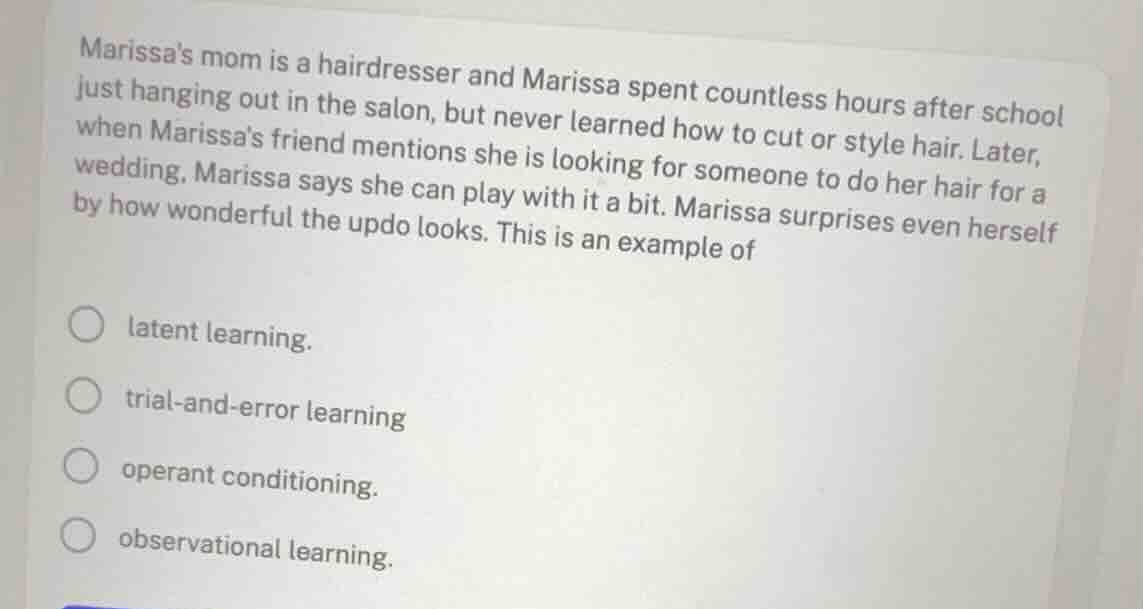
marissas mom is a hairdresser and marissa spent countless hours after school just hanging out in the salon, but never learned how to cut or style hair. later, when marissas friend mentions she is looking for someone to do her hair for a wedding, marissa says she can play with it a bit. marissa surprises even herself by how wonderful the updo looks. this is an example of
latent learning.
trial-and-error learning
operant conditioning.
observational learning.
<pre_analysis>
{
"quality": "clear",
"question_count": 1,
"skills_matched": [
"direct_cot",
"multiple_choice_formatter",
"explain_then_answer",
"tutor",
"mastery_adaptive_brevity"
],
"needs_drawing": false,
"concepts_used": [
"Latent Learning"
],
"new_concepts": [],
"current_concepts": [
"Latent Learning",
"Observational Learning",
"Operant Conditioning"
]
}
</pre_analysis>
<reasoning>
Analyze the scenario
Using the Latent Learning knowledge point
The scenario describes Marissa spending hours in her mother's hair salon without actively trying to learn hair styling or receiving any reinforcement. When a need arises later, she demonstrates that she has acquired this knowledge without immediate reinforcement or conscious awareness. This is a classic demonstration of latent learning, where learning occurs but is not apparent until there is an incentive or opportunity to demonstrate it.
Compare with other options
Using the Latent Learning knowledge point
- Latent learning: Learning that occurs without obvious reinforcement and remains hidden until a demonstration is required. This fits Marissa's situation perfectly.
- Trial-and-error learning: Trying various methods until one succeeds. Marissa did not engage in systematic trial-and-error; she surprised herself by immediately producing a wonderful updo.
- Operant conditioning: Learning through association of behavior with consequences (rewards/punishments). Marissa had no active reinforcement history for styling hair.
- Observational learning: While she was in the environment, observational learning typically involves active attention and modeling of a specific behavior to reproduce it. Latent learning specifically highlights the hidden nature of the acquired knowledge until a later motivation reveals it.
</reasoning>
<answer>
<mcq-correct>latent learning.</mcq-correct>
<mcq-option>trial-and-error learning</mcq-option>
<mcq-option>operant conditioning.</mcq-option>
<mcq-option>observational learning.</mcq-option>
</answer>
<post_analysis>
{
"subject": "Social Science",
"question_type": "Multiple Choice",
"knowledge_point": [
"Social Science",
"Psychology",
"Latent Learning"
]
}
</post_analysis>
Snap & solve any problem in the app
Get step-by-step solutions on Sovi AI
Photo-based solutions with guided steps
Explore more problems and detailed explanations
<pre_analysis>
{
"quality": "clear",
"question_count": 1,
"skills_matched": [
"direct_cot",
"multiple_choice_formatter",
"explain_then_answer",
"tutor",
"mastery_adaptive_brevity"
],
"needs_drawing": false,
"concepts_used": [
"Latent Learning"
],
"new_concepts": [],
"current_concepts": [
"Latent Learning",
"Observational Learning",
"Operant Conditioning"
]
}
</pre_analysis>
<reasoning>
Analyze the scenario
Using the Latent Learning knowledge point
The scenario describes Marissa spending hours in her mother's hair salon without actively trying to learn hair styling or receiving any reinforcement. When a need arises later, she demonstrates that she has acquired this knowledge without immediate reinforcement or conscious awareness. This is a classic demonstration of latent learning, where learning occurs but is not apparent until there is an incentive or opportunity to demonstrate it.
Compare with other options
Using the Latent Learning knowledge point
- Latent learning: Learning that occurs without obvious reinforcement and remains hidden until a demonstration is required. This fits Marissa's situation perfectly.
- Trial-and-error learning: Trying various methods until one succeeds. Marissa did not engage in systematic trial-and-error; she surprised herself by immediately producing a wonderful updo.
- Operant conditioning: Learning through association of behavior with consequences (rewards/punishments). Marissa had no active reinforcement history for styling hair.
- Observational learning: While she was in the environment, observational learning typically involves active attention and modeling of a specific behavior to reproduce it. Latent learning specifically highlights the hidden nature of the acquired knowledge until a later motivation reveals it.
</reasoning>
<answer>
<mcq-correct>latent learning.</mcq-correct>
<mcq-option>trial-and-error learning</mcq-option>
<mcq-option>operant conditioning.</mcq-option>
<mcq-option>observational learning.</mcq-option>
</answer>
<post_analysis>
{
"subject": "Social Science",
"question_type": "Multiple Choice",
"knowledge_point": [
"Social Science",
"Psychology",
"Latent Learning"
]
}
</post_analysis>