Sovi.AI - AI Math Tutor

Scan to solve math questions

QUESTION IMAGE

i have many chores every morning milking the cows, feeding the cat, fin…

Question

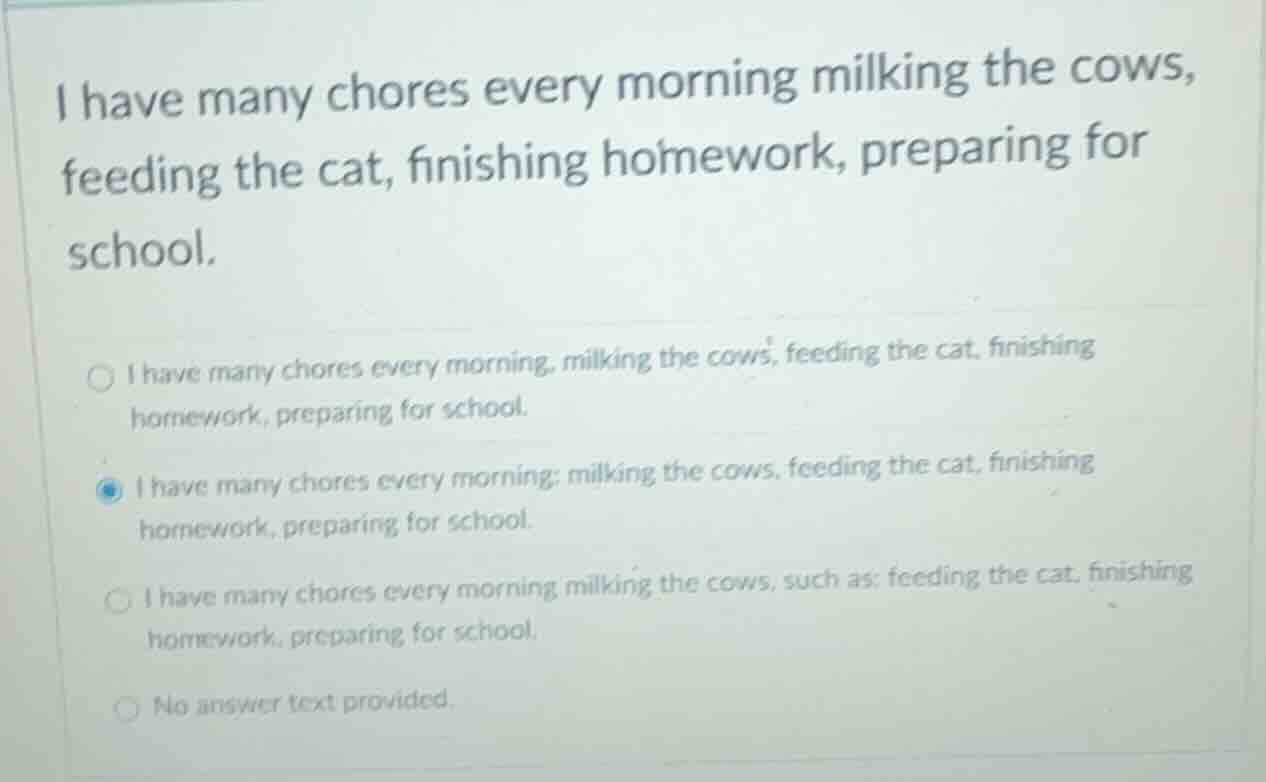
i have many chores every morning milking the cows, feeding the cat, finishing homework, preparing for school.

  • i have many chores every morning, milking the cows, feeding the cat, finishing homework, preparing for school.
  • i have many chores every morning: milking the cows, feeding the cat, finishing homework, preparing for school.
  • i have many chores every morning milking the cows, such as: feeding the cat, finishing homework, preparing for school.
  • no answer text provided.

Explanation:

Response

<pre_analysis>
{
"quality": "clear",
"question_count": 1,
"skills_matched": [
"direct_cot",
"multiple_choice_formatter",
"explain_then_answer",
"quick"
],
"needs_drawing": false,
"concepts_used": [
"Colon Usage",
"Punctuation Rules"
],
"new_concepts": [
"List Punctuation"
],
"current_concepts": [
"Colon Usage",
"Punctuation Rules",
"List Punctuation"
]
}
</pre_analysis>

<reasoning>

Analyze the original sentence structure

The original sentence contains an independent clause followed by a list of items: "I have many chores every morning milking the cows, feeding the cat, finishing homework, preparing for school." This lacks punctuation to separate the introductory independent clause from the list of chores.

Evaluate the punctuation rules for lists

A colon is used to introduce a list of items that follows an independent clause. The clause "I have many chores every morning" is a complete independent clause, making the colon the correct punctuation mark to introduce the list of chores.

Compare the multiple-choice options

  • Option 1 uses a comma, which creates a run-on/comma splice structure.
  • Option 2 correctly uses a colon after the independent clause to introduce the list.
  • Option 3 alters the meaning and structure awkwardly.
  • Option 4 is a placeholder.

</reasoning>

<answer>
<mcq-option>(A) I have many chores every morning, milking the cows, feeding the cat, finishing homework, preparing for school.</mcq-option>
<mcq-correct>(B) I have many chores every morning: milking the cows, feeding the cat, finishing homework, preparing for school.</mcq-correct>
<mcq-option>(C) I have many chores every morning milking the cows, such as: feeding the cat, finishing homework, preparing for school.</mcq-option>
<mcq-option>(D) No answer text provided.</mcq-option>
</answer>

<post_analysis>
{
"subject": "Others",
"question_type": "Multiple Choice",
"knowledge_point": [
"Others",
"English Grammar",
"Punctuation Rules"
]
}
</post_analysis>

Answer:

<pre_analysis>
{
"quality": "clear",
"question_count": 1,
"skills_matched": [
"direct_cot",
"multiple_choice_formatter",
"explain_then_answer",
"quick"
],
"needs_drawing": false,
"concepts_used": [
"Colon Usage",
"Punctuation Rules"
],
"new_concepts": [
"List Punctuation"
],
"current_concepts": [
"Colon Usage",
"Punctuation Rules",
"List Punctuation"
]
}
</pre_analysis>

<reasoning>

Analyze the original sentence structure

The original sentence contains an independent clause followed by a list of items: "I have many chores every morning milking the cows, feeding the cat, finishing homework, preparing for school." This lacks punctuation to separate the introductory independent clause from the list of chores.

Evaluate the punctuation rules for lists

A colon is used to introduce a list of items that follows an independent clause. The clause "I have many chores every morning" is a complete independent clause, making the colon the correct punctuation mark to introduce the list of chores.

Compare the multiple-choice options

  • Option 1 uses a comma, which creates a run-on/comma splice structure.
  • Option 2 correctly uses a colon after the independent clause to introduce the list.
  • Option 3 alters the meaning and structure awkwardly.
  • Option 4 is a placeholder.

</reasoning>

<answer>
<mcq-option>(A) I have many chores every morning, milking the cows, feeding the cat, finishing homework, preparing for school.</mcq-option>
<mcq-correct>(B) I have many chores every morning: milking the cows, feeding the cat, finishing homework, preparing for school.</mcq-correct>
<mcq-option>(C) I have many chores every morning milking the cows, such as: feeding the cat, finishing homework, preparing for school.</mcq-option>
<mcq-option>(D) No answer text provided.</mcq-option>
</answer>

<post_analysis>
{
"subject": "Others",
"question_type": "Multiple Choice",
"knowledge_point": [
"Others",
"English Grammar",
"Punctuation Rules"
]
}
</post_analysis>