QUESTION IMAGE
Question
making an inference about shakespeare
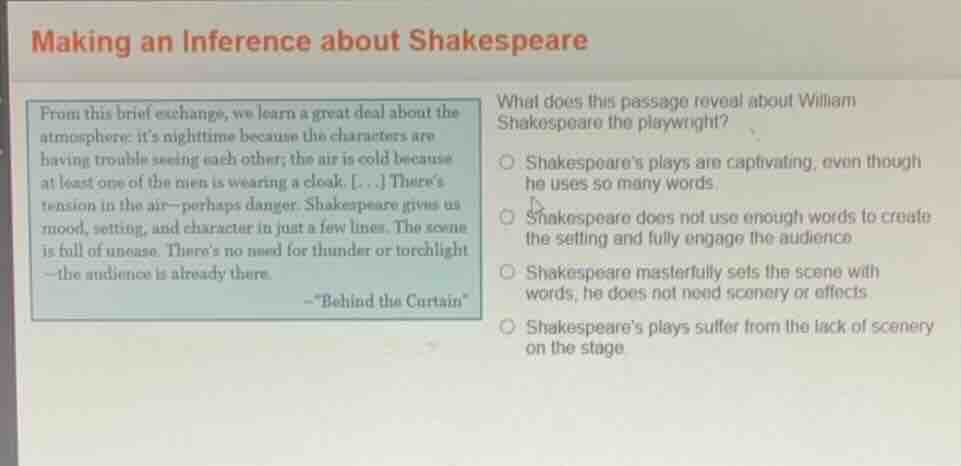
from this brief exchange, we learn a great deal about the atmosphere: its nighttime because the characters are having trouble seeing each other; the air is cold because at least one of the men is wearing a cloak. ... theres tension in the air-perhaps danger. shakespeare gives us mood, setting, and character in just a few lines. the scene is full of unease. theres no need for thunder or torchlight-the audience is already there.
-\behind the curtain\
what does this passage reveal about william shakespeare the playwright?
shakespeares plays are captivating, even though he uses so many words.
shakespeare does not use enough words to create the setting and fully engage the audience.
shakespeare masterfully sets the scene with words, he does not need scenery or effects.
shakespeares plays suffer from the lack of scenery on the stage.
<pre_analysis>
{
"quality": "clear",
"question_count": 1,
"skills_matched": [
"direct_cot",
"multiple_choice_formatter",
"explain_then_answer",
"tutor"
],
"needs_drawing": false,
"concepts_used": [
"Making Inferences",
"Textual Analysis"
],
"new_concepts": [
"Dramatic Analysis",
"Authorial Craft"
],
"current_concepts": [
"Making Inferences",
"Textual Analysis",
"Dramatic Analysis",
"Authorial Craft"
]
}
</pre_analysis>
<reasoning>
Analyze the passage details
The passage from "Behind the Curtain" explains how a brief exchange in Shakespeare's work conveys the atmosphere: it establishes that it is nighttime, cold, and full of tension or danger. The author notes that "Shakespeare gives us mood, setting, and character in just a few lines." Crucially, the passage concludes by stating, "There's no need for thunder or torchlight—the audience is already there." This emphasizes that his words alone are sufficient to transport the audience.
Evaluate the options
Using Textual Analysis, we can evaluate each option against the passage:
- Option 1 suggests Shakespeare uses "so many words," which contradicts the passage's praise of him doing this in "just a few lines."
- Option 2 claims he "does not use enough words," which is incorrect as the passage states he successfully establishes the setting.
- Option 3 states that "Shakespeare masterfully sets the scene with words, he does not need scenery or effects." This directly aligns with the text's assertion that he gives us mood and setting in a few lines and that there is "no need for thunder or torchlight."
- Option 4 claims his plays "suffer from the lack of scenery," which contradicts the positive tone of the passage.
Formulate the inference
By Making Inferences from the text, we conclude that Shakespeare's mastery lies in his ability to use language to build a vivid world for the audience, rendering physical stage effects like thunder or torchlight unnecessary. Therefore, Option 3 is the correct choice.
</reasoning>
<answer>
<mcq-option>(A) Shakespeare's plays are captivating, even though he uses so many words.</mcq-option>
<mcq-option>(B) Shakespeare does not use enough words to create the setting and fully engage the audience.</mcq-option>
<mcq-correct>(C) Shakespeare masterfully sets the scene with words, he does not need scenery or effects.</mcq-correct>
<mcq-option>(D) Shakespeare's plays suffer from the lack of scenery on the stage.</mcq-option>
</answer>
<post_analysis>
{
"subject": "Others",
"question_type": "Multiple Choice",
"knowledge_point": [
"Others",
"English Language Arts",
"Reading Comprehension and Inference"
]
}
</post_analysis>
Snap & solve any problem in the app
Get step-by-step solutions on Sovi AI
Photo-based solutions with guided steps
Explore more problems and detailed explanations
<pre_analysis>
{
"quality": "clear",
"question_count": 1,
"skills_matched": [
"direct_cot",
"multiple_choice_formatter",
"explain_then_answer",
"tutor"
],
"needs_drawing": false,
"concepts_used": [
"Making Inferences",
"Textual Analysis"
],
"new_concepts": [
"Dramatic Analysis",
"Authorial Craft"
],
"current_concepts": [
"Making Inferences",
"Textual Analysis",
"Dramatic Analysis",
"Authorial Craft"
]
}
</pre_analysis>
<reasoning>
Analyze the passage details
The passage from "Behind the Curtain" explains how a brief exchange in Shakespeare's work conveys the atmosphere: it establishes that it is nighttime, cold, and full of tension or danger. The author notes that "Shakespeare gives us mood, setting, and character in just a few lines." Crucially, the passage concludes by stating, "There's no need for thunder or torchlight—the audience is already there." This emphasizes that his words alone are sufficient to transport the audience.
Evaluate the options
Using Textual Analysis, we can evaluate each option against the passage:
- Option 1 suggests Shakespeare uses "so many words," which contradicts the passage's praise of him doing this in "just a few lines."
- Option 2 claims he "does not use enough words," which is incorrect as the passage states he successfully establishes the setting.
- Option 3 states that "Shakespeare masterfully sets the scene with words, he does not need scenery or effects." This directly aligns with the text's assertion that he gives us mood and setting in a few lines and that there is "no need for thunder or torchlight."
- Option 4 claims his plays "suffer from the lack of scenery," which contradicts the positive tone of the passage.
Formulate the inference
By Making Inferences from the text, we conclude that Shakespeare's mastery lies in his ability to use language to build a vivid world for the audience, rendering physical stage effects like thunder or torchlight unnecessary. Therefore, Option 3 is the correct choice.
</reasoning>
<answer>
<mcq-option>(A) Shakespeare's plays are captivating, even though he uses so many words.</mcq-option>
<mcq-option>(B) Shakespeare does not use enough words to create the setting and fully engage the audience.</mcq-option>
<mcq-correct>(C) Shakespeare masterfully sets the scene with words, he does not need scenery or effects.</mcq-correct>
<mcq-option>(D) Shakespeare's plays suffer from the lack of scenery on the stage.</mcq-option>
</answer>
<post_analysis>
{
"subject": "Others",
"question_type": "Multiple Choice",
"knowledge_point": [
"Others",
"English Language Arts",
"Reading Comprehension and Inference"
]
}
</post_analysis>