QUESTION IMAGE
Question
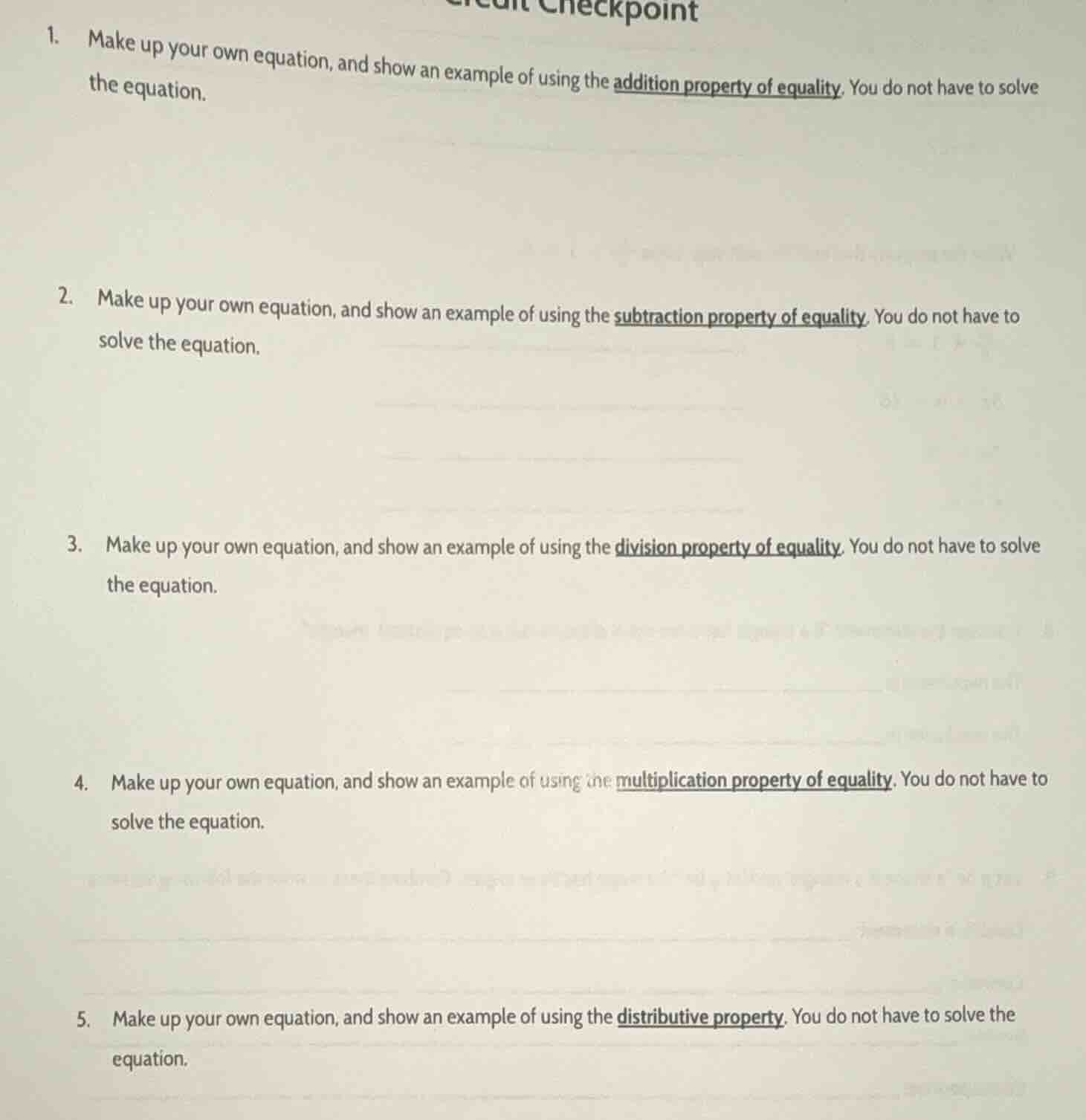
- make up your own equation, and show an example of using the addition property of equality. you do not have to solve the equation.
- make up your own equation, and show an example of using the subtraction property of equality. you do not have to solve the equation.
- make up your own equation, and show an example of using the division property of equality. you do not have to solve the equation.
- make up your own equation, and show an example of using the multiplication property of equality. you do not have to solve the equation.
- make up your own equation, and show an example of using the distributive property. you do not have to solve the equation.
Step1: Define original equation
$x - 7 = 12$
Step2: Apply addition property
Add 9 to both sides: $x - 7 + 9 = 12 + 9$
Step1: Define original equation
$y + 4 = 19$
Step2: Apply subtraction property
Subtract 6 from both sides: $y + 4 - 6 = 19 - 6$
Step1: Define original equation
$3z = 21$
Step2: Apply division property
Divide both sides by 3: $\frac{3z}{3} = \frac{21}{3}$
Step1: Define original equation
$\frac{w}{5} = 8$
Step2: Apply multiplication property
Multiply both sides by 4: $4 \times \frac{w}{5} = 8 \times 4$
Step1: Define original equation
$5(2a + 3) = 40$
Step2: Apply distributive property
Expand left side: $5 \times 2a + 5 \times 3 = 40$

Snap & solve any problem in the app
Get step-by-step solutions on Sovi AI
Photo-based solutions with guided steps
Explore more problems and detailed explanations
- Original equation: $x - 7 = 12$; Using addition property: $x - 7 + 9 = 12 + 9$
- Original equation: $y + 4 = 19$; Using subtraction property: $y + 4 - 6 = 19 - 6$
- Original equation: $3z = 21$; Using division property: $\frac{3z}{3} = \frac{21}{3}$
- Original equation: $\frac{w}{5} = 8$; Using multiplication property: $4 \times \frac{w}{5} = 8 \times 4$
- Original equation: $5(2a + 3) = 40$; Using distributive property: $10a + 15 = 40$