QUESTION IMAGE
Question
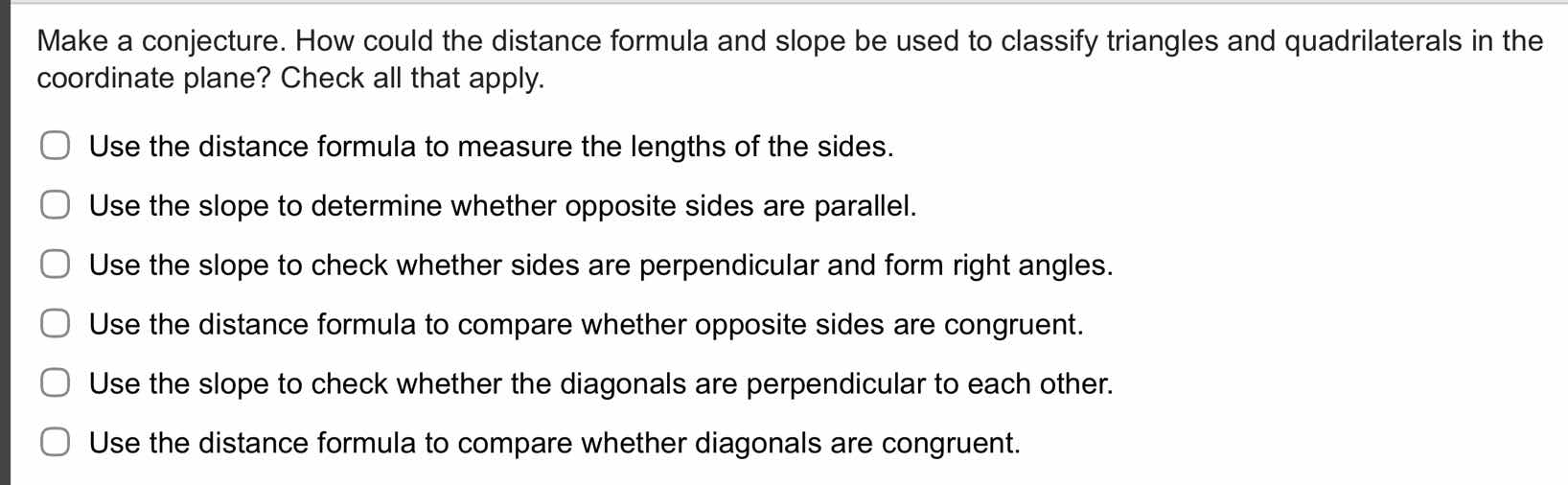
make a conjecture. how could the distance formula and slope be used to classify triangles and quadrilaterals in the coordinate plane? check all that apply. use the distance formula to measure the lengths of the sides. use the slope to determine whether opposite sides are parallel. use the slope to check whether sides are perpendicular and form right angles. use the distance formula to compare whether opposite sides are congruent. use the slope to check whether the diagonals are perpendicular to each other. use the distance formula to compare whether diagonals are congruent.
- Side lengths from distance formula help classify triangles (equilateral, isosceles, scalene) and quadrilaterals (rhombus, square) by congruence.
- Equal slopes mean parallel sides, key for identifying parallelograms, rectangles, etc.
- Perpendicular sides (slopes are negative reciprocals) indicate right angles, critical for right triangles, rectangles, squares.
- Congruent opposite sides (via distance formula) define parallelograms and related shapes.
- Perpendicular diagonals (slope check) identify rhombuses, squares, kites.
- Congruent diagonals (distance formula) mark rectangles, squares, isosceles trapezoids.

Snap & solve any problem in the app
Get step-by-step solutions on Sovi AI
Photo-based solutions with guided steps
Explore more problems and detailed explanations
A. Use the distance formula to measure the lengths of the sides.
B. Use the slope to determine whether opposite sides are parallel.
C. Use the slope to check whether sides are perpendicular and form right angles.
D. Use the distance formula to compare whether opposite sides are congruent.
E. Use the slope to check whether the diagonals are perpendicular to each other.
F. Use the distance formula to compare whether diagonals are congruent.