QUESTION IMAGE
Question
macbeth
by william shakespeare
act i, scene 7
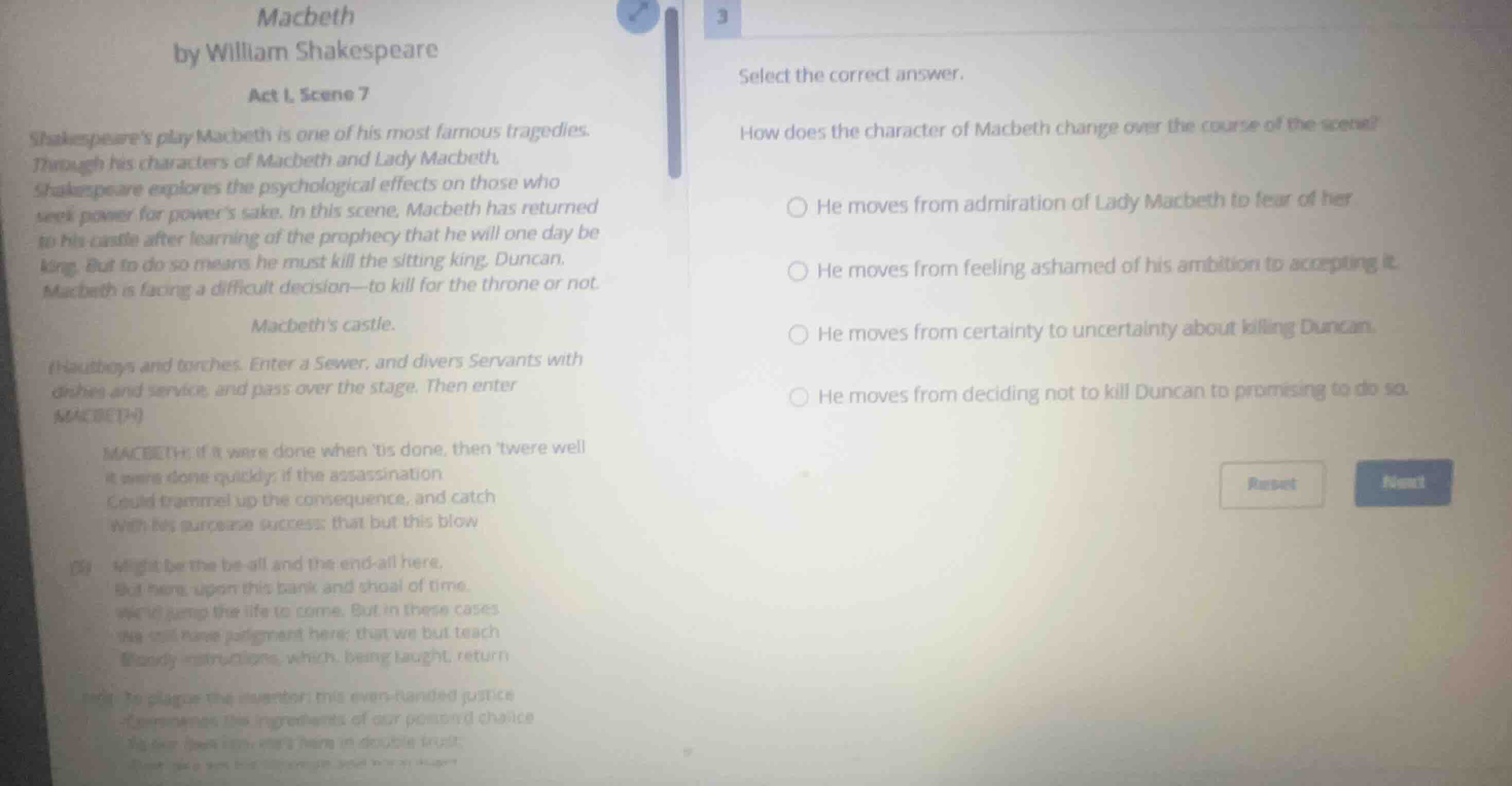
shakespeares play macbeth is one of his most famous tragedies. through his characters of macbeth and lady macbeth, shakespeare explores the psychological effects on those who seek power for powers sake. in this scene, macbeth has returned to his castle after learning of the prophecy that he will one day be king. but to do so means he must kill the sitting king, duncan. macbeth is facing a difficult decision—to kill for the throne or not.
macbeths castle.
(hautboys and torches. enter a sewer, and divers servants with dishes and service, and pass over the stage. then enter macbeth)
macbeth: if it were done when tis done, then twere well
it were done quickly: if the assassination
could trammel up the consequence, and catch
with his surcease success; that but this blow
might be the be-all and the end-all here,
but here, upon this bank and shoal of time,
weld jump the life to come. but in these cases
we still have judgment here; that we but teach
bloody instructions, which, being taught, return
to plague the inventor: this even-handed justice
commends the ingredients of our poisond chalice
to our own lips. hes here in double trust:
select the correct answer.
how does the character of macbeth change over the course of the scene?
he moves from admiration of lady macbeth to fear of her
he moves from feeling ashamed of his ambition to accepting it.
he moves from certainty to uncertainty about killing duncan.
he moves from deciding not to kill duncan to promising to do so.
Analyze Macbeth's initial state in Act I, Scene 7
At the beginning of Act I, Scene 7, Macbeth delivers a famous soliloquy ("If it were done when 'tis done...") expressing deep hesitation, moral conflict, and a decision not to proceed with the murder of King Duncan, concluding that he has "no spur to prick the sides of my intent, but only vaulting ambition."
Analyze Macbeth's final state in Act I, Scene 7
After Macbeth tells Lady Macbeth, "We will proceed no further in this business," she questions his manhood, courage, and love. She presents a detailed plan to frame Duncan's chamberlains. Persuaded and resolved by her arguments, Macbeth changes his mind, concluding the scene with: "I am settled, and bend up / Each corporal agent to this terrible feat."
Evaluate the multiple-choice options
- Option 1: "He moves from admiration of Lady Macbeth to fear of her" — Incorrect; his attitude is one of being resolved and inspired by her boldness, not fear.
- Option 2: "He moves from feeling ashamed of his ambition to accepting it" — Incorrect; he already accepted his ambition but feared the consequences and moral judgment.
- Option 3: "He moves from certainty to uncertainty about killing Duncan" — Incorrect; he moves from a decision not to kill him to a firm resolution to do so.
- Option 4: "He moves from deciding not to kill Duncan to promising to do so" — Correct; this directly tracks his transition from "We will proceed no further" to "I am settled... to this terrible feat."

Snap & solve any problem in the app
Get step-by-step solutions on Sovi AI
Photo-based solutions with guided steps
Explore more problems and detailed explanations
- He moves from admiration of Lady Macbeth to fear of her
- He moves from feeling ashamed of his ambition to accepting it
- He moves from certainty to uncertainty about killing Duncan
- He moves from deciding not to kill Duncan to promising to do so (Correct answer)