QUESTION IMAGE
Question
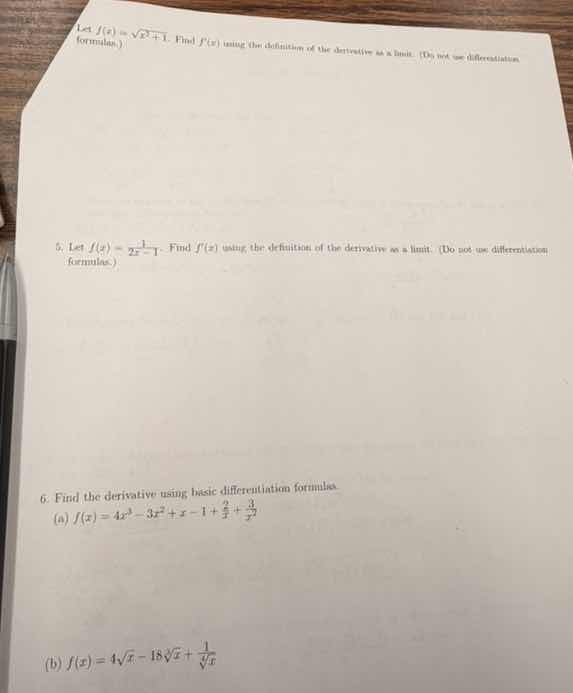
- let ( f(x) = sqrt{2x + 1} ). find ( f(x) ) using the definition of the derivative as a limit. (do not use differentiation formulas.)
- let ( f(x) = \frac{1}{2x - 1} ). find ( f(x) ) using the definition of the derivative as a limit. (do not use differentiation formulas.)
- find the derivative using basic differentiation formulas.
(a) ( f(x) = 4x^3 - 3x^2 + x - 1 + \frac{2}{x} + \frac{3}{x^2} )
(b) ( f(x) = 4sqrt{x} - 18sqrt3{x} + \frac{1}{sqrt4{x}} )
Problem 4: Let \( f(x) = \sqrt{x + 1} \). Find \( f'(x) \) using the definition of the derivative as a limit. (Do not use differentiation formulas.)
Step 1: Recall the definition of the derivative
The derivative of a function \( f(x) \) is given by:
First, find \( f(x + h) \):
And \( f(x) = \sqrt{x + 1} \). So the difference quotient is:
Step 2: Rationalize the numerator
Multiply the numerator and denominator by the conjugate of the numerator, \( \sqrt{x + h + 1} + \sqrt{x + 1} \):
The numerator is a difference of squares: \( (a - b)(a + b) = a^2 - b^2 \), so:
Step 3: Simplify the numerator
Simplify the numerator:
Cancel the \( h \) in the numerator and denominator (assuming \( h
eq 0 \), which is valid since we are taking the limit as \( h \to 0 \)):
Step 4: Take the limit as \( h \to 0 \)
Now, take the limit as \( h \to 0 \):
As \( h \to 0 \), \( \sqrt{x + h + 1} \to \sqrt{x + 1} \), so:
Step 1: Recall the definition of the derivative
The derivative of a function \( f(x) \) is given by:
First, find \( f(x + h) \):
And \( f(x) = \frac{1}{2x - 1} \). So the difference quotient is:
Step 2: Combine the fractions in the numerator
Find a common denominator for the numerator: \( (2x + 2h - 1)(2x - 1) \)
Step 3: Simplify the numerator
Simplify the numerator:
Cancel the \( h \) in the numerator and denominator (assuming \( h
eq 0 \)):
Step 4: Take the limit as \( h \to 0 \)
Now, take the limit as \( h \to 0 \):
As \( h \to 0 \), \( 2x + 2h - 1 \to 2x - 1 \), so:
Step 1: Rewrite the terms with negative exponents
Rewrite \( \frac{2}{x} \) as \( 2x^{-1} \) and \( \frac{3}{x^2} \) as \( 3x^{-2} \):
Step 2: Apply the power rule and sum/difference rule
The power rule is \( \frac{d}{dx}(x^n) = nx^{n - 1} \), and the derivative of a constant is 0.
- Derivative of \( 4x^3 \): \( 4 \cdot 3x^{3 - 1} = 12x^2 \)
- Derivative of \( -3x^2 \): \( -3 \cdot 2x^{2 - 1} = -6x \)
- Derivative of \( x \): \( 1 \cdot x^{1 - 1} = 1 \)
- Derivative of \( -1 \): \( 0 \)
- Derivative of \( 2x^{-1} \): \( 2 \cdot (-1)x^{-1 - 1} = -2x^{-2} \)
- Derivative of \( 3x^{-2} \): \( 3 \cdot (-2)x^{-2 - 1} = -6x^{-3} \)
Step 3: Combine the derivatives
Combine the results:
Rewrite back with positive exponents for the last two terms:

Snap & solve any problem in the app
Get step-by-step solutions on Sovi AI
Photo-based solutions with guided steps
Explore more problems and detailed explanations
\( f'(x) = \frac{1}{2\sqrt{x + 1}} \)