QUESTION IMAGE
Question
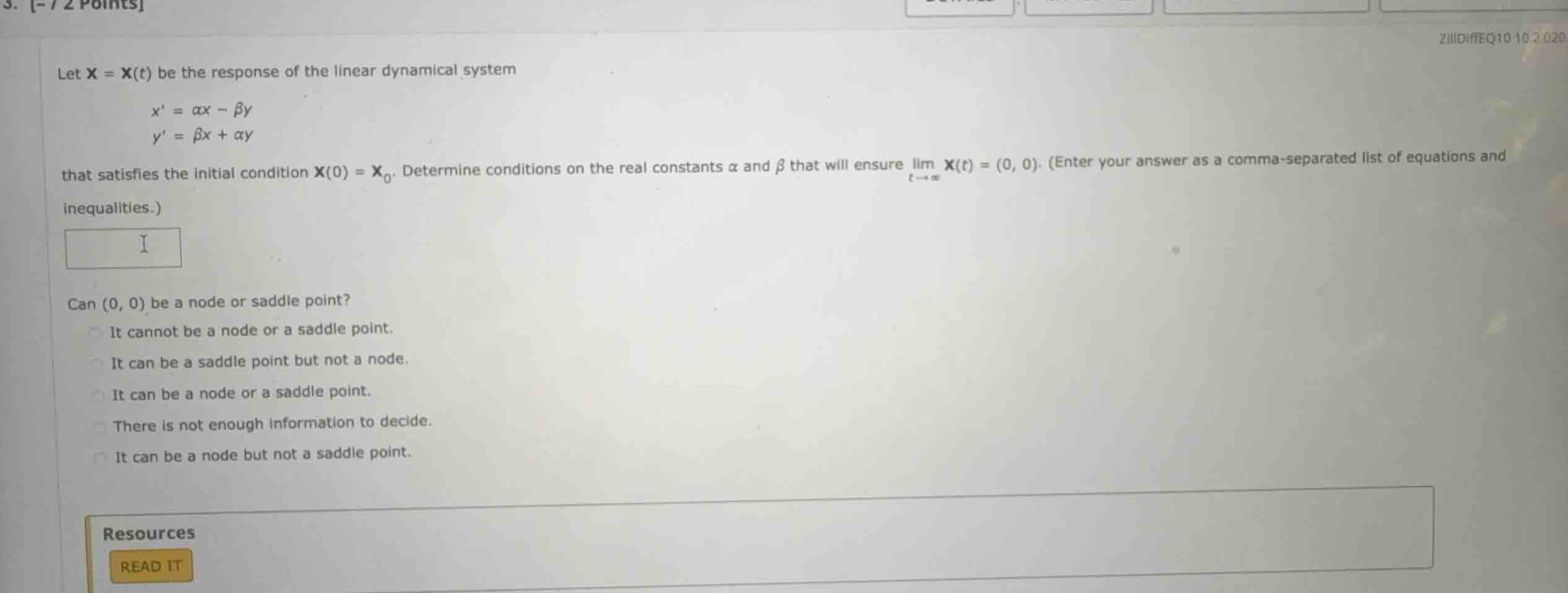
let \\(\mathbf{x} = \mathbf{x}(t)\\) be the response of the linear dynamical system
\\
\
\\
that satisfies the initial condition \\(\mathbf{x}(0) = \mathbf{x}_0\\). determine conditions on the real constants \\(\alpha\\) and \\(\beta\\) that will ensure \\(\lim_{t \to \infty} \mathbf{x}(t) = (0, 0)\\). (enter your answer as a comma-separated list of equations and inequalities.)
can \\((0, 0)\\) be a node or saddle point?
- it cannot be a node or a saddle point.
- it can be a saddle point but not a node.
- it can be a node or a saddle point.
- there is not enough information to decide.
- it can be a node but not a saddle point.
<pre_analysis>
{
"quality": "clear",
"question_count": 2,
"skills_matched": [
"step_cot",
"explain_then_answer",
"tutor"
],
"needs_drawing": false,
"concepts_used": [
"Linear Systems of ODEs",
"Asymptotic Behavior of ODEs",
"Stability of Critical Points"
],
"new_concepts": [],
"current_concepts": [
"Linear Systems of ODEs",
"Asymptotic Behavior of ODEs",
"Stability of Critical Points",
"Complex Eigenvalues"
]
}
</pre_analysis>
<reasoning>
Analyze the system matrix and eigenvalues
Using the Linear Systems of ODEs knowledge point, we represent the system in matrix form:
\[
\mathbf{X}' = A\mathbf{X}, \quad \text{where } A =
\]
The characteristic equation is:
\[
\det(A - \lambda I) = (\alpha - \lambda)^2 + \beta^2 = 0
\]
Solving for the eigenvalues \(\lambda\):
\[
\lambda = \alpha \pm i\beta
\]
Determine asymptotic stability conditions
Using the Asymptotic Behavior of ODEs knowledge point, the condition for \(\lim_{t \to \infty} \mathbf{X}(t) = (0,0)\) for any initial condition \(\mathbf{X}_0\) is that the real part of all eigenvalues must be strictly negative:
\[
\text{Re}(\lambda) < 0 \implies \alpha < 0
\]
Additionally, for the system to be well-defined with distinct complex eigenvalues or real eigenvalues, we must consider the role of \(\beta\). If \(\beta
eq 0\), the eigenvalues are complex conjugates with a non-zero imaginary part, representing a spiral sink. If \(\beta = 0\), the system has a repeated real eigenvalue \(\lambda = \alpha < 0\), representing a proper node (star node). In both cases, the limit is \((0,0)\). Thus, the only condition required to ensure the limit is \((0,0)\) is:
\[
\alpha < 0
\]
Classify the critical point stability types
Using the Stability of Critical Points knowledge point, we analyze whether the origin \((0,0)\) can be a node or a saddle point under the condition \(\alpha < 0\):
- A node requires real eigenvalues of the same sign. If \(\beta = 0\), the eigenvalues are \(\lambda_1 = \lambda_2 = \alpha < 0\), which is a stable node (specifically, a proper node or star node). Thus, it can be a node.
- A saddle point requires real eigenvalues of opposite signs (\(\lambda_1 < 0 < \lambda_2\)). Here, the eigenvalues are \(\alpha \pm i\beta\). If they are real (which requires \(\beta = 0\)), they are both equal to \(\alpha < 0\). They can never have opposite signs because they are identical. Thus, it cannot be a saddle point.
- Therefore, the critical point \((0,0)\) can be a node (when \(\beta = 0\)) but not a saddle point.
</reasoning>
<answer>
Question 1
Determine conditions on the real constants \(\alpha\) and \(\beta\) that will ensure \(\lim_{t \to \infty} \mathbf{X}(t) = (0,0)\):
<blank>\(\alpha < 0\)</blank>
Question 2
Can \((0,0)\) be a node or saddle point?
<mcq-option>It cannot be a node or a saddle point.</mcq-option>
<mcq-option>It can be a saddle point but not a node.</mcq-option>
<mcq-option>It can be a node or a saddle point.</mcq-option>
<mcq-option>There is not enough information to decide.</mcq-option>
<mcq-correct>It can be a node but not a saddle point.</mcq-correct>
</answer>
<post_analysis>
{
"subject": "Mathematics",
"question_type": "Multi-part",
"knowledge_point": [
"Mathematics",
"Calculus",
"Linear Systems of ODEs"
]
}
</post_analysis>
Snap & solve any problem in the app
Get step-by-step solutions on Sovi AI
Photo-based solutions with guided steps
Explore more problems and detailed explanations
<pre_analysis>
{
"quality": "clear",
"question_count": 2,
"skills_matched": [
"step_cot",
"explain_then_answer",
"tutor"
],
"needs_drawing": false,
"concepts_used": [
"Linear Systems of ODEs",
"Asymptotic Behavior of ODEs",
"Stability of Critical Points"
],
"new_concepts": [],
"current_concepts": [
"Linear Systems of ODEs",
"Asymptotic Behavior of ODEs",
"Stability of Critical Points",
"Complex Eigenvalues"
]
}
</pre_analysis>
<reasoning>
Analyze the system matrix and eigenvalues
Using the Linear Systems of ODEs knowledge point, we represent the system in matrix form:
\[
\mathbf{X}' = A\mathbf{X}, \quad \text{where } A =
\]
The characteristic equation is:
\[
\det(A - \lambda I) = (\alpha - \lambda)^2 + \beta^2 = 0
\]
Solving for the eigenvalues \(\lambda\):
\[
\lambda = \alpha \pm i\beta
\]
Determine asymptotic stability conditions
Using the Asymptotic Behavior of ODEs knowledge point, the condition for \(\lim_{t \to \infty} \mathbf{X}(t) = (0,0)\) for any initial condition \(\mathbf{X}_0\) is that the real part of all eigenvalues must be strictly negative:
\[
\text{Re}(\lambda) < 0 \implies \alpha < 0
\]
Additionally, for the system to be well-defined with distinct complex eigenvalues or real eigenvalues, we must consider the role of \(\beta\). If \(\beta
eq 0\), the eigenvalues are complex conjugates with a non-zero imaginary part, representing a spiral sink. If \(\beta = 0\), the system has a repeated real eigenvalue \(\lambda = \alpha < 0\), representing a proper node (star node). In both cases, the limit is \((0,0)\). Thus, the only condition required to ensure the limit is \((0,0)\) is:
\[
\alpha < 0
\]
Classify the critical point stability types
Using the Stability of Critical Points knowledge point, we analyze whether the origin \((0,0)\) can be a node or a saddle point under the condition \(\alpha < 0\):
- A node requires real eigenvalues of the same sign. If \(\beta = 0\), the eigenvalues are \(\lambda_1 = \lambda_2 = \alpha < 0\), which is a stable node (specifically, a proper node or star node). Thus, it can be a node.
- A saddle point requires real eigenvalues of opposite signs (\(\lambda_1 < 0 < \lambda_2\)). Here, the eigenvalues are \(\alpha \pm i\beta\). If they are real (which requires \(\beta = 0\)), they are both equal to \(\alpha < 0\). They can never have opposite signs because they are identical. Thus, it cannot be a saddle point.
- Therefore, the critical point \((0,0)\) can be a node (when \(\beta = 0\)) but not a saddle point.
</reasoning>
<answer>
Question 1
Determine conditions on the real constants \(\alpha\) and \(\beta\) that will ensure \(\lim_{t \to \infty} \mathbf{X}(t) = (0,0)\):
<blank>\(\alpha < 0\)</blank>
Question 2
Can \((0,0)\) be a node or saddle point?
<mcq-option>It cannot be a node or a saddle point.</mcq-option>
<mcq-option>It can be a saddle point but not a node.</mcq-option>
<mcq-option>It can be a node or a saddle point.</mcq-option>
<mcq-option>There is not enough information to decide.</mcq-option>
<mcq-correct>It can be a node but not a saddle point.</mcq-correct>
</answer>
<post_analysis>
{
"subject": "Mathematics",
"question_type": "Multi-part",
"knowledge_point": [
"Mathematics",
"Calculus",
"Linear Systems of ODEs"
]
}
</post_analysis>