QUESTION IMAGE
Question
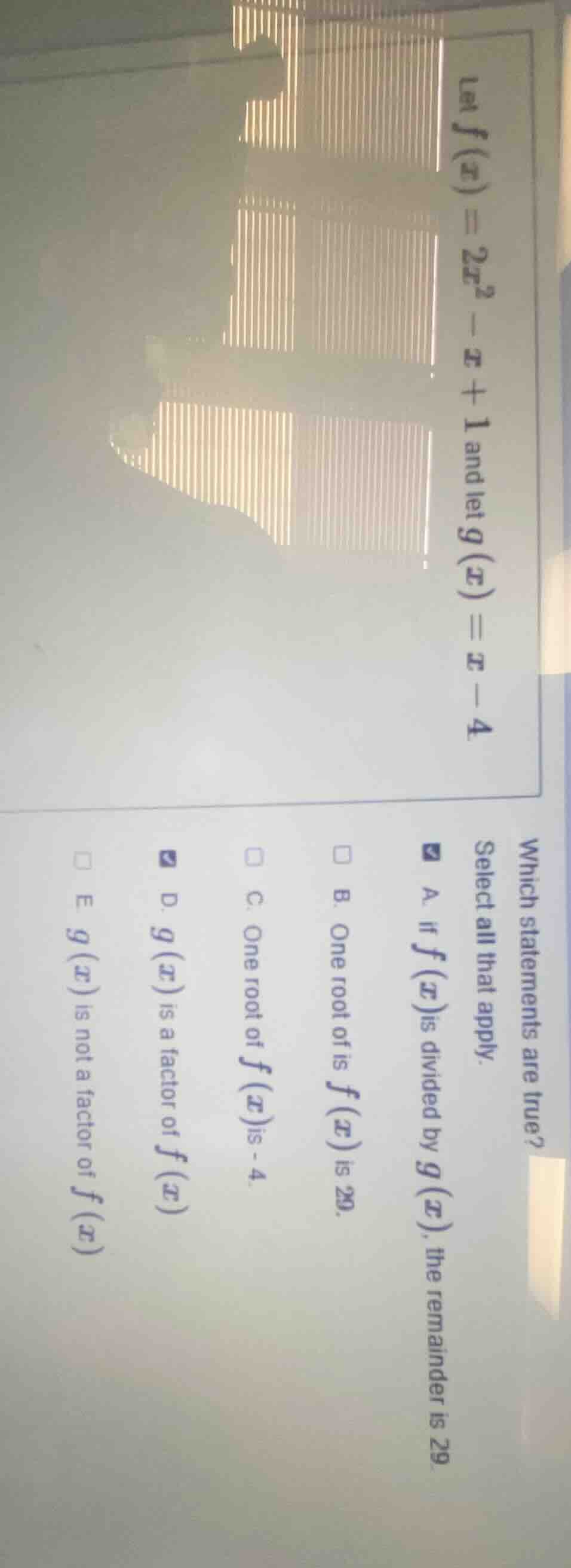
let $f(x) = 2x^2 - x + 1$ and let $g(x) = x - 4$\which statements are true?\select all that apply.\\a. if $f(x)$ is divided by $g(x)$, the remainder is 29.\\b. one root of $f(x)$ is 20.\\c. one root of $f(x)$ is -4.\\d. $g(x)$ is a factor of $f(x)$\\e. $g(x)$ is not a factor of $f(x)$
To determine the validity of each statement, we use the Remainder Theorem and analyze the roots of \( f(x) \). The Remainder Theorem states that if a polynomial \( f(x) \) is divided by \( x - a \), the remainder is \( f(a) \). For \( g(x) = x - 4 \), we evaluate \( f(4) \) to find the remainder when \( f(x) \) is divided by \( g(x) \). We also check if \( g(x) \) is a factor by seeing if \( f(4) = 0 \), and analyze the roots of \( f(x) \) by solving \( 2x^2 - x + 1 = 0 \).
Step 1: Evaluate \( f(4) \) for Statement A
Using the Remainder Theorem, substitute \( x = 4 \) into \( f(x) = 2x^2 - x + 1 \):
So, the remainder when \( f(x) \) is divided by \( g(x) \) is 29. Thus, Statement A is true.
Step 2: Check if \( g(x) \) is a factor (Statement D and E)
For \( g(x) = x - 4 \) to be a factor of \( f(x) \), \( f(4) \) must be 0. But we found \( f(4) = 29
eq 0 \), so \( g(x) \) is not a factor of \( f(x) \). Thus, Statement D is false, and Statement E is true.
Step 3: Analyze roots of \( f(x) \) (Statement B and C)
Solve the quadratic equation \( 2x^2 - x + 1 = 0 \) using the quadratic formula \( x = \frac{-b \pm \sqrt{b^2 - 4ac}}{2a} \), where \( a = 2 \), \( b = -1 \), and \( c = 1 \):
Since the discriminant is negative, the roots are complex (not real). Thus, neither 20 nor -4 can be roots (as they are real numbers), so Statements B and C are false.

Snap & solve any problem in the app
Get step-by-step solutions on Sovi AI
Photo-based solutions with guided steps
Explore more problems and detailed explanations
A. if \( f(x) \) is divided by \( g(x) \), the remainder is 29
E. \( g(x) \) is not a factor of \( f(x) \)