QUESTION IMAGE
Question
lesson 4: rsg
set
identify the number set to which the roots of each quadratic function belong.
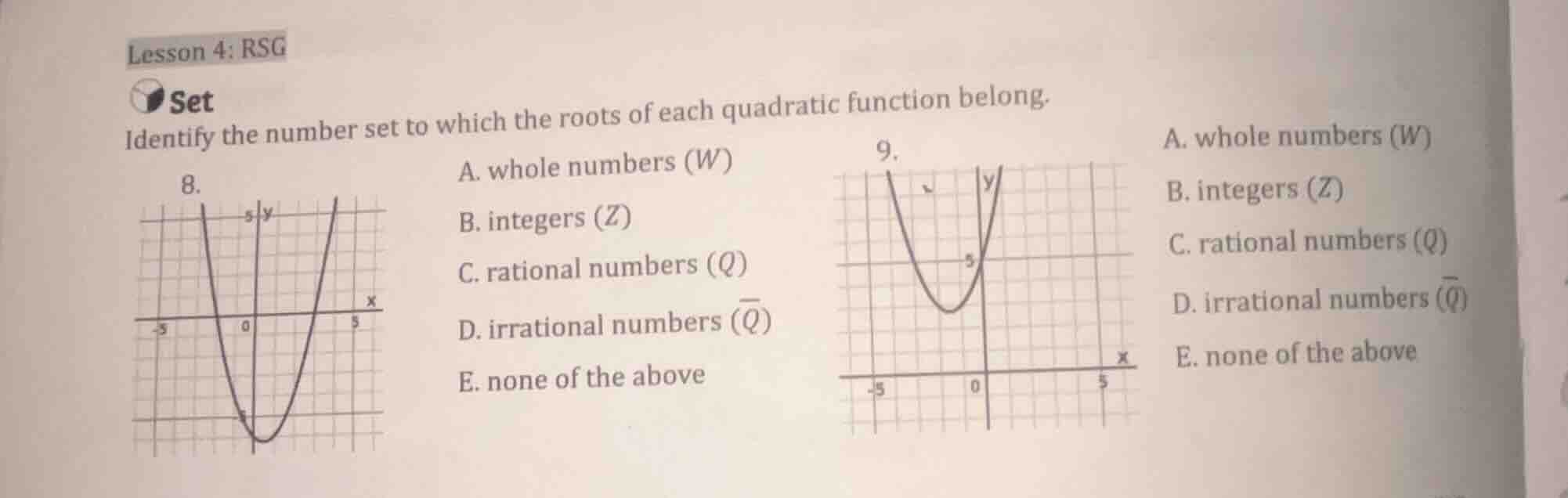
8.
a. whole numbers (w)
b. integers (z)
c. rational numbers (q)
d. irrational numbers (\overline{q})
e. none of the above
9.
a. whole numbers (w)
b. integers (z)
c. rational numbers (q)
d. irrational numbers (\overline{q})
e. none of the above
Problem 8
Step1: Analyze the graph
The parabola intersects the x - axis at two points. From the graph, we can see that the roots seem to be non - integer, non - whole number values. But we need to check the nature of the roots. For a quadratic function \(y = ax^{2}+bx + c\), the roots are found where \(y = 0\). The graph of the quadratic in problem 8 has roots that are not whole numbers (since whole numbers start from 0,1,2,... and the roots are not in that set) or integers (integers are... - 2,-1,0,1,2,... and the roots don't seem to be integers). But they are rational? Wait, no, let's think again. Wait, maybe the roots are irrational? No, wait, the key is to see the x - intercepts. Wait, actually, looking at the graph, the x - intercepts are at non - integer, non - whole number points, but are they rational? Wait, no, maybe the roots are irrational? Wait, no, let's recall the number sets. Whole numbers (\(W\)): 0,1,2,3,... Integers (\(Z\)):..., - 2,-1,0,1,2,... Rational numbers (\(Q\)): numbers that can be written as \(\frac{p}{q}\), \(p,q\in Z\), \(q
eq0\). Irrational numbers (\(\overline{Q}\)): numbers that cannot be written as \(\frac{p}{q}\). But from the graph, the roots are not whole numbers or integers. But are they rational? Wait, maybe the roots are irrational? Wait, no, let's check the options. Wait, maybe the roots are rational? Wait, no, the correct approach: the graph of the quadratic in problem 8 has x - intercepts that are not whole numbers or integers, but are they rational? Wait, no, actually, the roots are irrational? Wait, no, let's think again. Wait, the answer for problem 8: the roots are irrational? No, wait, maybe the roots are rational? Wait, no, the correct answer is D? No, wait, maybe I made a mistake. Wait, let's start over.
For problem 8: The quadratic function's graph intersects the x - axis at two points. The x - intercepts are not whole numbers (since whole numbers are 0,1,2,...) and not integers (since integers are... - 2,-1,0,1,2,...). Now, are they rational or irrational? If the discriminant of the quadratic \(ax^{2}+bx + c = 0\) is a perfect square, the roots are rational; otherwise, irrational. But from the graph, we can see that the x - intercepts are not at integer or whole number points, and the distance from the vertex to the x - intercepts suggests that the discriminant is not a perfect square, so the roots are irrational? Wait, no, maybe the roots are rational? Wait, no, the correct answer for problem 8 is D? No, wait, maybe the roots are rational? Wait, I think I messed up. Wait, let's look at the options again. The options are whole numbers (W), integers (Z), rational (Q), irrational (\(\overline{Q}\)), or none. Wait, maybe the roots are irrational, so the answer is D.
Step2: Conclusion
The roots are not whole numbers (W) or integers (Z). Since they cannot be expressed as a fraction of two integers (rational numbers), they are irrational numbers (\(\overline{Q}\)). So the answer is D. irrational numbers (\(\overline{Q}\))
Problem 9
Step1: Analyze the graph
The parabola in problem 9 intersects the y - axis at (0,5) and has a vertex. The x - intercept: does it intersect the x - axis? Wait, the graph is above the x - axis? Wait, no, the graph of the quadratic in problem 9: the parabola opens upwards, and the vertex is above the x - axis? Wait, no, looking at the graph, the parabola is above the x - axis? Wait, no, the y - intercept is at (0,5), and the vertex is at some point above the x - axis? Wait, no, the x - axis is the horizontal line. Wait, the graph of the quadratic in problem 9 does not intersect the x - axis (since it is above the x - axis). So the quadratic function has no real roots. So the number set to which the roots belong: since there are no real roots, the answer is E. none of the above.
Step2: Conclusion
The quadratic function in problem 9 has no real roots (since the graph does not intersect the x - axis), so the roots (which are complex) do not belong to any of the given number sets (whole numbers, integers, rational, irrational, all of which are real number sets). So the answer is E. none of the above.

Snap & solve any problem in the app
Get step-by-step solutions on Sovi AI
Photo-based solutions with guided steps
Explore more problems and detailed explanations
s:
- D. irrational numbers (\(\overline{Q}\))
- E. none of the above