QUESTION IMAGE
Question
lesson 11.3 checkpoint
once you have completed the above problems and checked your solutions, complete the lesson checkpoint below.
complete the lesson reflection above by circling your current understanding of the learning goal.
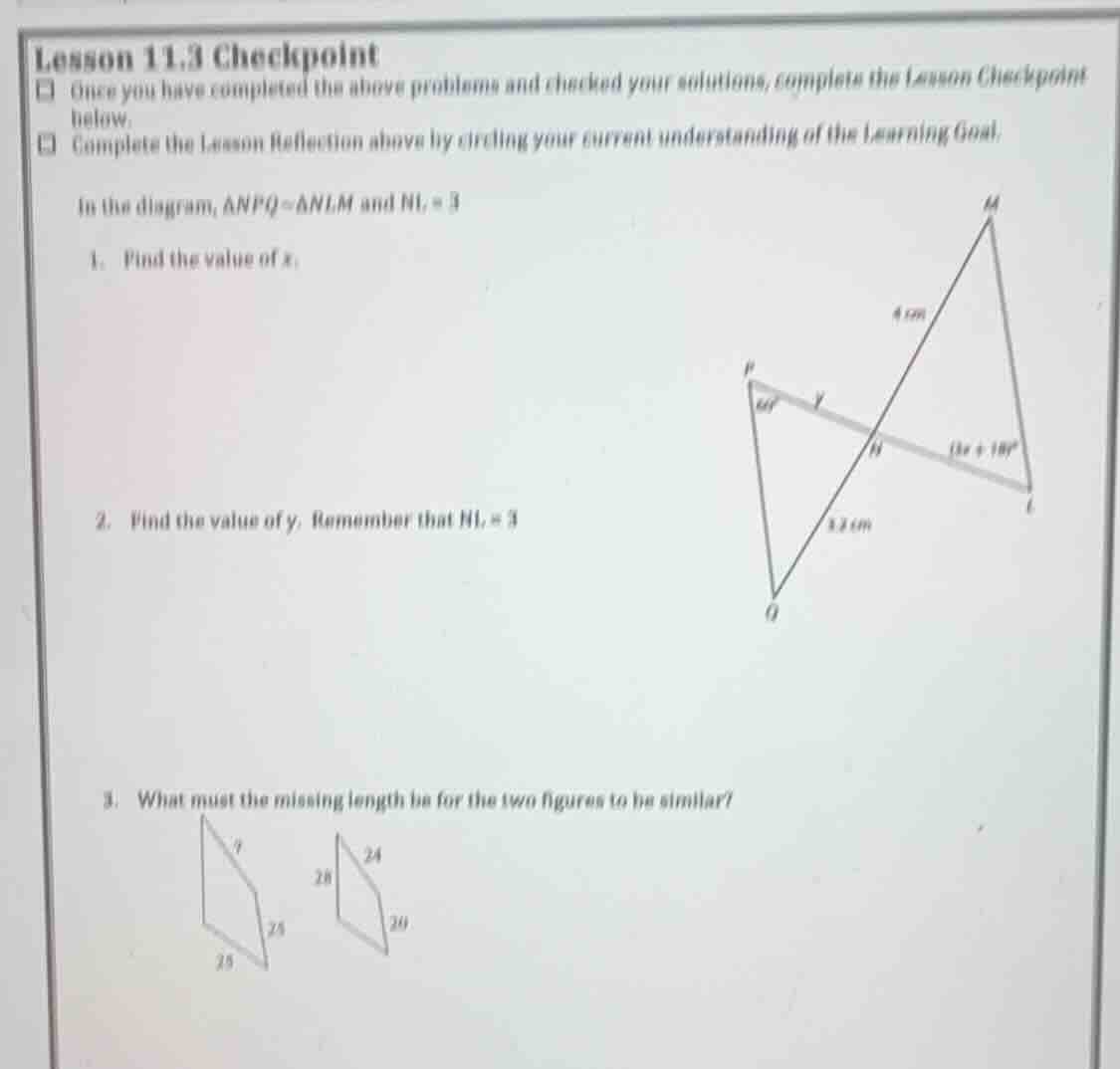
in the diagram, \\(\delta npq \sim \delta nlm\\) and \\(nl = 3\\)
- find the value of \\(x\\).
- find the value of \\(y\\). remember that \\(nl = 3\\)
- what must the missing length be for the two figures to be similar?
Identify corresponding angles for Question 1
Using the Corresponding Angles of Similar Figures knowledge point
Given \(\Delta NPQ \sim \Delta NLM\), the corresponding angles are:
From the diagram:
Solve for x
Using the Solving Linear Equations knowledge point
Set up the ratio for Question 2
Using the Corresponding Sides of Similar Figures knowledge point
The similarity statement \(\Delta NPQ \sim \Delta NLM\) gives the ratio of corresponding sides:
From the diagram and given values:
Solve for y
Using the Solving Linear Equations knowledge point
Determine the missing length for Question 3
Using the Corresponding Sides of Similar Figures knowledge point
Let the missing side of the first quadrilateral be \(z\). Comparing corresponding sides of the two similar quadrilaterals:
Matching corresponding sides by ratio:
Let's pair the sides by ordering them from smallest to largest:
First figure: \(9 < z < 25\)
Second figure: \(20 < 24 < 28\)
Matching ratios:
Let's match corresponding sides of the similar quadrilaterals:
If the scale factor is \(k = \frac{20}{25} = 0.8\):
If the scale factor is \(k = \frac{24}{25}\):
Let's match the corresponding sides directly:
Using the ratio of known corresponding sides:
Let the vertices be matched. The sides of the first figure are \(9\), \(25\), and \(z\). The sides of the second figure are \(24\), \(20\), and \(28\).
Matching the ratios:
Let's match:
Let's match:
Let's check:
\[
\frac{28}{25} = \frac{24}{z}…

Snap & solve any problem in the app
Get step-by-step solutions on Sovi AI
Photo-based solutions with guided steps
Explore more problems and detailed explanations
Question 1
\(x = 14\)
Question 2
\(y = 2.4\)
Question 3
\(35\)