QUESTION IMAGE
Question
(laying paris in the tomb)
how oft when men are at the point of death
(90) have they been merry! which their keepers call
a lightning before death: o, how may i
call this a lightning? o my love! my wife!
death, that hath suckd the honey of thy breath,
hath had no power yet upon thy beauty:
which portions of the text best reveal dramatic irony?
to think it was so? o, give me thy hand,
one writ with me in sour misfortunes book!
ill bury thee in a triumphant grave;
a grave? o no! a lantern, slaughterd youth,
for here lies juliet, and her beauty makes
this vault a feasting presence full of light.
Define dramatic irony in this context
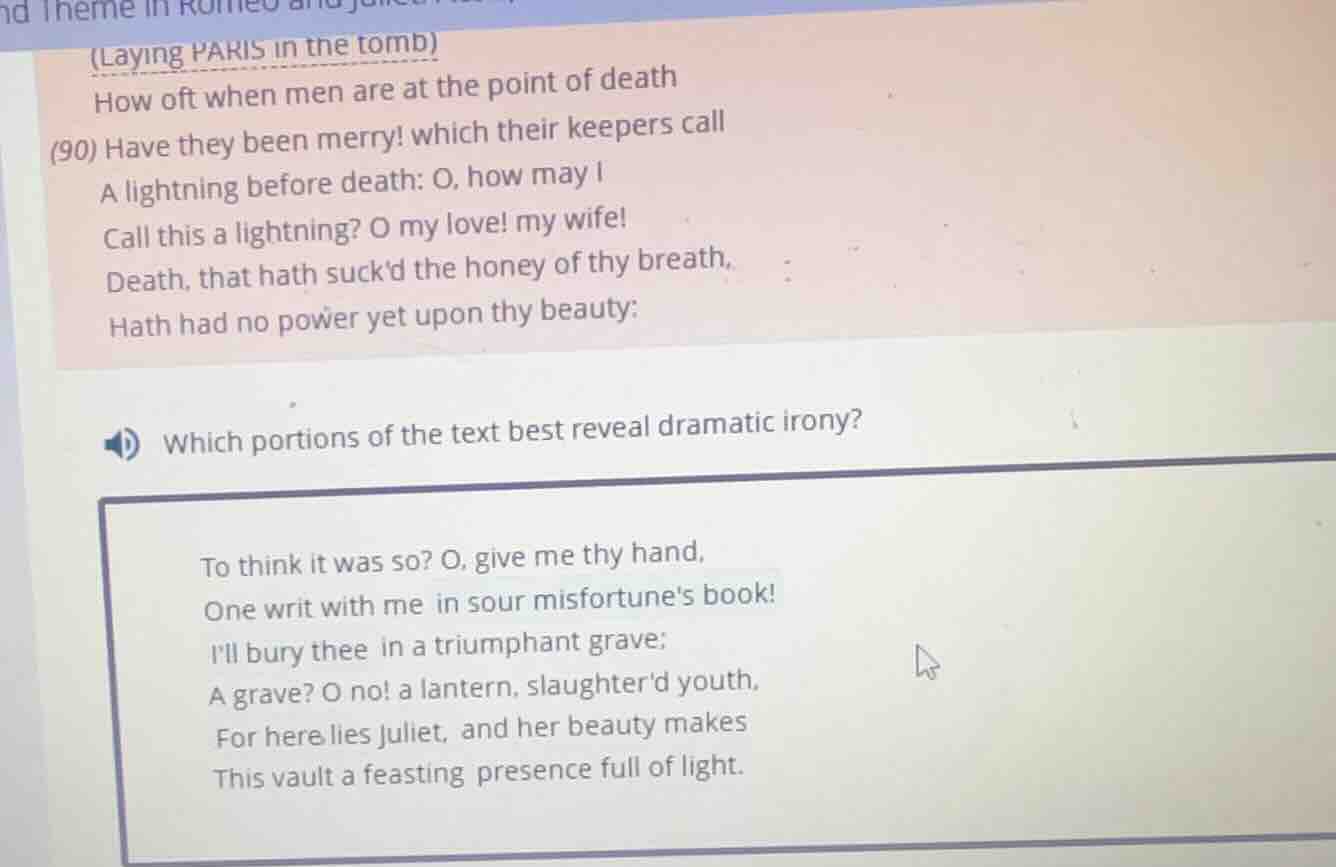
Dramatic irony occurs when the audience knows a vital piece of information that a character does not. In this scene from Act 5, Scene 3 of Romeo and Juliet, the audience knows Juliet is not actually dead, but Romeo believes she is.
Analyze the first passage
In the top passage, Romeo observes: "Death, that hath suck'd the honey of thy breath, / Hath had no power yet upon thy beauty." This is highly ironic because Juliet's beauty remains because she is alive and about to wake up, which Romeo mistakes as death failing to conquer her beauty.
Analyze the second passage
In the bottom passage, Romeo states: "For here lies Juliet, and her beauty makes / This vault a feasting presence full of light." This also highlights the irony of her radiant, living beauty inside a dark tomb, which the audience knows is due to her being alive.

Snap & solve any problem in the app
Get step-by-step solutions on Sovi AI
Photo-based solutions with guided steps
Explore more problems and detailed explanations
The portions of the text that best reveal dramatic irony are:
- "Death, that hath suck'd the honey of thy breath, / Hath had no power yet upon thy beauty:"
This is ironic because Romeo believes Juliet still looks beautiful despite being dead, whereas the audience knows she still looks beautiful and lifelike because she is actually alive and waking up from her potion.
- "For here lies Juliet, and her beauty makes / This vault a feasting presence full of light."
This is ironic because Romeo perceives her beauty as illuminating the dark tomb of death, unaware that her physical radiance is a sign of her active, living state.