QUESTION IMAGE
Question
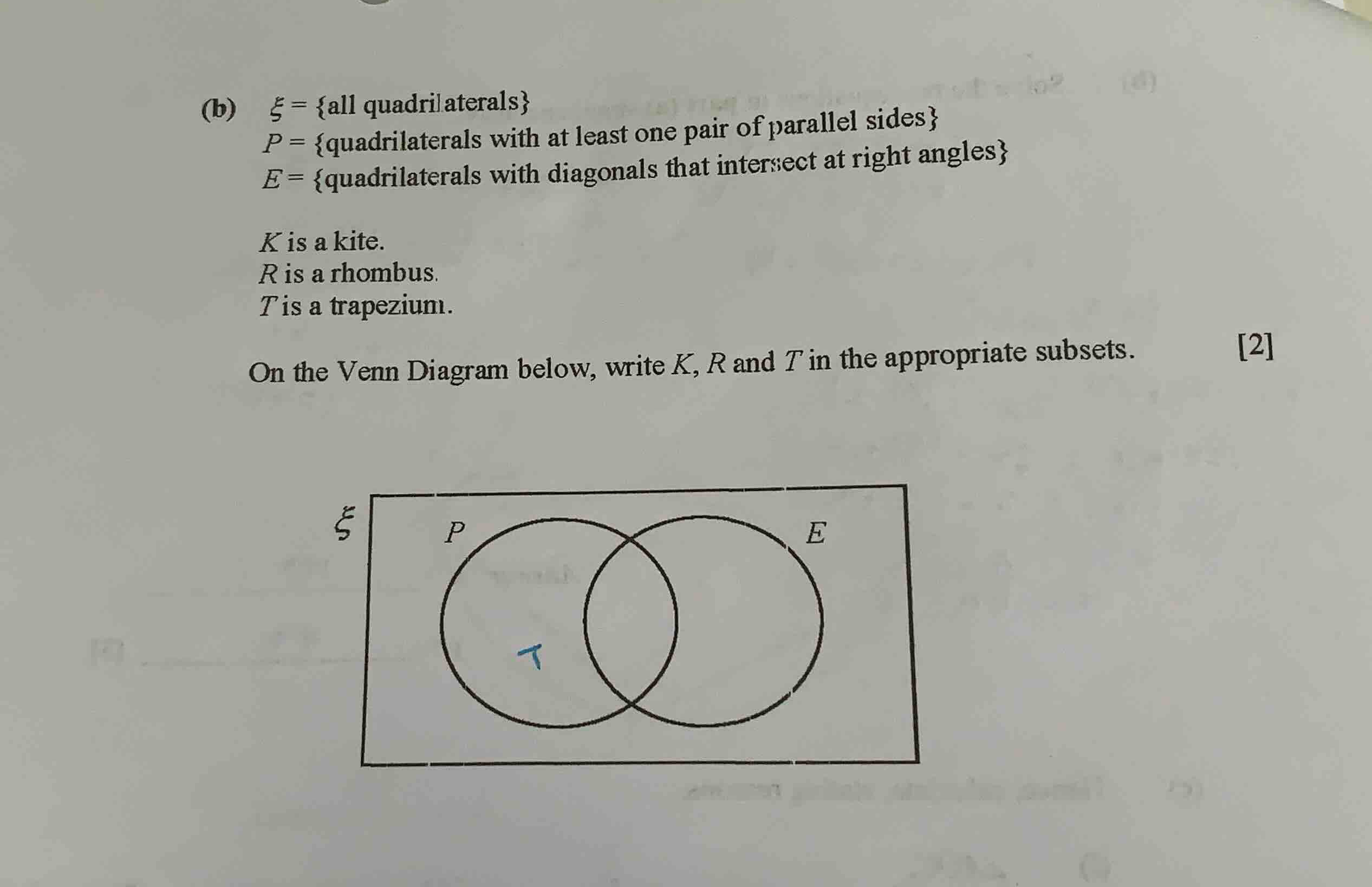
(b) \\(\xi = \\{\text{all quadrilaterals}\\}\\)
\\(p = \\{\text{quadrilaterals with at least one pair of parallel sides}\\}\\)
\\(e = \\{\text{quadrilaterals with diagonals that intersect at right angles}\\}\\)
\\(k\\) is a kite.
\\(r\\) is a rhombus.
\\(t\\) is a trapezium.
on the venn diagram below, write \\(k\\), \\(r\\) and \\(t\\) in the appropriate subsets.
Analyze the defined sets
We first identify the geometric properties required for membership in each set:
- Universal set \(\xi\) contains all quadrilaterals.
- Set \(P\) contains quadrilaterals with at least one pair of parallel sides.
- Set \(E\) contains quadrilaterals with diagonals that intersect at right angles (perpendicular diagonals).
Classify the trapezium T
A trapezium is defined as a quadrilateral with at least one pair of parallel sides.
- It belongs to set \(P\) because it has parallel sides.
- Its diagonals do not generally intersect at right angles, so it does not belong to set \(E\).
- Therefore, \(T\) is placed in the region \(P \cap E'\) (inside \(P\) but outside \(E\)).
Classify the kite K
A kite is defined as a quadrilateral with two pairs of adjacent equal sides.
- It does not necessarily have any parallel sides, so it does not belong to set \(P\).
- Its diagonals always intersect at right angles, so it belongs to set \(E\).
- Therefore, \(K\) is placed in the region \(E \cap P'\) (inside \(E\) but outside \(P\)).
Classify the rhombus R
A rhombus is a quadrilateral with four equal sides.
- It is a parallelogram, meaning it has two pairs of parallel sides. Thus, it belongs to set \(P\).
- Its diagonals always intersect at right angles, so it belongs to set \(E\).
- Therefore, \(R\) belongs to both sets and is placed in the intersection region \(P \cap E\).

Snap & solve any problem in the app
Get step-by-step solutions on Sovi AI
Photo-based solutions with guided steps
Explore more problems and detailed explanations
On the Venn diagram, the labels should be placed in the following regions:
- \(T\) (Trapezium) is placed inside circle \(P\) only (in the left region, outside the intersection).
- \(R\) (Rhombus) is placed in the intersection of circle \(P\) and circle \(E\) (the middle overlapping region).
- \(K\) (Kite) is placed inside circle \(E\) only (in the right region, outside the intersection).