Sovi.AI - AI Math Tutor

Scan to solve math questions

QUESTION IMAGE

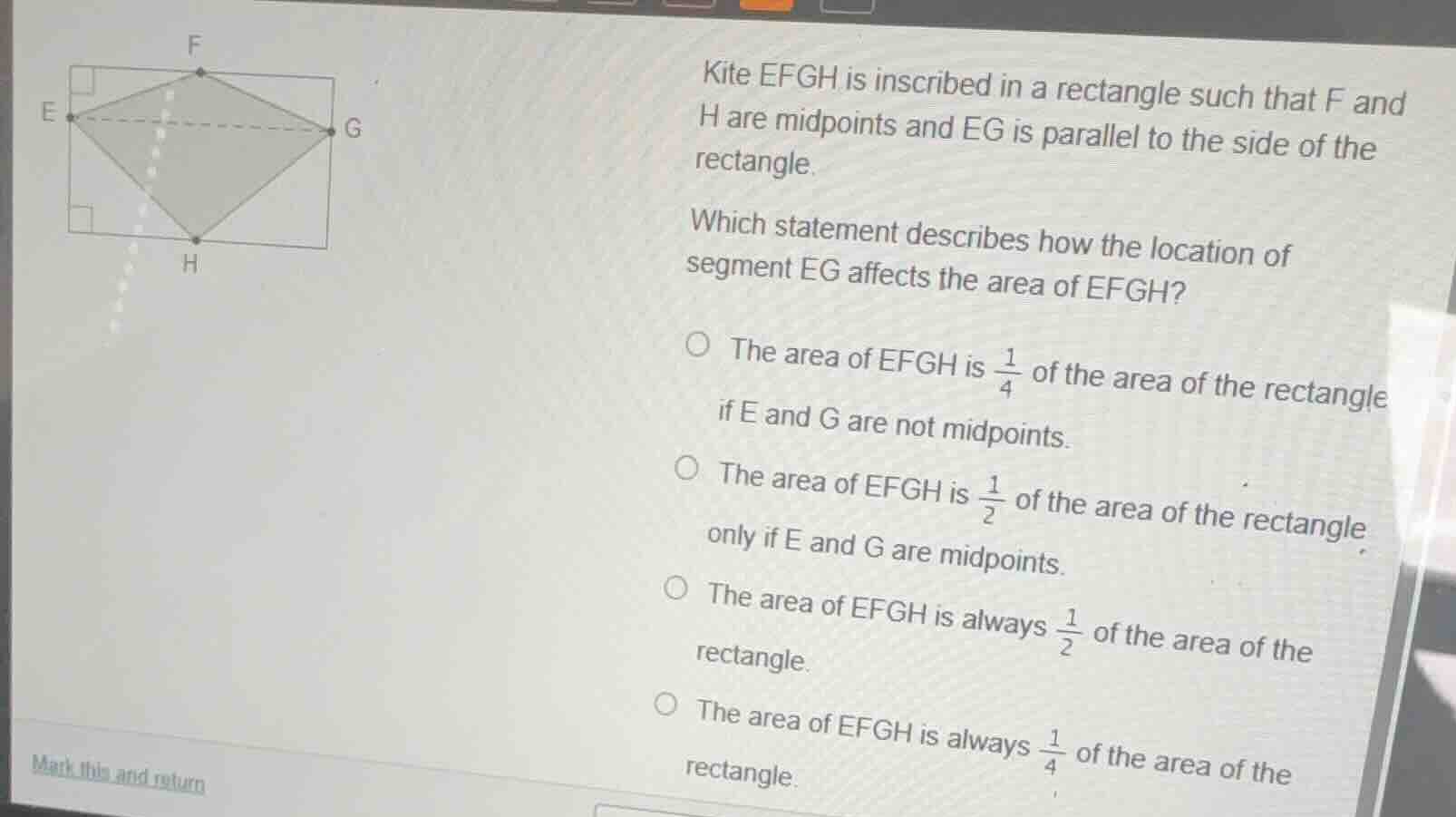
kite efgh is inscribed in a rectangle such that f and h are midpoints a…

Question

kite efgh is inscribed in a rectangle such that f and h are midpoints and eg is parallel to the side of the rectangle.

which statement describes how the location of segment eg affects the area of efgh?

  • the area of efgh is \\(\frac{1}{4}\\) of the area of the rectangle if e and g are not midpoints.
  • the area of efgh is \\(\frac{1}{2}\\) of the area of the rectangle only if e and g are midpoints.
  • the area of efgh is always \\(\frac{1}{2}\\) of the area of the rectangle.
  • the area of efgh is always \\(\frac{1}{4}\\) of the area of the rectangle.

Explanation:

Response

<pre_analysis>
{
"quality": "clear",
"question_count": 1,
"skills_matched": [
"step_cot",
"multiple_choice_formatter",
"explain_then_answer",
"quick"
],
"needs_drawing": false,
"concepts_used": [],
"new_concepts": [
"Area of a Kite",
"Inscribed Polygons"
],
"current_concepts": [
"Area of a Kite",
"Inscribed Polygons",
"Geometric Area Relations"
]
}
</pre_analysis>

<reasoning>

Express the area of the rectangle and the kite

\[

$$\begin{aligned} &\text{Let the width of the rectangle be } w \text{ and the height be } h.\\ &\text{Area of the rectangle: } A_{\text{rect}} = w \cdot h\\ &\text{Since } EG \text{ is parallel to the horizontal sides, its length is } w.\\ &\text{Since } F \text{ and } H \text{ are midpoints of the top and bottom sides, the vertical distance between them is } h.\\ &\text{The diagonals of kite } EFGH \text{ are } EG \text{ and } FH, \text{ which are perpendicular.}\\ &\text{Area of the kite: } A_{\text{kite}} = \frac{1}{2} \cdot EG \cdot FH = \frac{1}{2} \cdot w \cdot h \end{aligned}$$

\]

Determine the relationship between the areas

\[

$$\begin{aligned} &A_{\text{kite}} = \frac{1}{2} A_{\text{rect}}\\ &\text{This relationship depends only on } EG = w \text{ and } FH = h.\\ &\text{The vertical position of } EG \text{ (whether } E \text{ and } G \text{ are midpoints or not) does not affect the lengths of the diagonals.}\\ &\text{Thus, the area of } EFGH \text{ is always } \frac{1}{2} \text{ of the area of the rectangle.} \end{aligned}$$

\]
</reasoning>

<answer>
<mcq-option>The area of EFGH is \(\frac{1}{4}\) of the area of the rectangle if E and G are not midpoints.</mcq-option>
<mcq-option>The area of EFGH is \(\frac{1}{2}\) of the area of the rectangle only if E and G are midpoints.</mcq-option>
<mcq-correct>The area of EFGH is always \(\frac{1}{2}\) of the area of the rectangle.</mcq-correct>
<mcq-option>The area of EFGH is always \(\frac{1}{4}\) of the area of the rectangle.</mcq-option>
</answer>

<post_analysis>
{
"subject": "Mathematics",
"question_type": "Multiple Choice",
"knowledge_point": [
"Mathematics",
"Geometry",
"Area of a Kite"
]
}
</post_analysis>

Answer:

<pre_analysis>
{
"quality": "clear",
"question_count": 1,
"skills_matched": [
"step_cot",
"multiple_choice_formatter",
"explain_then_answer",
"quick"
],
"needs_drawing": false,
"concepts_used": [],
"new_concepts": [
"Area of a Kite",
"Inscribed Polygons"
],
"current_concepts": [
"Area of a Kite",
"Inscribed Polygons",
"Geometric Area Relations"
]
}
</pre_analysis>

<reasoning>

Express the area of the rectangle and the kite

\[

$$\begin{aligned} &\text{Let the width of the rectangle be } w \text{ and the height be } h.\\ &\text{Area of the rectangle: } A_{\text{rect}} = w \cdot h\\ &\text{Since } EG \text{ is parallel to the horizontal sides, its length is } w.\\ &\text{Since } F \text{ and } H \text{ are midpoints of the top and bottom sides, the vertical distance between them is } h.\\ &\text{The diagonals of kite } EFGH \text{ are } EG \text{ and } FH, \text{ which are perpendicular.}\\ &\text{Area of the kite: } A_{\text{kite}} = \frac{1}{2} \cdot EG \cdot FH = \frac{1}{2} \cdot w \cdot h \end{aligned}$$

\]

Determine the relationship between the areas

\[

$$\begin{aligned} &A_{\text{kite}} = \frac{1}{2} A_{\text{rect}}\\ &\text{This relationship depends only on } EG = w \text{ and } FH = h.\\ &\text{The vertical position of } EG \text{ (whether } E \text{ and } G \text{ are midpoints or not) does not affect the lengths of the diagonals.}\\ &\text{Thus, the area of } EFGH \text{ is always } \frac{1}{2} \text{ of the area of the rectangle.} \end{aligned}$$

\]
</reasoning>

<answer>
<mcq-option>The area of EFGH is \(\frac{1}{4}\) of the area of the rectangle if E and G are not midpoints.</mcq-option>
<mcq-option>The area of EFGH is \(\frac{1}{2}\) of the area of the rectangle only if E and G are midpoints.</mcq-option>
<mcq-correct>The area of EFGH is always \(\frac{1}{2}\) of the area of the rectangle.</mcq-correct>
<mcq-option>The area of EFGH is always \(\frac{1}{4}\) of the area of the rectangle.</mcq-option>
</answer>

<post_analysis>
{
"subject": "Mathematics",
"question_type": "Multiple Choice",
"knowledge_point": [
"Mathematics",
"Geometry",
"Area of a Kite"
]
}
</post_analysis>