QUESTION IMAGE
Question
key knowledge
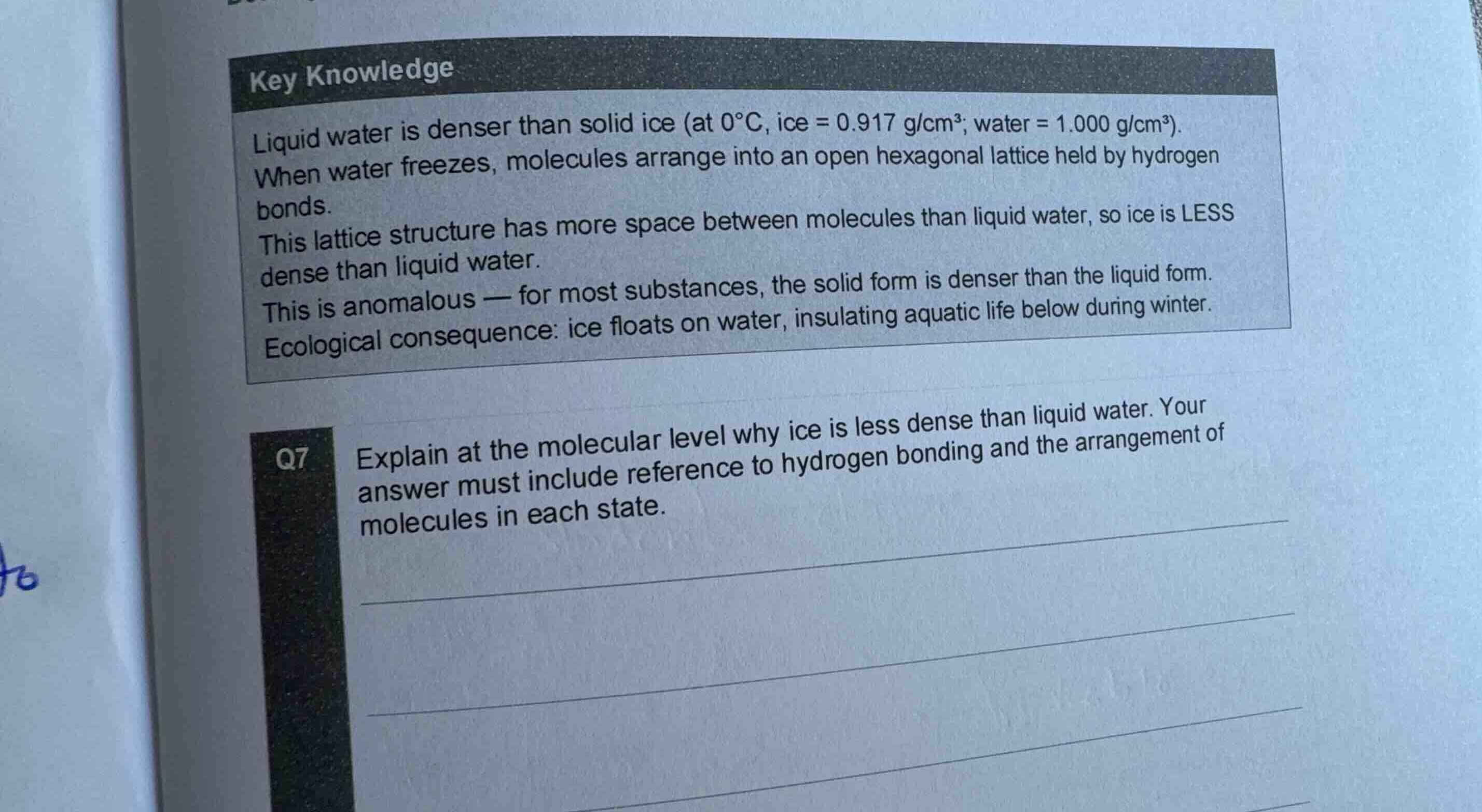
liquid water is denser than solid ice (at \\(0^\circ\text{c}\\), \\(\text{ice} = 0.917\text{ g/cm}^3\\); \\(\text{water} = 1.000\text{ g/cm}^3\\)).
when water freezes, molecules arrange into an open hexagonal lattice held by hydrogen bonds.
this lattice structure has more space between molecules than liquid water, so ice is less dense than liquid water.
this is anomalous — for most substances, the solid form is denser than the liquid form.
ecological consequence: ice floats on water, insulating aquatic life below during winter.
q7 explain at the molecular level why ice is less dense than liquid water. your answer must include reference to hydrogen bonding and the arrangement of molecules in each state.
Describe liquid water molecular behavior
Using the Hydrogen Bonding in Water knowledge point
In liquid water, thermal energy causes molecules to constantly move, break, and reform temporary hydrogen bonds, allowing them to crowd closely together.
Describe solid ice molecular structure
Using the Density of Ice knowledge point
As water freezes, decreased thermal motion allows stable hydrogen bonds to lock molecules into a fixed, open hexagonal lattice structure.
Compare density and volume
Using the Density of Ice knowledge point
The rigid hexagonal lattice keeps water molecules farther apart on average in ice than in liquid water, increasing the volume for a given mass and resulting in a lower density.

Snap & solve any problem in the app
Get step-by-step solutions on Sovi AI
Photo-based solutions with guided steps
Explore more problems and detailed explanations
Ice is less dense than liquid water because of how hydrogen bonds behave in each state:
- In liquid water: The molecules have more kinetic energy, allowing them to continuously move, break, and reform hydrogen bonds. This allows the molecules to pack closely together.
- In solid ice: As temperature drops, molecules lose kinetic energy and form stable, permanent hydrogen bonds. These bonds hold the water molecules in a rigid, open hexagonal lattice structure.
Because this crystalline lattice keeps the molecules farther apart than they are in the liquid state, ice contains more empty space, making it less dense than liquid water.