QUESTION IMAGE
Question
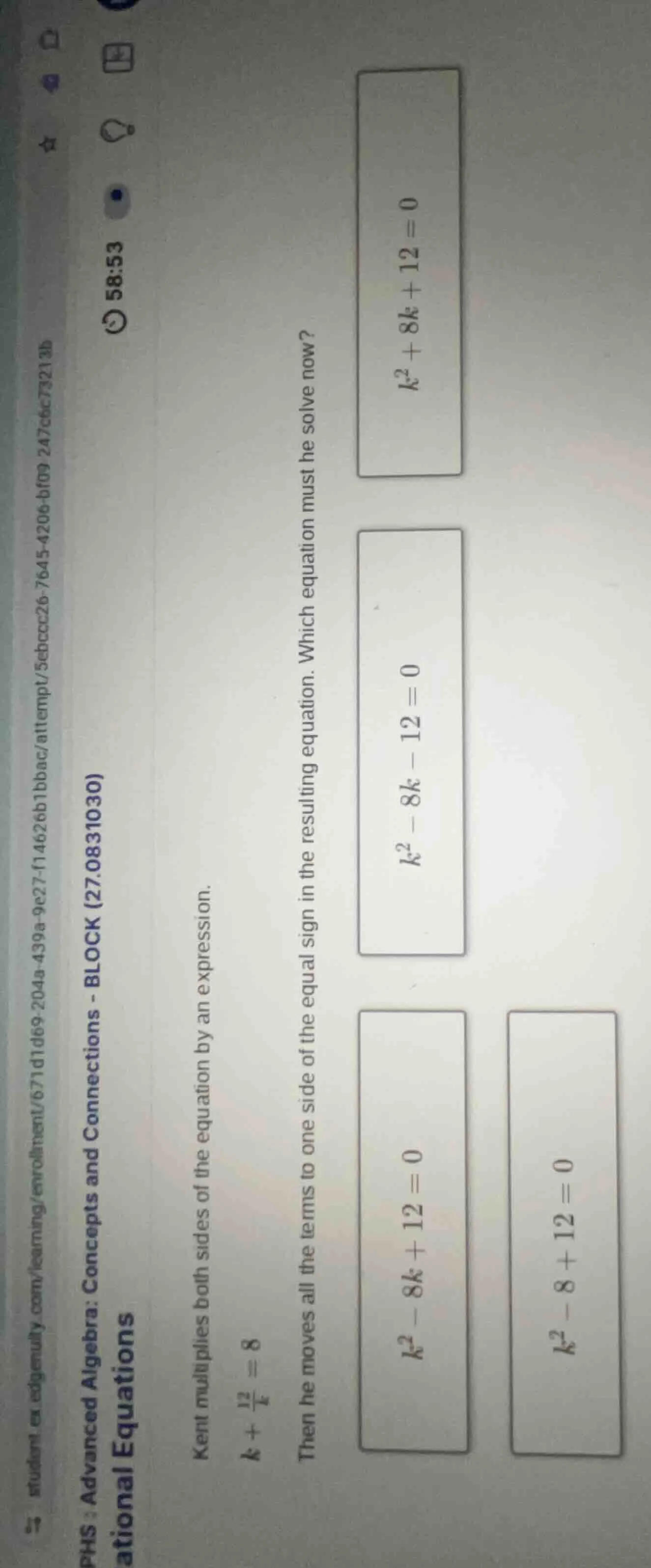
kent multiplies both sides of the equation by an expression.
k + \frac{12}{k} = 8
then he moves all the terms to one side of the equal sign in the resulting equation. which equation must he solve now?
options:
k^2 - 8k + 12 = 0
k^2 - 8k - 12 = 0
k^2 + 8k + 12 = 0
k^2 - 8 + 12 = 0
Step1: Multiply both sides by \( k \)
The original equation is \( k + \frac{12}{k} = 8 \). Multiply each term by \( k \) (assuming \( k
eq 0 \)) to eliminate the denominator:
\( k \times k + k \times \frac{12}{k} = 8 \times k \)
Simplify each term: \( k^2 + 12 = 8k \).
Step2: Move all terms to one side
Subtract \( 8k \) from both sides to get all terms on the left:
\( k^2 - 8k + 12 = 0 \).

Snap & solve any problem in the app
Get step-by-step solutions on Sovi AI
Photo-based solutions with guided steps
Explore more problems and detailed explanations
\( k^2 - 8k + 12 = 0 \) (the first option among the four, assuming the first box is \( k^2 - 8k + 12 = 0 \))