QUESTION IMAGE
Question
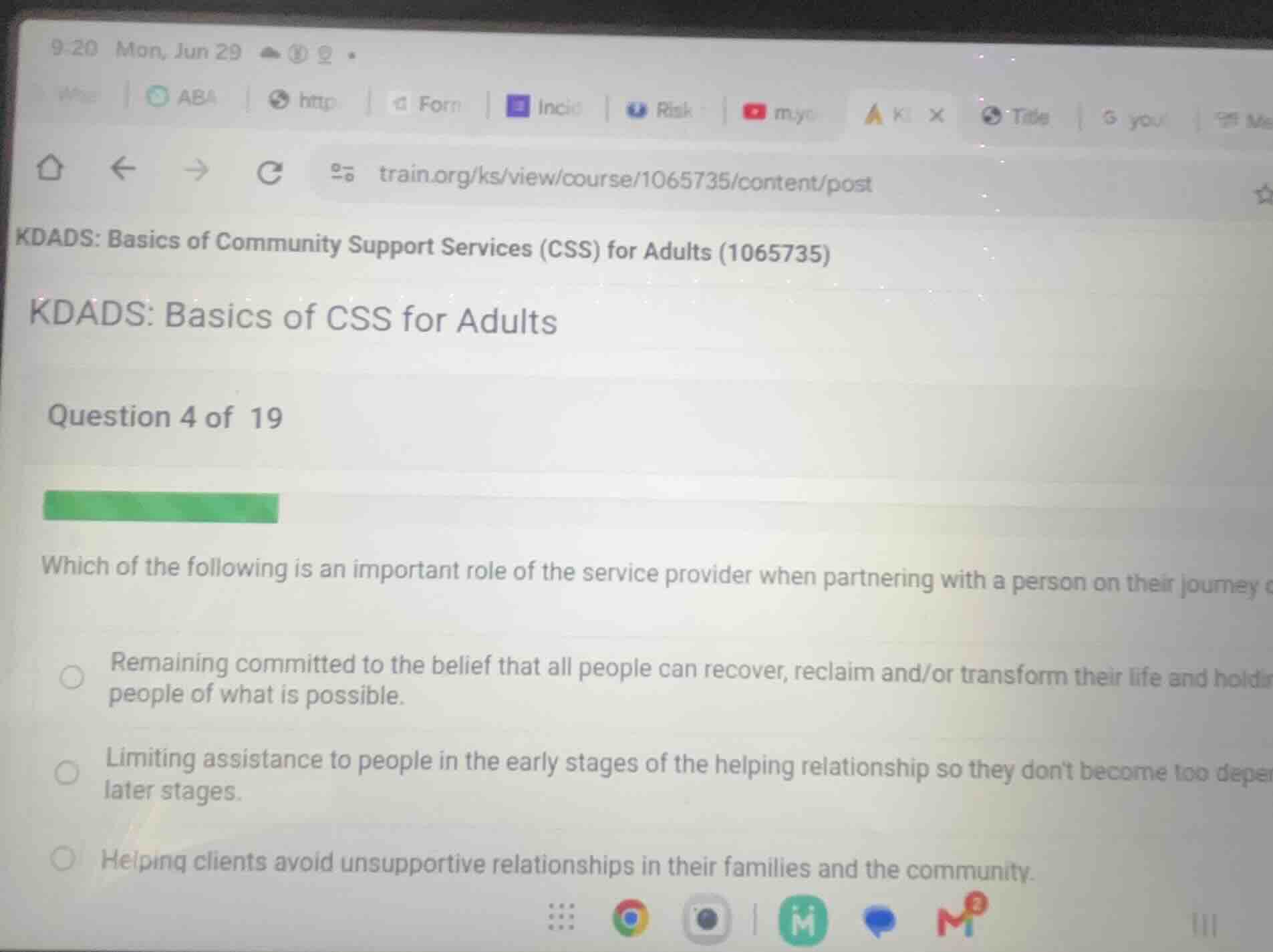
kdads: basics of css for adults
question 4 of 19
which of the following is an important role of the service provider when partnering with a person on their journey of recovery?
- remaining committed to the belief that all people can recover, reclaim and/or transform their life and holding hope for people of what is possible.
- limiting assistance to people in the early stages of the helping relationship so they dont become too dependent in later stages.
- helping clients avoid unsupportive relationships in their families and the community.
Analyze the core principles of recovery-oriented care
The question asks for an important role of a service provider when partnering with a person on their journey of recovery. Under the psychiatric recovery model, a fundamental tenet is the belief that recovery is possible for everyone, and providers must hold hope and remain committed to this belief.
Evaluate the given options
- Option 1: "Remaining committed to the belief that all people can recover, reclaim and/or transform their life and holding hope for people of what is possible." This directly aligns with the core values of recovery-oriented systems of care.
- Option 2: "Limiting assistance to people in the early stages..." This goes against supportive care and relationship building.
- Option 3: "Helping clients avoid unsupportive relationships..." While supportive, it is overly restrictive and does not capture the primary, overarching philosophical role of holding hope and believing in recovery.

Snap & solve any problem in the app
Get step-by-step solutions on Sovi AI
Photo-based solutions with guided steps
Explore more problems and detailed explanations
- (A) Remaining committed to the belief that all people can recover, reclaim and/or transform their life and holding hope for people of what is possible. (Correct answer)
- (B) Limiting assistance to people in the early stages of the helping relationship so they don't become too dependent in later stages.
- (C) Helping clients avoid unsupportive relationships in their families and the community.