QUESTION IMAGE
Question
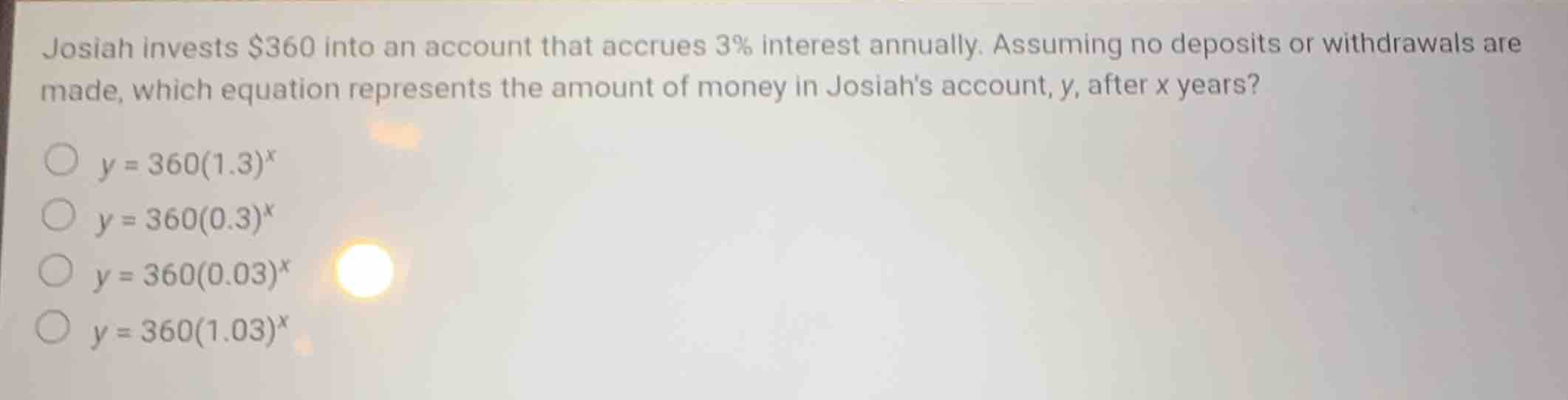
josiah invests $360 into an account that accrues 3% interest annually. assuming no deposits or withdrawals are made, which equation represents the amount of money in josiahs account, y, after x years?
\\(y = 360(1.3)^x\\)
\\(y = 360(0.3)^x\\)
\\(y = 360(0.03)^x\\)
\\(y = 360(1.03)^x\\)
Identify the initial value and growth rate
$$
LATEXBLOCK0
$$
Determine the growth factor
$$
1 + r = 1 + 0.03 = 1.03
$$
Formulate the exponential equation
$$
y = 360(1.03)^x
$$

Snap & solve any problem in the app
Get step-by-step solutions on Sovi AI
Photo-based solutions with guided steps
Explore more problems and detailed explanations
- (A) \(y = 360(1.3)^x\)
- (B) \(y = 360(0.3)^x\)
- (C) \(y = 360(0.03)^x\)
- (D) \(y = 360(1.03)^x\) (Correct answer)