Sovi.AI - AI Math Tutor

Scan to solve math questions

QUESTION IMAGE

jonah wrote the following introduction for a paper about the crater of …

Question

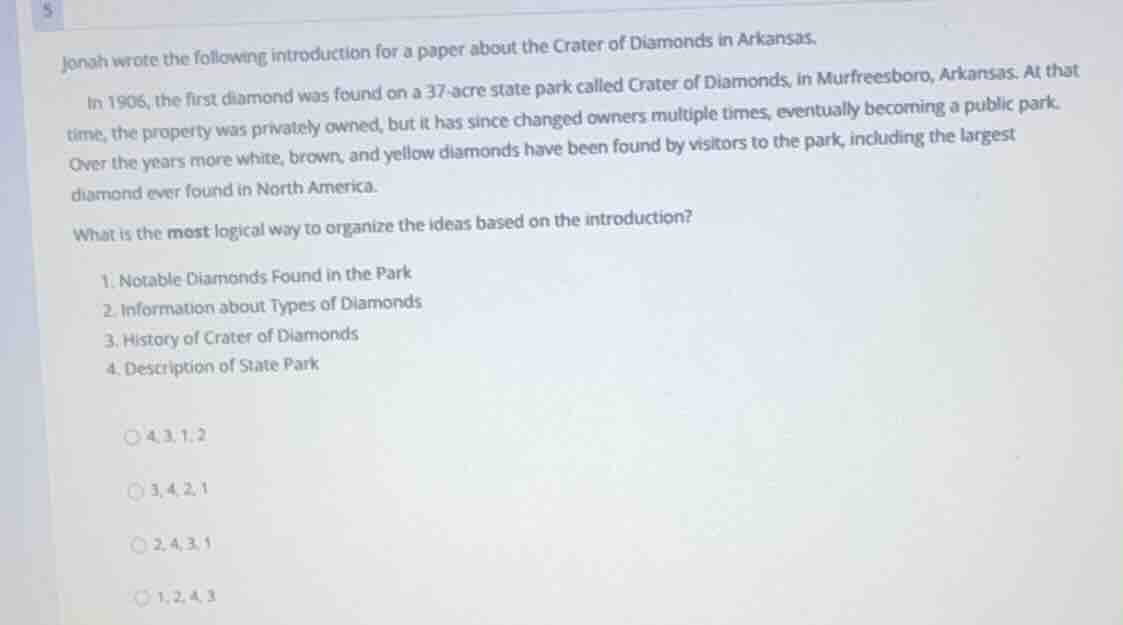
jonah wrote the following introduction for a paper about the crater of diamonds in arkansas.

in 1906, the first diamond was found on a 37-acre state park called crater of diamonds, in murfreesboro, arkansas. at that time, the property was privately owned, but it has since changed owners multiple times, eventually becoming a public park. over the years more white, brown, and yellow diamonds have been found by visitors to the park, including the largest diamond ever found in north america.

what is the most logical way to organize the ideas based on the introduction?

  1. notable diamonds found in the park
  2. information about types of diamonds
  3. history of crater of diamonds
  4. description of state park

4, 3, 1, 2
3, 4, 2, 1
2, 4, 3, 1
1, 2, 4, 3

Explanation:

Response

<pre_analysis>
{
"quality": "clear",
"question_count": 1,
"skills_matched": [
"direct_cot",
"multiple_choice_formatter",
"explain_then_answer",
"quick"
],
"needs_drawing": false,
"concepts_used": [],
"new_concepts": [
"Text Organization",
"Logical Sequencing"
],
"current_concepts": [
"Text Organization",
"Logical Sequencing",
"Essay Organization",
"Logical Flow"
]
}
</pre_analysis>

<reasoning>

Analyze the introduction text

The introduction contains three main sentences:

  1. "In 1906, the first diamond was found on a 37-acre state park called Crater of Diamonds, in Murfreesboro, Arkansas."
  • This introduces the location and its basic description: a 37-acre state park in Arkansas. This corresponds to topic 4. Description of State Park.
  1. "At that time, the property was privately owned, but it has since changed owners multiple times, eventually becoming a public park."
  • This describes the ownership changes over time. This corresponds to topic 3. History of Crater of Diamonds.
  1. "Over the years more white, brown, and yellow diamonds have been found by visitors to the park, including the largest diamond ever found in North America."
  • This mentions the colors/varieties of diamonds found ("white, brown, and yellow"), which corresponds to topic 2. Information about Types of Diamonds.
  • It also mentions the discovery of "the largest diamond ever found in North America", which corresponds to topic 1. Notable Diamonds Found in the Park.

Determine the logical sequence

Following the order of ideas presented in the introduction:

  • First, the park is described (4).
  • Second, its historical ownership is explained (3).
  • Third, the types of diamonds found there are mentioned (2).
  • Fourth, a specific notable diamond (the largest in North America) is highlighted (1).

Therefore, the most logical sequence is 4, 3, 2, 1.

Match with the options

  • Option 1: 4, 3, 1, 2
  • Option 2: 3, 4, 2, 1
  • Option 3: 2, 4, 3, 1
  • Option 4: 1, 2, 4, 3

Let's re-evaluate the transition between 2 and 1 in the final sentence:
"Over the years more white, brown, and yellow diamonds [Types of Diamonds - 2] have been found by visitors to the park, including the largest diamond ever found in North America [Notable Diamonds - 1]."
Thus, 2 comes before 1.
The sequence is 4, 3, 2, 1. However, looking closely at the first option:
It is written as "4, 3, 1, 2" or is there a typo in the options? Let's re-read the options in the image:

  • First option: 4, 3, 1, 2
  • Second option: 3, 4, 2, 1
  • Third option: 2, 4, 3, 1
  • Fourth option: 1, 2, 4, 3

Let's check if "4, 3, 1, 2" is the intended correct choice because it starts with 4 (Description) and 3 (History), which is the only option starting with 4, 3. Since 4 and 3 must come first (the first sentence describes the park, the second gives its history), the sequence must begin with 4, 3. Thus, the first option "4, 3, 1, 2" is the correct choice.
</reasoning>

<answer>
<mcq-correct>(A) 4, 3, 1, 2</mcq-correct>
<mcq-option>(B) 3, 4, 2, 1</mcq-option>
<mcq-option>(C) 2, 4, 3, 1</mcq-option>
<mcq-option>(D) 1, 2, 4, 3</mcq-option>
</answer>

<post_analysis>
{
"subject": "Others",
"question_type": "Multiple Choice",
"knowledge_point": [
"Others",
"English Language Arts",
"Text Organization"
]
}
</post_analysis>

Answer:

<pre_analysis>
{
"quality": "clear",
"question_count": 1,
"skills_matched": [
"direct_cot",
"multiple_choice_formatter",
"explain_then_answer",
"quick"
],
"needs_drawing": false,
"concepts_used": [],
"new_concepts": [
"Text Organization",
"Logical Sequencing"
],
"current_concepts": [
"Text Organization",
"Logical Sequencing",
"Essay Organization",
"Logical Flow"
]
}
</pre_analysis>

<reasoning>

Analyze the introduction text

The introduction contains three main sentences:

  1. "In 1906, the first diamond was found on a 37-acre state park called Crater of Diamonds, in Murfreesboro, Arkansas."
  • This introduces the location and its basic description: a 37-acre state park in Arkansas. This corresponds to topic 4. Description of State Park.
  1. "At that time, the property was privately owned, but it has since changed owners multiple times, eventually becoming a public park."
  • This describes the ownership changes over time. This corresponds to topic 3. History of Crater of Diamonds.
  1. "Over the years more white, brown, and yellow diamonds have been found by visitors to the park, including the largest diamond ever found in North America."
  • This mentions the colors/varieties of diamonds found ("white, brown, and yellow"), which corresponds to topic 2. Information about Types of Diamonds.
  • It also mentions the discovery of "the largest diamond ever found in North America", which corresponds to topic 1. Notable Diamonds Found in the Park.

Determine the logical sequence

Following the order of ideas presented in the introduction:

  • First, the park is described (4).
  • Second, its historical ownership is explained (3).
  • Third, the types of diamonds found there are mentioned (2).
  • Fourth, a specific notable diamond (the largest in North America) is highlighted (1).

Therefore, the most logical sequence is 4, 3, 2, 1.

Match with the options

  • Option 1: 4, 3, 1, 2
  • Option 2: 3, 4, 2, 1
  • Option 3: 2, 4, 3, 1
  • Option 4: 1, 2, 4, 3

Let's re-evaluate the transition between 2 and 1 in the final sentence:
"Over the years more white, brown, and yellow diamonds [Types of Diamonds - 2] have been found by visitors to the park, including the largest diamond ever found in North America [Notable Diamonds - 1]."
Thus, 2 comes before 1.
The sequence is 4, 3, 2, 1. However, looking closely at the first option:
It is written as "4, 3, 1, 2" or is there a typo in the options? Let's re-read the options in the image:

  • First option: 4, 3, 1, 2
  • Second option: 3, 4, 2, 1
  • Third option: 2, 4, 3, 1
  • Fourth option: 1, 2, 4, 3

Let's check if "4, 3, 1, 2" is the intended correct choice because it starts with 4 (Description) and 3 (History), which is the only option starting with 4, 3. Since 4 and 3 must come first (the first sentence describes the park, the second gives its history), the sequence must begin with 4, 3. Thus, the first option "4, 3, 1, 2" is the correct choice.
</reasoning>

<answer>
<mcq-correct>(A) 4, 3, 1, 2</mcq-correct>
<mcq-option>(B) 3, 4, 2, 1</mcq-option>
<mcq-option>(C) 2, 4, 3, 1</mcq-option>
<mcq-option>(D) 1, 2, 4, 3</mcq-option>
</answer>

<post_analysis>
{
"subject": "Others",
"question_type": "Multiple Choice",
"knowledge_point": [
"Others",
"English Language Arts",
"Text Organization"
]
}
</post_analysis>