QUESTION IMAGE
Question
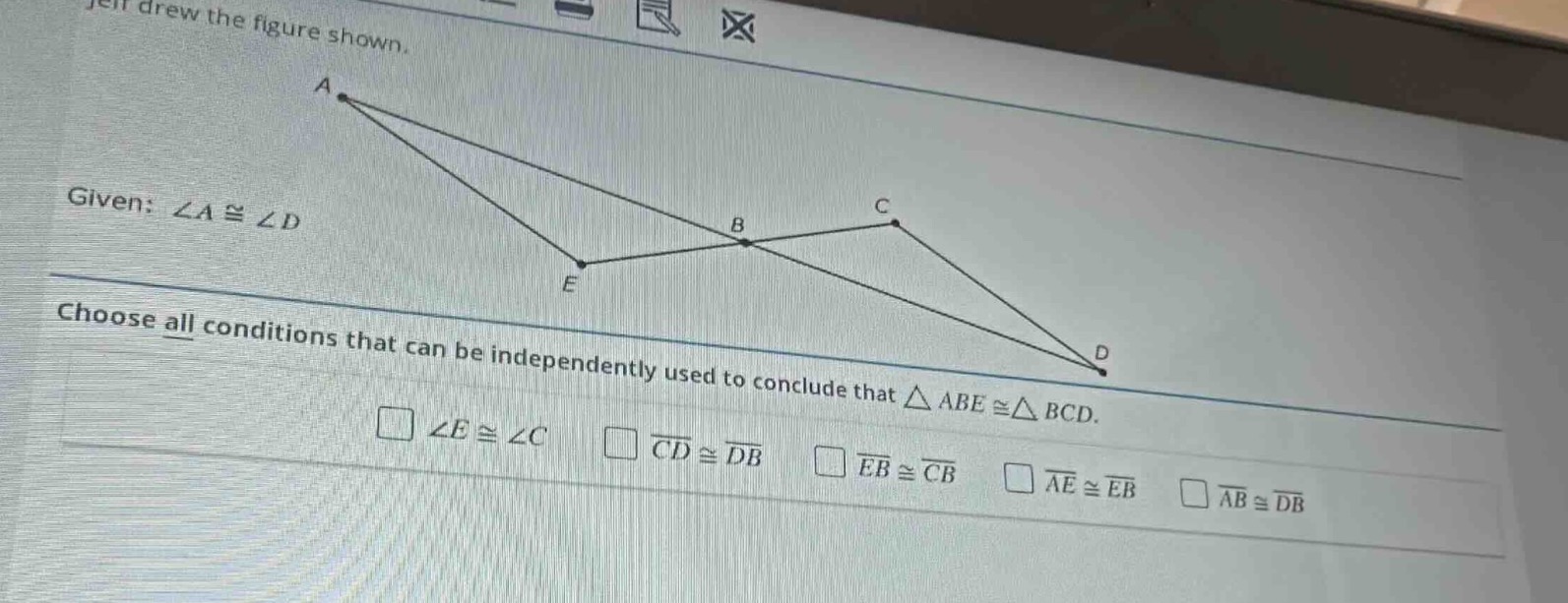
jeff drew the figure shown.
given: $angle a cong angle d$
choose all conditions that can be independently used to conclude that $\triangle abe cong \triangle bcd$.
$square angle e cong angle c$ $square overline{cd} cong overline{db}$ $square overline{eb} cong overline{cb}$ $square overline{ae} cong overline{eb}$ $square overline{ab} cong overline{db}$
Step1: Recall triangle congruence rules
We use ASA, AAS, SAS, SSS to test each condition, given $\angle A \cong \angle D$ and vertical angles $\angle ABE \cong \angle DBC$.
Step2: Test $\angle E \cong \angle C$
With $\angle A \cong \angle D$, $\angle E \cong \angle C$, and $\angle ABE \cong \angle DBC$, this is AAS congruence.
Step3: Test $\overline{CD} \cong \overline{DB}$
This pairs a side of $\triangle BCD$ with another side of the same triangle, not a corresponding side of $\triangle ABE$, so no congruence.
Step4: Test $\overline{EB} \cong \overline{CB}$
With $\angle A \cong \angle D$, $\angle ABE \cong \angle DBC$, and $\overline{EB} \cong \overline{CB}$, this is AAS congruence.
Step5: Test $\overline{AE} \cong \overline{EB}$
This is a pair of sides within $\triangle ABE$, not corresponding to $\triangle BCD$, so no congruence.
Step6: Test $\overline{AB} \cong \overline{DB}$
With $\angle A \cong \angle D$, $\overline{AB} \cong \overline{DB}$, and $\angle ABE \cong \angle DBC$, this is ASA congruence.

Snap & solve any problem in the app
Get step-by-step solutions on Sovi AI
Photo-based solutions with guided steps
Explore more problems and detailed explanations
$\boldsymbol{\angle E \cong \angle C}$, $\boldsymbol{\overline{EB} \cong \overline{CB}}$, $\boldsymbol{\overline{AB} \cong \overline{DB}}$