QUESTION IMAGE
Question
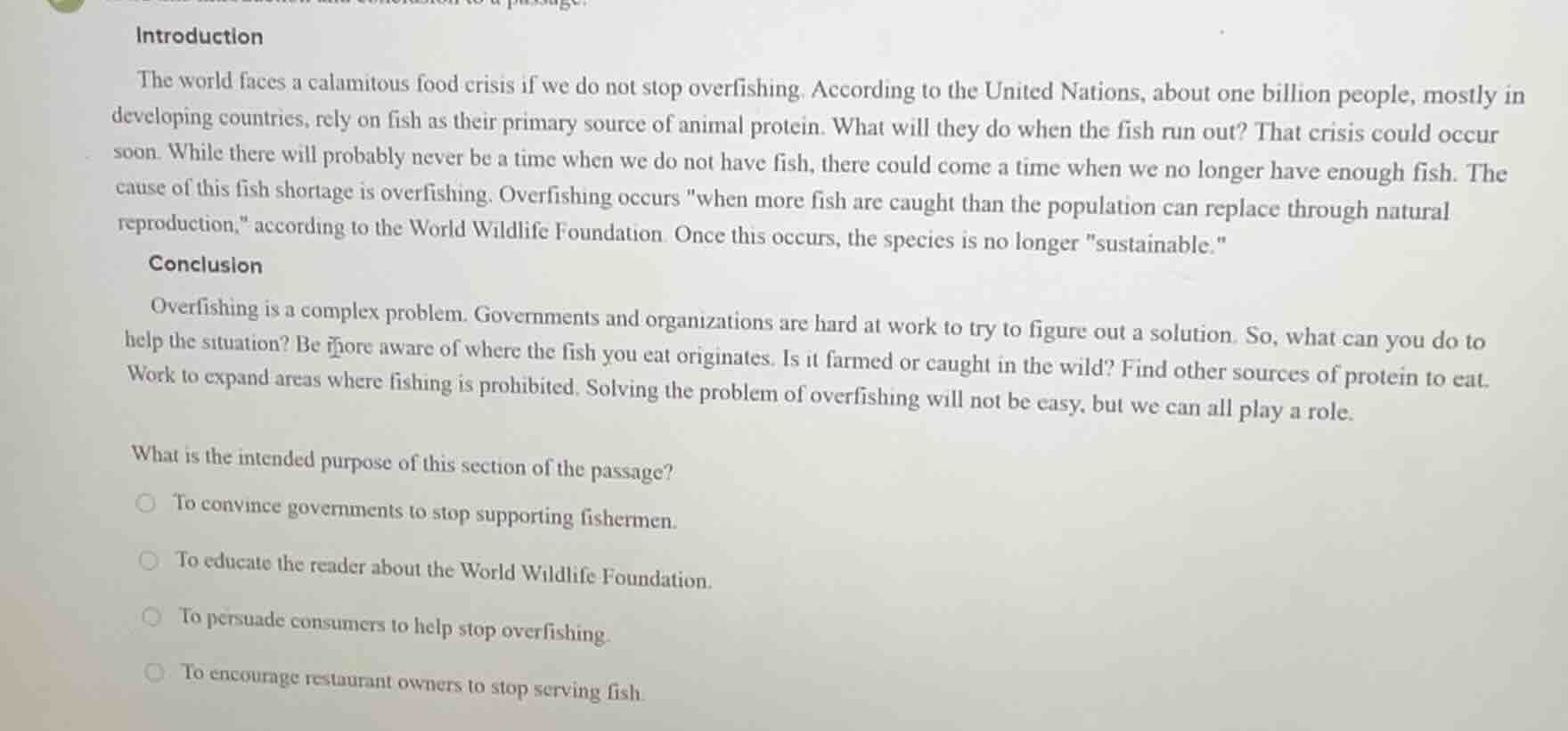
introduction
the world faces a calamitous food crisis if we do not stop overfishing. according to the united nations, about one billion people, mostly in developing countries, rely on fish as their primary source of animal protein. what will they do when the fish run out? that crisis could occur soon. while there will probably never be a time when we do not have fish, there could come a time when we no longer have enough fish. the cause of this fish shortage is overfishing. overfishing occurs \when more fish are caught than the population can replace through natural reproduction,\ according to the world wildlife foundation. once this occurs, the species is no longer \sustainable.\
conclusion
overfishing is a complex problem. governments and organizations are hard at work to try to figure out a solution. so, what can you do to help the situation? be more aware of where the fish you eat originates. is it farmed or caught in the wild? find other sources of protein to eat. work to expand areas where fishing is prohibited. solving the problem of overfishing will not be easy, but we can all play a role.
what is the intended purpose of this section of the passage?
to convince governments to stop supporting fishermen.
to educate the reader about the world wildlife foundation.
to persuade consumers to help stop overfishing.
to encourage restaurant owners to stop serving fish.
Analyze the text and identify the core message
The introduction highlights a "calamitous food crisis" caused by overfishing and notes that one billion people rely on fish as their primary protein source. The conclusion calls the reader to action with direct questions and suggestions: "Be more aware of where the fish you eat originates," "Find other sources of protein to eat," and "we can all play a role."
Evaluate the options against the text
- Option 1 ("To convince governments to stop supporting fishermen") is incorrect because the text focuses on individual consumer actions rather than government policy towards fishermen.
- Option 2 ("To educate the reader about the World Wildlife Foundation") is incorrect because the WWF is only mentioned once to provide a definition of overfishing.
- Option 3 ("To persuade consumers to help stop overfishing") is correct because the conclusion directly addresses the reader ("what can you do", "where the fish you eat originates", "sources of protein to eat") to encourage personal action.
- Option 4 ("To encourage restaurant owners to stop serving fish") is incorrect because the text is addressed to general consumers, not specifically restaurant owners.

Snap & solve any problem in the app
Get step-by-step solutions on Sovi AI
Photo-based solutions with guided steps
Explore more problems and detailed explanations
- To convince governments to stop supporting fishermen.
- To educate the reader about the World Wildlife Foundation.
- To persuade consumers to help stop overfishing. (Correct answer)
- To encourage restaurant owners to stop serving fish.