QUESTION IMAGE
Question
instructions: you are not allowed to consult any notes, books, ai, or the internet during this quiz. a scientific calculator (no graphing or text capabilities) is allowed on this quiz. show all of your work on each problem. good luck!
- given the graph of \\(f(x)\\) below, find each of the following:
(a) \\(f(0) =\\)
(b) \\(f(6) =\\)
(c) \\(f(7) =\\)
(d) \\(\lim_{x \to 6^-} f(x) =\\)
(e) \\(\lim_{x \to 6^+} f(x) =\\)
(f) \\(\lim_{x \to 6} f(x) =\\)
(g) \\(\lim_{x \to 7} f(x) =\\)
- is \\(f(x)\\) continuous at \\(x = 7\\)? justify your answer.
- is \\(f(x)\\) continuous at \\(x = 2\\)? justify your answer.
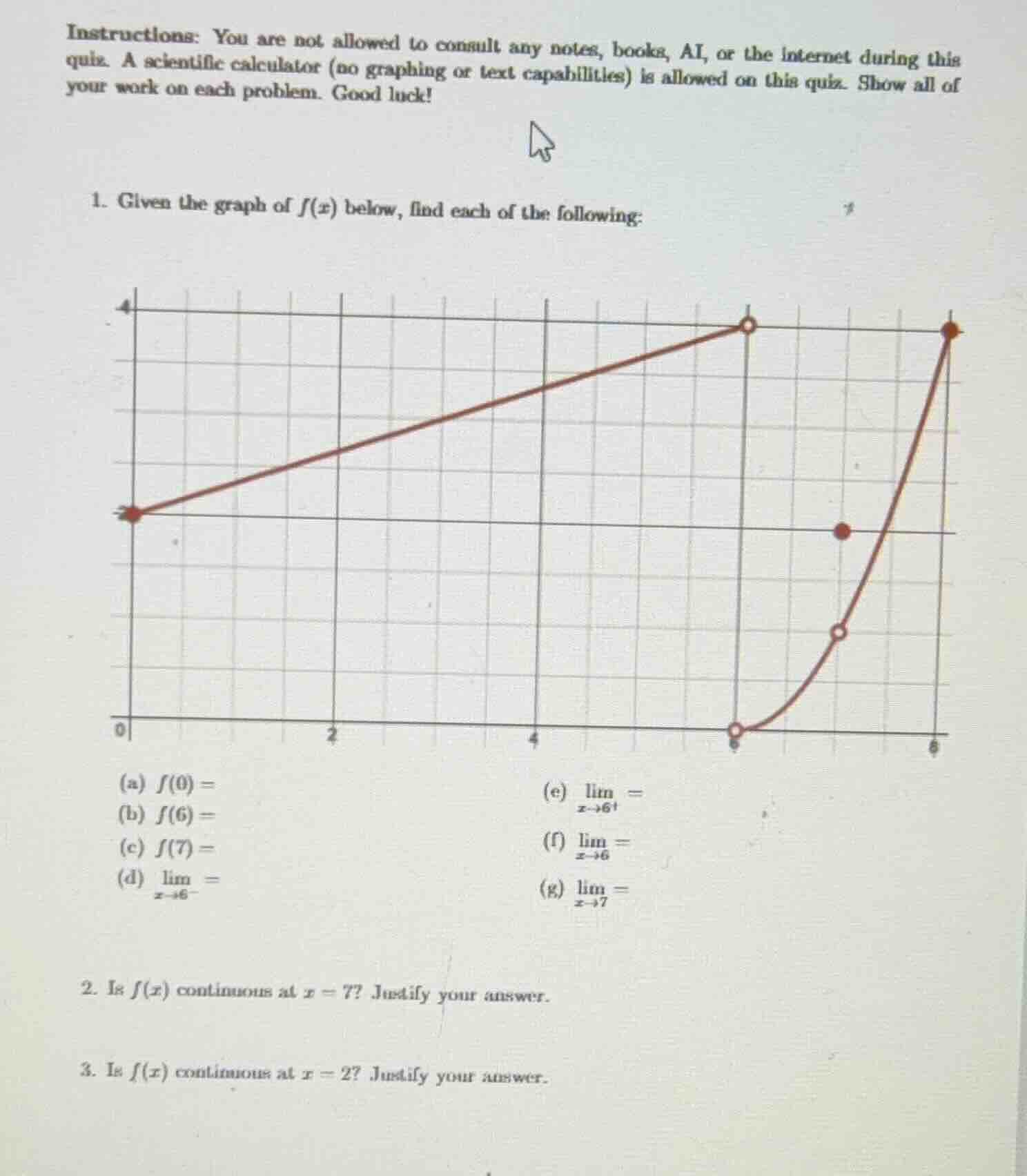
Analyze the graph and find values for Question 1
Let's examine the grid and the key points of the function \(f(x)\) on the interval \([0, 8]\):
- At \(x = 0\): There is a solid point at \((0, 2)\). Thus, \(f(0) = 2\).
- At \(x = 6\):
- The curve from the left approaches an open circle at \((6, 4)\). Thus, the left-hand limit is \(\lim_{x \to 6^-} f(x) = 4\).
- The curve to the right starts at an open circle at \((6, 0)\). Thus, the right-hand limit is \(\lim_{x \to 6^+} f(x) = 0\).
- Since the left-hand and right-hand limits are not equal, the two-sided limit \(\lim_{x \to 6} f(x)\) does not exist (DNE).
- There is no solid point at \(x = 6\), so \(f(6)\) is undefined (DNE).
- At \(x = 7\):
- There is an open circle on the curve at \((7, 1.5)\).
- There is a solid point plotted at \((7, 2)\). Thus, \(f(7) = 2\).
- The curve approaches the open circle from both sides, so \(\lim_{x \to 7} f(x) = 1.5\).
- At \(x = 8\): There is a solid point at \((8, 4)\).
Let's fill in the subparts of Question 1:
- (a) \(f(0) = 2\)
- (b) \(f(6) =\) Undefined (or DNE)
- (c) \(f(7) = 2\)
- (d) \(\lim_{x \to 6^-} f(x) = 4\)
- (e) \(\lim_{x \to 6^+} f(x) = 0\)
- (f) \(\lim_{x \to 6} f(x) =\) DNE
- (g) \(\lim_{x \to 7} f(x) = 1.5\)
Evaluate continuity at x = 7 for Question 2
For a function \(f(x)\) to be continuous at \(x = c\), three conditions must be met:
- \(f(c)\) is defined.
- \(\lim_{x \to c} f(x)\) exists.
- \(\lim_{x \to c} f(x) = f(c)\).
Let's check these conditions at \(x = 7\):
- \(f(7) = 2\) (defined).
- \(\lim_{x \to 7} f(x) = 1.5\) (exists).
- Since \(\lim_{x \to 7} f(x) = 1.5
eq f(7) = 2\), the third condition is violated.
Therefore, \(f(x)\) is not continuous at \(x = 7\).
Evaluate continuity at x = 2 for Question 3
Let's check the continuity conditions at \(x = 2\):
- Looking at the graph, at \(x = 2\), the curve is solid and unbroken. The value is \(f(2) = 2.5\).
- The curve approaches the same value from both the left and the right: \(\lim_{x \to 2^-} f(x) = 2.5\) and \(\lim_{x \to 2^+} f(x) = 2.5\). Thus, \(\lim_{x \to 2} f(x) = 2.5\).
- Since \(\lim_{x \to 2} f(x) = f(2) = 2.5\), all three conditions for continuity are satisfied.
Therefore, \(f(x)\) is continuous at \(x = 2\).

Snap & solve any problem in the app
Get step-by-step solutions on Sovi AI
Photo-based solutions with guided steps
Explore more problems and detailed explanations
Question 1
(a) \(f(0) = 2\)
(b) \(f(6) =\) Undefined (or DNE)
(c) \(f(7) = 2\)
(d) \(\lim_{x \to 6^-} f(x) = 4\)
(e) \(\lim_{x \to 6^+} f(x) = 0\)
(f) \(\lim_{x \to 6} f(x) =\) DNE
(g) \(\lim_{x \to 7} f(x) = 1.5\)
Question 2
No, \(f(x)\) is not continuous at \(x = 7\) because \(\lim_{x \to 7} f(x) = 1.5\), which does not equal the function value \(f(7) = 2\).
Question 3
Yes, \(f(x)\) is continuous at \(x = 2\) because \(\lim_{x \to 2} f(x) = f(2) = 2.5\).