Sovi.AI - AI Math Tutor

Scan to solve math questions

QUESTION IMAGE

in an insightful study about habitual behaviors, wood, quinn, and kashy…

Question

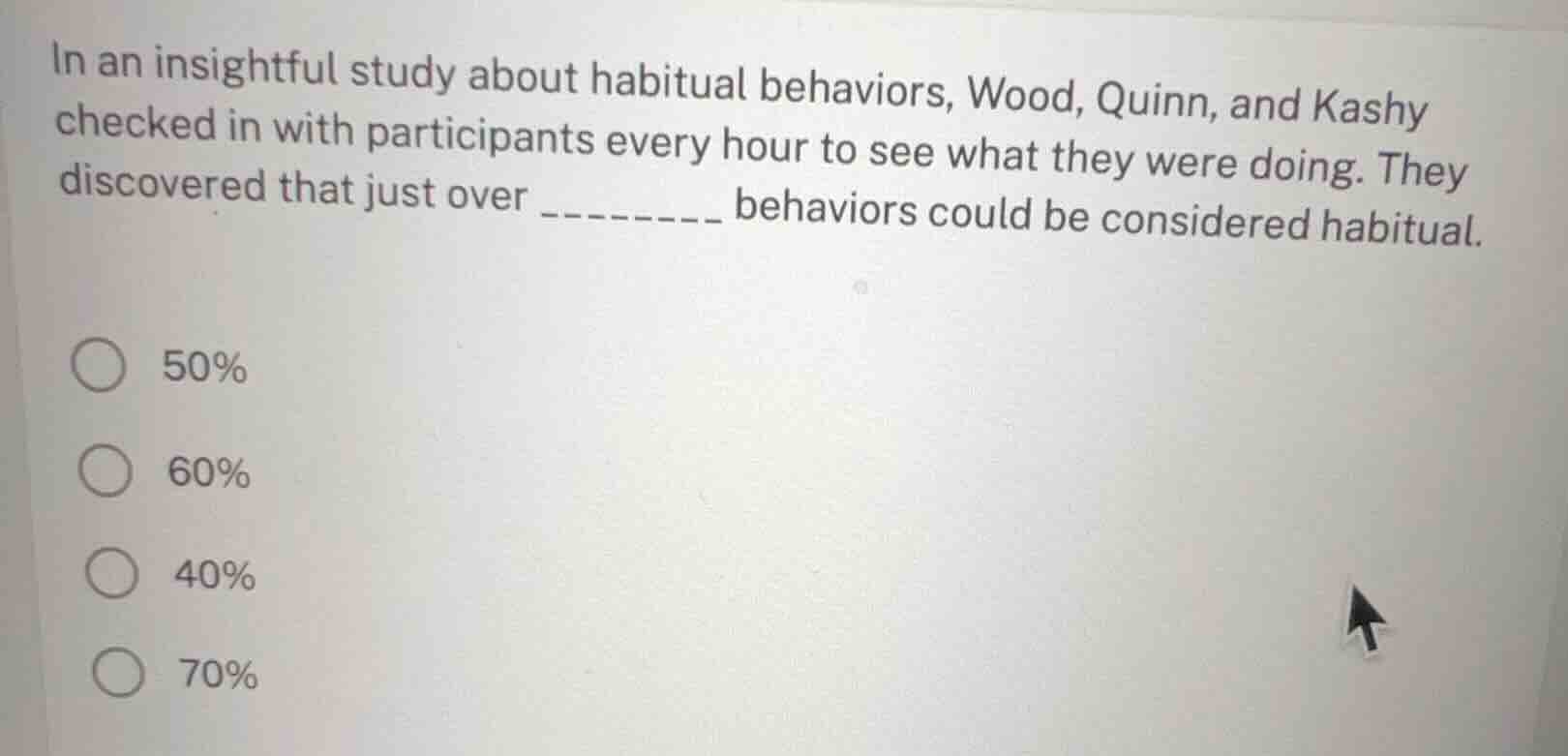
in an insightful study about habitual behaviors, wood, quinn, and kashy checked in with participants every hour to see what they were doing. they discovered that just over ________ behaviors could be considered habitual.

50%
60%
40%
70%

Explanation:

Response

<pre_analysis>
{
"quality": "clear",
"question_count": 1,
"skills_matched": [
"direct_cot",
"multiple_choice_formatter",
"explain_then_answer",
"tutor",
"mastery_adaptive_brevity"
],
"needs_drawing": false,
"concepts_used": [
"Habit Impact",
"Habit Formation Psychology"
],
"new_concepts": [
"Wood Quinn Kashy Study"
],
"current_concepts": [
"Habit Impact",
"Habit Formation Psychology",
"Wood Quinn Kashy Study"
]
}
</pre_analysis>

<reasoning>

Identify the study and findings

Using the Habit Formation Psychology and Habit Impact knowledge points

In their influential 2002 diary study, researchers Wendy Wood, Jeffrey M. Quinn, and Deborah A. Kashy tracked participants' daily activities using experience sampling. They found that approximately \(43\%\) of behaviors were performed almost daily in the same context, indicating that just over \(40\%\) of daily behaviors are habitual.

Match with the options

Comparing the study's finding of approximately \(43\%\) with the given choices:

  • \(50\%\)
  • \(60\%\)
  • \(40\%\)
  • \(70\%\)

The finding of \(43\%\) is described as "just over \(40\%\)".
</reasoning>

<answer>
<mcq-option>50%</mcq-option>
<mcq-option>60%</mcq-option>
<mcq-correct>40%</mcq-correct>
<mcq-option>70%</mcq-option>
</answer>

<post_analysis>
{
"subject": "Social Science",
"question_type": "Multiple Choice",
"knowledge_point": [
"Social Science",
"Psychology",
"Habit Formation Psychology"
]
}
</post_analysis>

Answer:

<pre_analysis>
{
"quality": "clear",
"question_count": 1,
"skills_matched": [
"direct_cot",
"multiple_choice_formatter",
"explain_then_answer",
"tutor",
"mastery_adaptive_brevity"
],
"needs_drawing": false,
"concepts_used": [
"Habit Impact",
"Habit Formation Psychology"
],
"new_concepts": [
"Wood Quinn Kashy Study"
],
"current_concepts": [
"Habit Impact",
"Habit Formation Psychology",
"Wood Quinn Kashy Study"
]
}
</pre_analysis>

<reasoning>

Identify the study and findings

Using the Habit Formation Psychology and Habit Impact knowledge points

In their influential 2002 diary study, researchers Wendy Wood, Jeffrey M. Quinn, and Deborah A. Kashy tracked participants' daily activities using experience sampling. They found that approximately \(43\%\) of behaviors were performed almost daily in the same context, indicating that just over \(40\%\) of daily behaviors are habitual.

Match with the options

Comparing the study's finding of approximately \(43\%\) with the given choices:

  • \(50\%\)
  • \(60\%\)
  • \(40\%\)
  • \(70\%\)

The finding of \(43\%\) is described as "just over \(40\%\)".
</reasoning>

<answer>
<mcq-option>50%</mcq-option>
<mcq-option>60%</mcq-option>
<mcq-correct>40%</mcq-correct>
<mcq-option>70%</mcq-option>
</answer>

<post_analysis>
{
"subject": "Social Science",
"question_type": "Multiple Choice",
"knowledge_point": [
"Social Science",
"Psychology",
"Habit Formation Psychology"
]
}
</post_analysis>