QUESTION IMAGE
Question
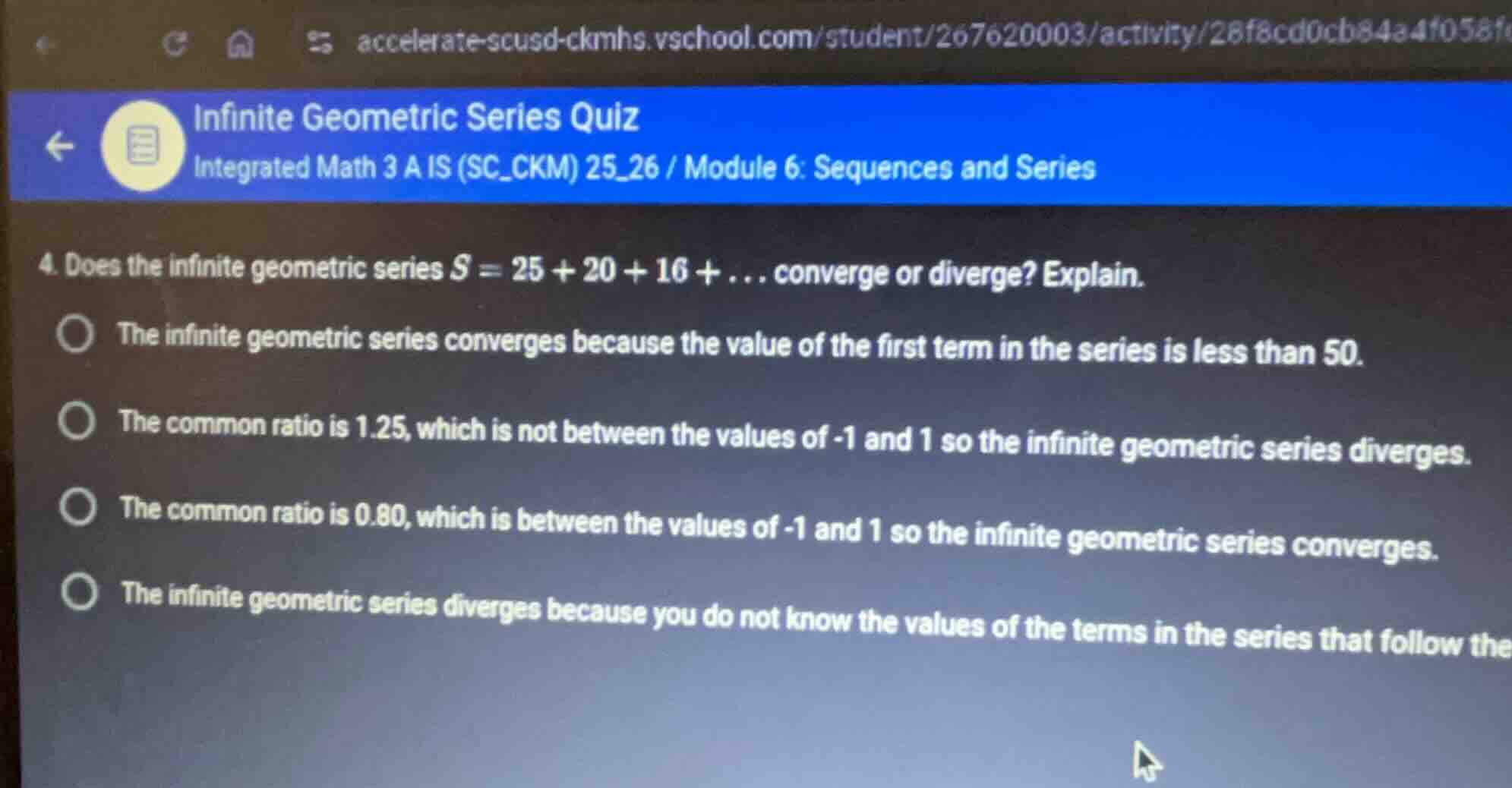
- does the infinite geometric series \\(s = 25 + 20 + 16 + \dots\\) converge or diverge? explain.
- the infinite geometric series converges because the value of the first term in the series is less than 50.
- the common ratio is 1.25, which is not between the values of -1 and 1 so the infinite geometric series diverges.
- the common ratio is 0.80, which is between the values of -1 and 1 so the infinite geometric series converges.
- the infinite geometric series diverges because you do not know the values of the terms in the series that follow the
🆕 New Concept Discovered: Infinite Geometric Series
How infinite sums settle on a single value
Step 1: Find the common ratio
To find the common ratio \( r \), divide the second term by the first term:
$$ r = \frac{20}{25} = 0.80 $$
Verify with the next term:
$$ \frac{16}{20} = 0.80 $$
Step 2: Determine convergence
An infinite geometric series converges if and only if the absolute value of its common ratio is strictly less than 1:
$$ |r| < 1 \implies -1 < r < 1 $$
Since \( r = 0.80 \), it lies between \(-1\) and \(1\). Therefore, the series converges.

Snap & solve any problem in the app
Get step-by-step solutions on Sovi AI
Photo-based solutions with guided steps
Explore more problems and detailed explanations
The common ratio is 0.80, which is between the values of -1 and 1 so the infinite geometric series converges.