QUESTION IMAGE
Question
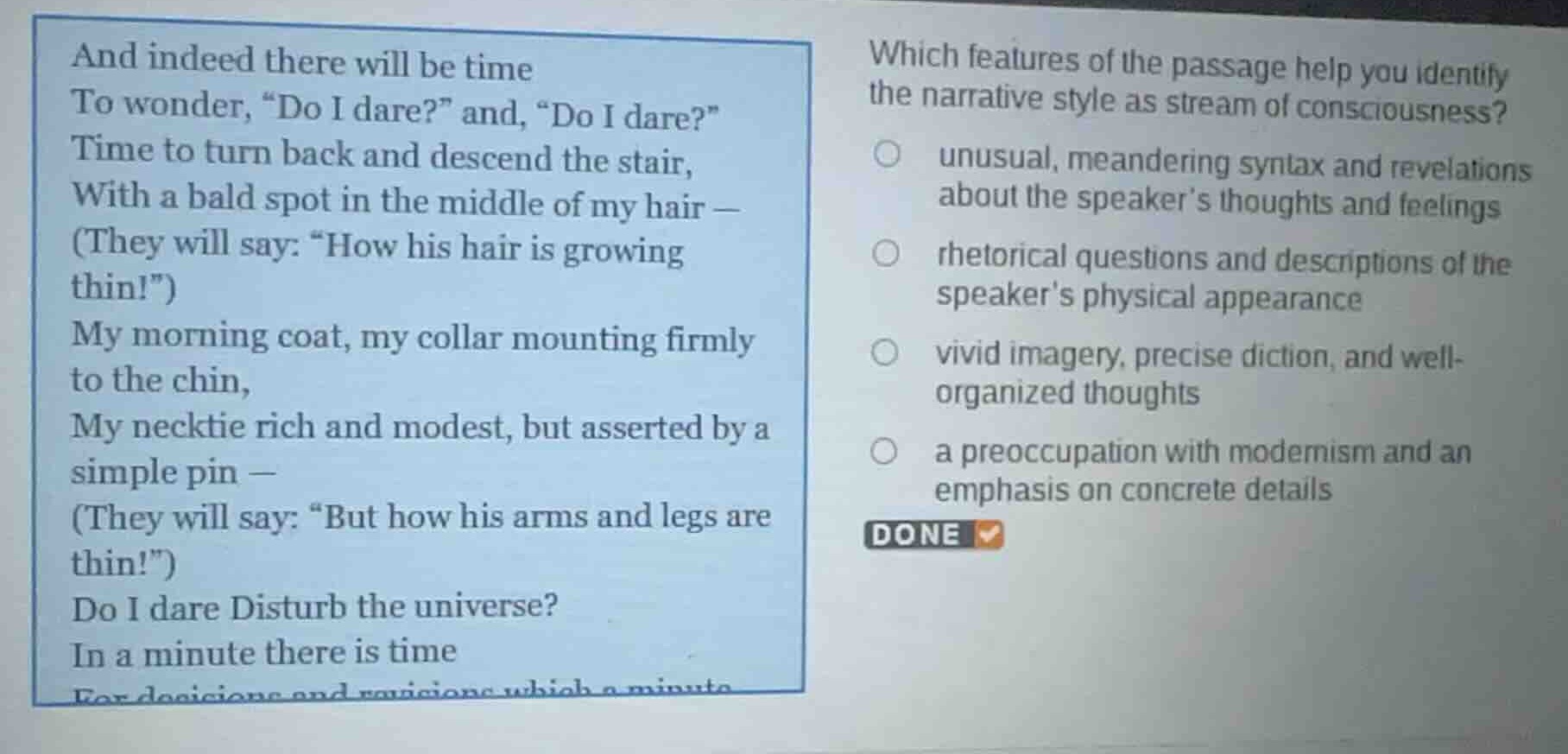
and indeed there will be time
to wonder, \do i dare?\ and, \do i dare?\
time to turn back and descend the stair,
with a bald spot in the middle of my hair -
(they will say: \how his hair is growing thin!\)
my morning coat, my collar mounting firmly to the chin,
my necktie rich and modest, but asserted by a simple pin -
(they will say: \but how his arms and legs are thin!\)
do i dare disturb the universe?
in a minute there is time
for decisions and revisions which a minute
which features of the passage help you identify the narrative style as stream of consciousness?
unusual, meandering syntax and revelations about the speakers thoughts and feelings
rhetorical questions and descriptions of the speakers physical appearance
vivid imagery, precise diction, and well-organized thoughts
a preoccupation with modernism and an emphasis on concrete details
<pre_analysis>
{
"quality": "clear",
"question_count": 1,
"skills_matched": [
"direct_cot",
"multiple_choice_formatter",
"explain_then_answer",
"tutor"
],
"needs_drawing": false,
"concepts_used": [
"Modernist Poetry",
"Prufrock Analysis"
],
"new_concepts": [
"Stream of Consciousness",
"Narrative Style"
],
"current_concepts": [
"Modernist Poetry",
"Prufrock Analysis",
"Stream of Consciousness",
"Narrative Style"
]
}
</pre_analysis>
<reasoning>
Analyze the passage style
The passage is an excerpt from T.S. Eliot's "The Love Song of J. Alfred Prufrock," a classic piece of Modernist Poetry. The text captures the internal monologue of the speaker, jumping from anxious thoughts about aging ("bald spot," "hair is growing thin") to social self-consciousness ("My morning coat," "My necktie") and existential hesitation ("Do I dare / Disturb the universe?"). This associative, non-linear progression of thoughts represents the inner workings of a mind.
Define stream of consciousness
Using our understanding of Prufrock Analysis, stream of consciousness is a narrative technique that attempts to depict the many thoughts and feelings which pass through the mind of a character. It is characterized by a flow of thoughts that is often associative, fragmented, and non-linear, rather than structured or logically organized.
Evaluate the options
- Option 1: "unusual, meandering syntax and revelations about the speaker's thoughts and feelings" directly aligns with the definition of stream of consciousness. The syntax wanders (meanders) as the speaker's mind drifts from one self-doubt to another, revealing deep-seated anxieties.
- Option 2: "rhetorical questions and descriptions of the speaker's physical appearance" describes elements present in the poem, but these features alone do not define the narrative style as stream of consciousness.
- Option 3: "vivid imagery, precise diction, and well-organized thoughts" is incorrect because stream of consciousness is characterized by fragmented and associative thoughts rather than "well-organized" ones.
- Option 4: "a preoccupation with modernism and an emphasis on concrete details" describes thematic elements but does not capture the stylistic essence of stream of consciousness.
</reasoning>
<answer>
<mcq-correct>(A) unusual, meandering syntax and revelations about the speaker's thoughts and feelings</mcq-correct>
<mcq-option>(B) rhetorical questions and descriptions of the speaker's physical appearance</mcq-option>
<mcq-option>(C) vivid imagery, precise diction, and well-organized thoughts</mcq-option>
<mcq-option>(D) a preoccupation with modernism and an emphasis on concrete details</mcq-option>
</answer>
<post_analysis>
{
"subject": "Others",
"question_type": "Multiple Choice",
"knowledge_point": [
"Others",
"Literature",
"Stream of Consciousness"
]
}
</post_analysis>
Snap & solve any problem in the app
Get step-by-step solutions on Sovi AI
Photo-based solutions with guided steps
Explore more problems and detailed explanations
<pre_analysis>
{
"quality": "clear",
"question_count": 1,
"skills_matched": [
"direct_cot",
"multiple_choice_formatter",
"explain_then_answer",
"tutor"
],
"needs_drawing": false,
"concepts_used": [
"Modernist Poetry",
"Prufrock Analysis"
],
"new_concepts": [
"Stream of Consciousness",
"Narrative Style"
],
"current_concepts": [
"Modernist Poetry",
"Prufrock Analysis",
"Stream of Consciousness",
"Narrative Style"
]
}
</pre_analysis>
<reasoning>
Analyze the passage style
The passage is an excerpt from T.S. Eliot's "The Love Song of J. Alfred Prufrock," a classic piece of Modernist Poetry. The text captures the internal monologue of the speaker, jumping from anxious thoughts about aging ("bald spot," "hair is growing thin") to social self-consciousness ("My morning coat," "My necktie") and existential hesitation ("Do I dare / Disturb the universe?"). This associative, non-linear progression of thoughts represents the inner workings of a mind.
Define stream of consciousness
Using our understanding of Prufrock Analysis, stream of consciousness is a narrative technique that attempts to depict the many thoughts and feelings which pass through the mind of a character. It is characterized by a flow of thoughts that is often associative, fragmented, and non-linear, rather than structured or logically organized.
Evaluate the options
- Option 1: "unusual, meandering syntax and revelations about the speaker's thoughts and feelings" directly aligns with the definition of stream of consciousness. The syntax wanders (meanders) as the speaker's mind drifts from one self-doubt to another, revealing deep-seated anxieties.
- Option 2: "rhetorical questions and descriptions of the speaker's physical appearance" describes elements present in the poem, but these features alone do not define the narrative style as stream of consciousness.
- Option 3: "vivid imagery, precise diction, and well-organized thoughts" is incorrect because stream of consciousness is characterized by fragmented and associative thoughts rather than "well-organized" ones.
- Option 4: "a preoccupation with modernism and an emphasis on concrete details" describes thematic elements but does not capture the stylistic essence of stream of consciousness.
</reasoning>
<answer>
<mcq-correct>(A) unusual, meandering syntax and revelations about the speaker's thoughts and feelings</mcq-correct>
<mcq-option>(B) rhetorical questions and descriptions of the speaker's physical appearance</mcq-option>
<mcq-option>(C) vivid imagery, precise diction, and well-organized thoughts</mcq-option>
<mcq-option>(D) a preoccupation with modernism and an emphasis on concrete details</mcq-option>
</answer>
<post_analysis>
{
"subject": "Others",
"question_type": "Multiple Choice",
"knowledge_point": [
"Others",
"Literature",
"Stream of Consciousness"
]
}
</post_analysis>