QUESTION IMAGE
Question
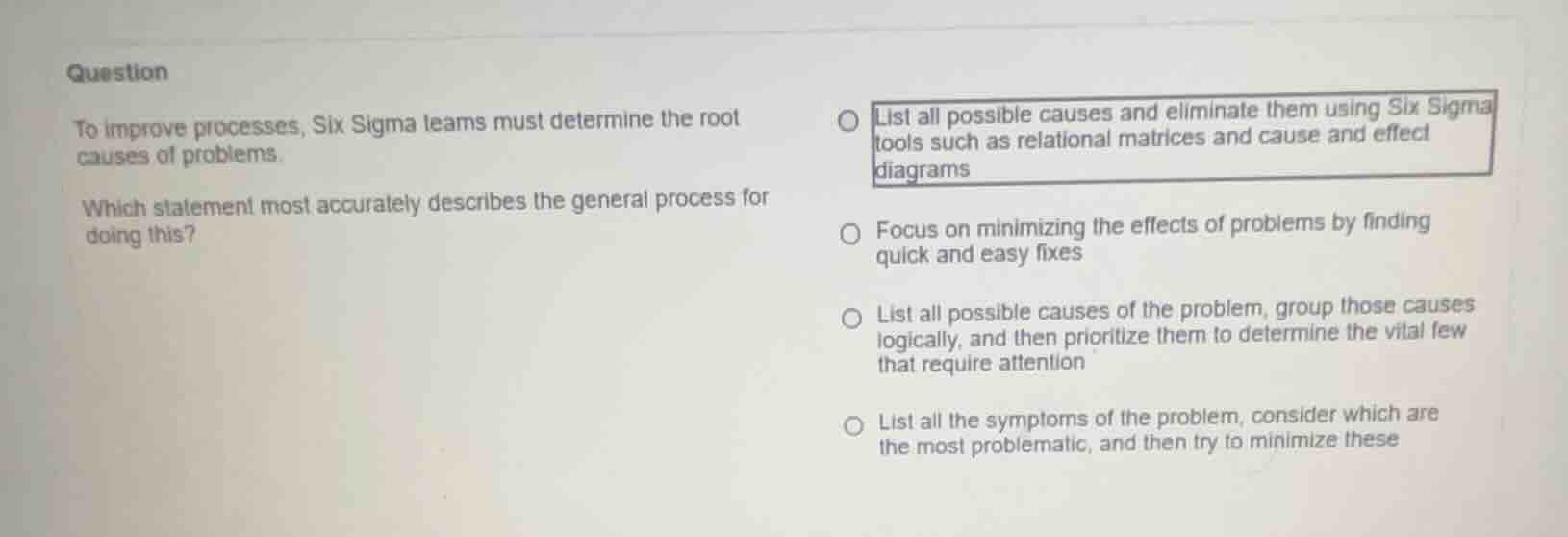
to improve processes, six sigma teams must determine the root causes of problems.
which statement most accurately describes the general process for doing this?
- list all possible causes and eliminate them using six sigma tools such as relational matrices and cause and effect diagrams
- focus on minimizing the effects of problems by finding quick and easy fixes
- list all possible causes of the problem, group those causes logically, and then prioritize them to determine the vital few that require attention
- list all the symptoms of the problem, consider which are the most problematic, and then try to minimize these
Analyze the goal of root cause analysis
The question asks for the statement that most accurately describes the general process for determining the root causes of problems within Six Sigma Teams. The goal of Root Cause Analysis is to move from a broad list of potential issues to identifying the actual underlying factors that cause a defect or process failure.
Evaluate the first option
The first option states: "List all possible causes and eliminate them using Six Sigma tools such as relational matrices and cause and effect diagrams." While cause-and-effect diagrams (like fishbone diagrams) are used to brainstorm and list causes, you do not simply "eliminate" causes without systematic grouping and prioritization. Thus, this is not the most complete description of the general process.
Evaluate the second option
The second option states: "Focus on minimizing the effects of problems by finding quick and easy fixes." This contradicts the core philosophy of Six Sigma and Root Cause Analysis, which seeks permanent, data-driven solutions to prevent recurrence rather than temporary "band-aid" fixes.
Evaluate the third option
The third option states: "List all possible causes of the problem, group those causes logically, and then prioritize them to determine the vital few that require attention." This perfectly describes the structured funneling process of Root Cause Analysis:
- Brainstorming (listing all possible causes).
- Affinity grouping (organizing them logically).
- Prioritizing (using tools like Pareto analysis to identify the "vital few" root causes).
Evaluate the fourth option
The fourth option states: "List all the symptoms of the problem, consider which are the most problematic, and then try to minimize these." This focuses on managing symptoms rather than identifying and resolving the actual root causes, which is contrary to Six Sigma methodologies.

Snap & solve any problem in the app
Get step-by-step solutions on Sovi AI
Photo-based solutions with guided steps
Explore more problems and detailed explanations
- (A) List all possible causes and eliminate them using Six Sigma tools such as relational matrices and cause and effect diagrams
- (B) Focus on minimizing the effects of problems by finding quick and easy fixes
- (C) List all possible causes of the problem, group those causes logically, and then prioritize them to determine the vital few that require attention (Correct answer)
- (D) List all the symptoms of the problem, consider which are the most problematic, and then try to minimize these