QUESTION IMAGE
Question
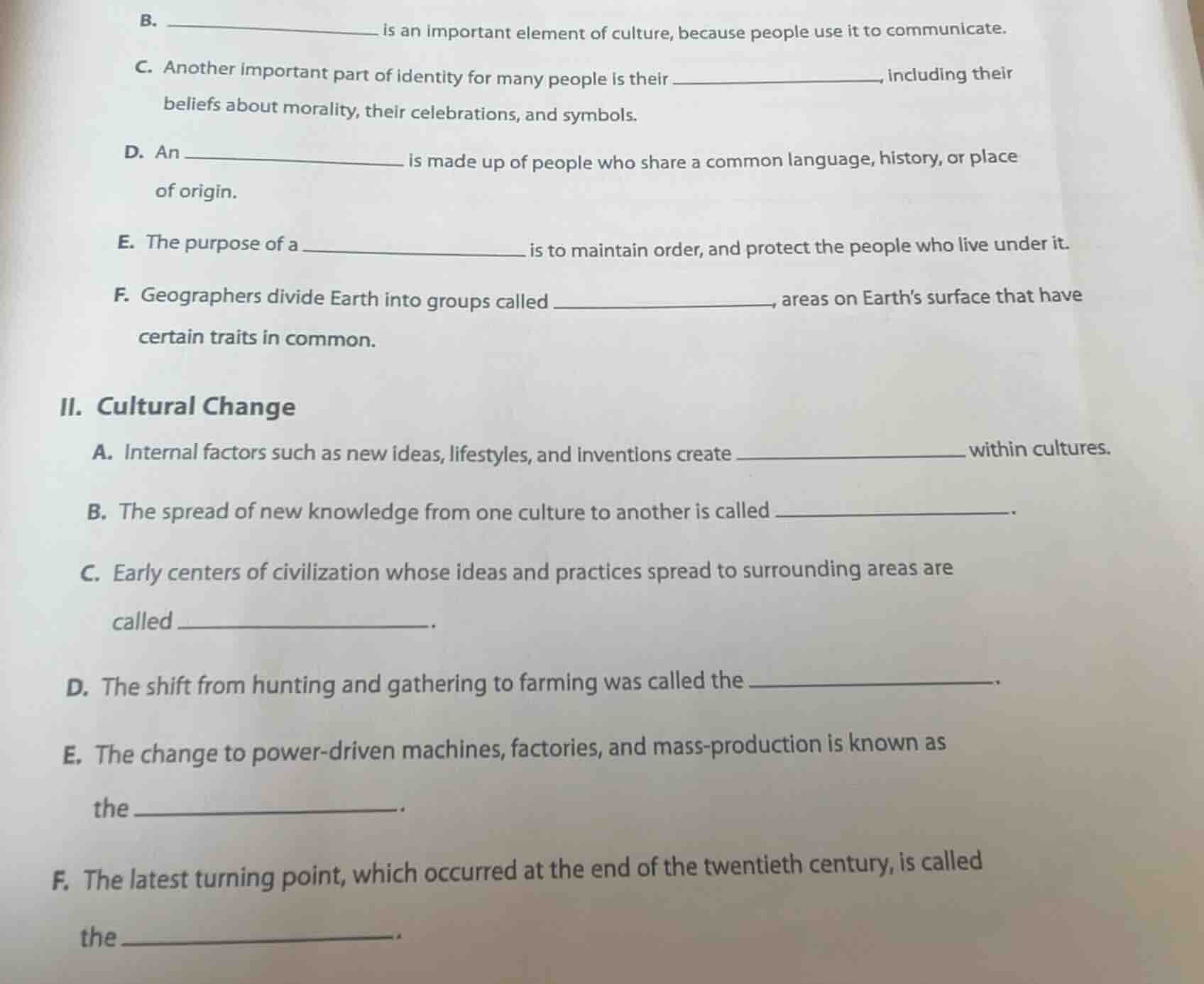
b. _________ is an important element of culture, because people use it to communicate.
c. another important part of identity for many people is their _________, including their beliefs about morality, their celebrations, and symbols.
d. an _________ is made up of people who share a common language, history, or place of origin.
e. the purpose of a _________ is to maintain order, and protect the people who live under it.
f. geographers divide earth into groups called _________, areas on earths surface that have certain traits in common.
ii. cultural change
a. internal factors such as new ideas, lifestyles, and inventions create _________ within cultures.
b. the spread of new knowledge from one culture to another is called _________.
c. early centers of civilization whose ideas and practices spread to surrounding areas are called _________.
d. the shift from hunting and gathering to farming was called the _________.
e. the change to power-driven machines, factories, and mass-production is known as the _________.
f. the latest turning point, which occurred at the end of the twentieth century, is called the _________.
Identify cultural elements
The first section contains sentences describing core elements of culture and human geography.
- Sentence B: "______ is an important element of culture, because people use it to communicate." The primary tool humans use to communicate is language.
- Sentence C: "Another important part of identity for many people is their ______, including their beliefs about morality, their celebrations, and symbols." Morality, celebrations, and symbols are core components of religion.
- Sentence D: "An ______ is made up of people who share a common language, history, or place of origin." A group sharing these traits is an ethnic group.
- Sentence E: "The purpose of a ______ is to maintain order, and protect the people who live under it." The institution designed to maintain order and protect citizens is a government.
- Sentence F: "Geographers divide Earth into groups called ______, areas on Earth's surface that have certain traits in common." Areas sharing common cultural traits are called culture regions.
Identify cultural change factors
The second section, titled "II. Cultural Change," focuses on how cultures evolve and interact.
- Sentence A: "Internal factors such as new ideas, lifestyles, and inventions create ______ within cultures." Internal developments that bring about change are called change (or innovation).
- Sentence B: "The spread of new knowledge from one culture to another is called ______." The geographical term for the spreading of cultural beliefs and social activities is cultural diffusion (or diffusion).
- Sentence C: "Early centers of civilization whose ideas and practices spread to surrounding areas are called ______." These influential historical centers are known as culture hearths.
- Sentence D: "The shift from hunting and gathering to farming was called the ______." This major historical transition is the Agricultural Revolution.
- Sentence E: "The change to power-driven machines, factories, and mass-production is known as the ______." This period of rapid industrial growth is the Industrial Revolution.
- Sentence F: "The latest turning point, which occurred at the end of the twentieth century, is called the ______." The rapid shift to computer-based technology is the Information Revolution.

Snap & solve any problem in the app
Get step-by-step solutions on Sovi AI
Photo-based solutions with guided steps
Explore more problems and detailed explanations
Question 1
B. <blank>Language</blank> is an important element of culture, because people use it to communicate.
Question 2
C. Another important part of identity for many people is their <blank>religion</blank>, including their beliefs about morality, their celebrations, and symbols.
Question 3
D. An <blank>ethnic group</blank> is made up of people who share a common language, history, or place of origin.
Question 4
E. The purpose of a <blank>government</blank> is to maintain order, and protect the people who live under it.
Question 5
F. Geographers divide Earth into groups called <blank>culture regions</blank>, areas on Earth's surface that have certain traits in common.
Question 6
A. Internal factors such as new ideas, lifestyles, and inventions create <blank>change</blank> within cultures.
Question 7
B. The spread of new knowledge from one culture to another is called <blank>cultural diffusion</blank>.
Question 8
C. Early centers of civilization whose ideas and practices spread to surrounding areas are called <blank>culture hearths</blank>.
Question 9
D. The shift from hunting and gathering to farming was called the <blank>Agricultural Revolution</blank>.
Question 10
E. The change to power-driven machines, factories, and mass-production is known as the <blank>Industrial Revolution</blank>.
Question 11
F. The latest turning point, which occurred at the end of the twentieth century, is called the <blank>Information Revolution</blank>.