QUESTION IMAGE
Question
identifying complex characters
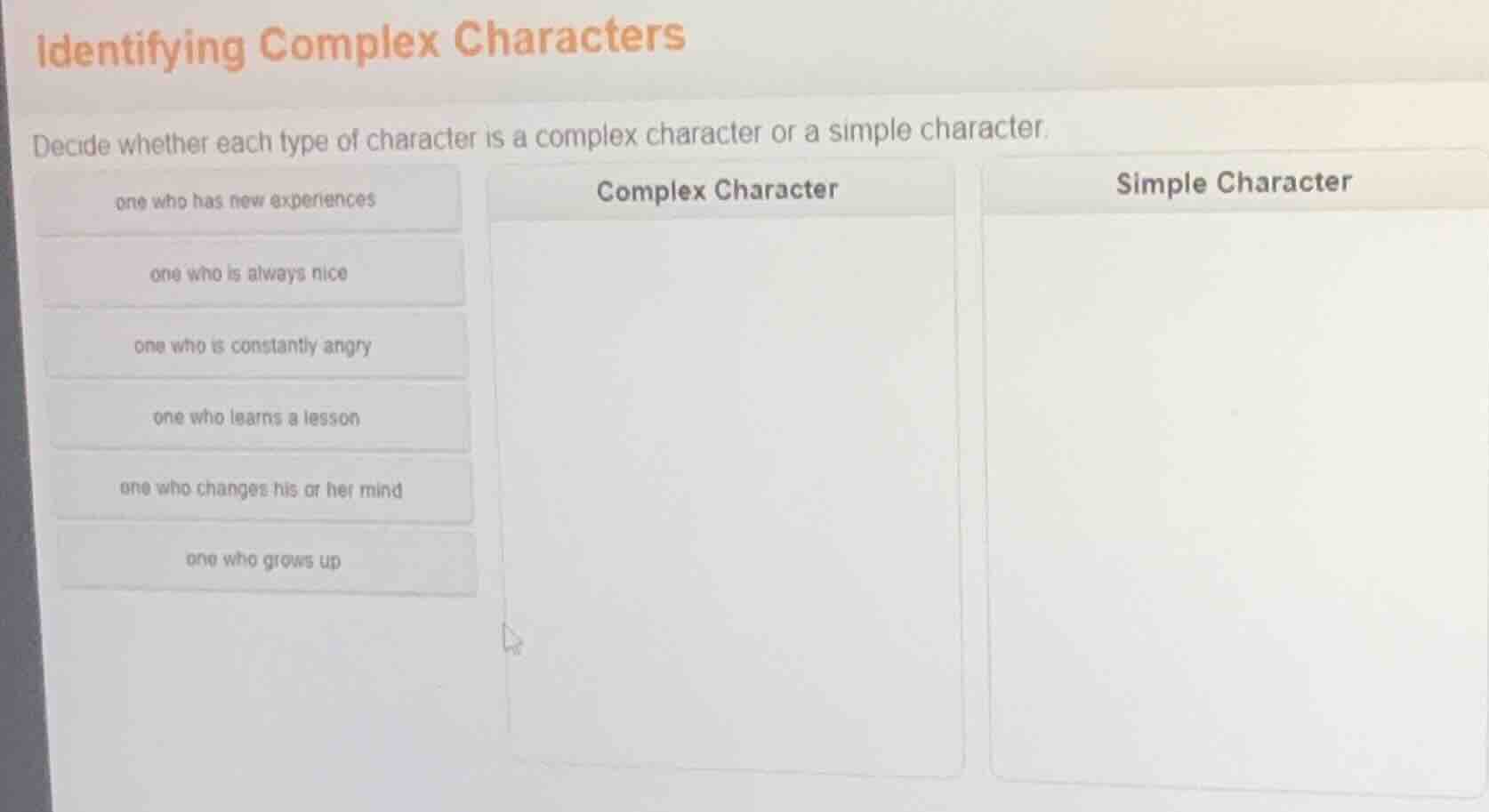
decide whether each type of character is a complex character or a simple character.
options:
- one who has new experiences
- one who is always nice
- one who is constantly angry
- one who learns a lesson
- one who changes his or her mind
- one who grows up
categories:
- complex character
- simple character
Define complex and simple characters
To categorize each description, we must first understand the literary definitions of complex (round/dynamic) and simple (flat/static) characters. A complex character is multi-dimensional, undergoes internal change, learns lessons, and grows through experiences. A simple character is one-dimensional, defined by a single dominant trait, and remains unchanged throughout the narrative.
Analyze the dynamic descriptions
Let's evaluate the descriptions that involve change, growth, or internal development:
- "one who has new experiences": Having and reacting to new experiences shapes a character's perspective, contributing to complexity.
- "one who learns a lesson": Learning a lesson represents internal growth and a shift in understanding, which is a hallmark of a complex character.
- "one who changes his or her mind": Changing one's mind shows internal conflict, decision-making, and cognitive flexibility, indicating complexity.
- "one who grows up": Growing up involves maturity, psychological development, and personal evolution over time, which defines a dynamic, complex character.
Analyze the static descriptions
Now let's evaluate the descriptions that represent unchanging, single-dimensional traits:
- "one who is always nice": Being "always nice" represents a single, unchanging personality trait with no internal conflict or variation, making the character simple.
- "one who is constantly angry": Being "constantly angry" likewise represents a flat, one-dimensional emotional state that does not change, defining a simple character.
Organize the final classification
We group the analyzed descriptions into their respective categories:
- Complex Character: "one who has new experiences", "one who learns a lesson", "one who changes his or her mind", "one who grows up".
- Simple Character: "one who is always nice", "one who is constantly angry".

Snap & solve any problem in the app
Get step-by-step solutions on Sovi AI
Photo-based solutions with guided steps
Explore more problems and detailed explanations
| Complex Character | Simple Character |
|---|---|
| one who learns a lesson | one who is constantly angry |
| one who changes his or her mind | |
| one who grows up |