Sovi.AI - AI Math Tutor

Scan to solve math questions

QUESTION IMAGE

identify the structure labeled d. nail bed nail matrix lunula hyponychi…

Question

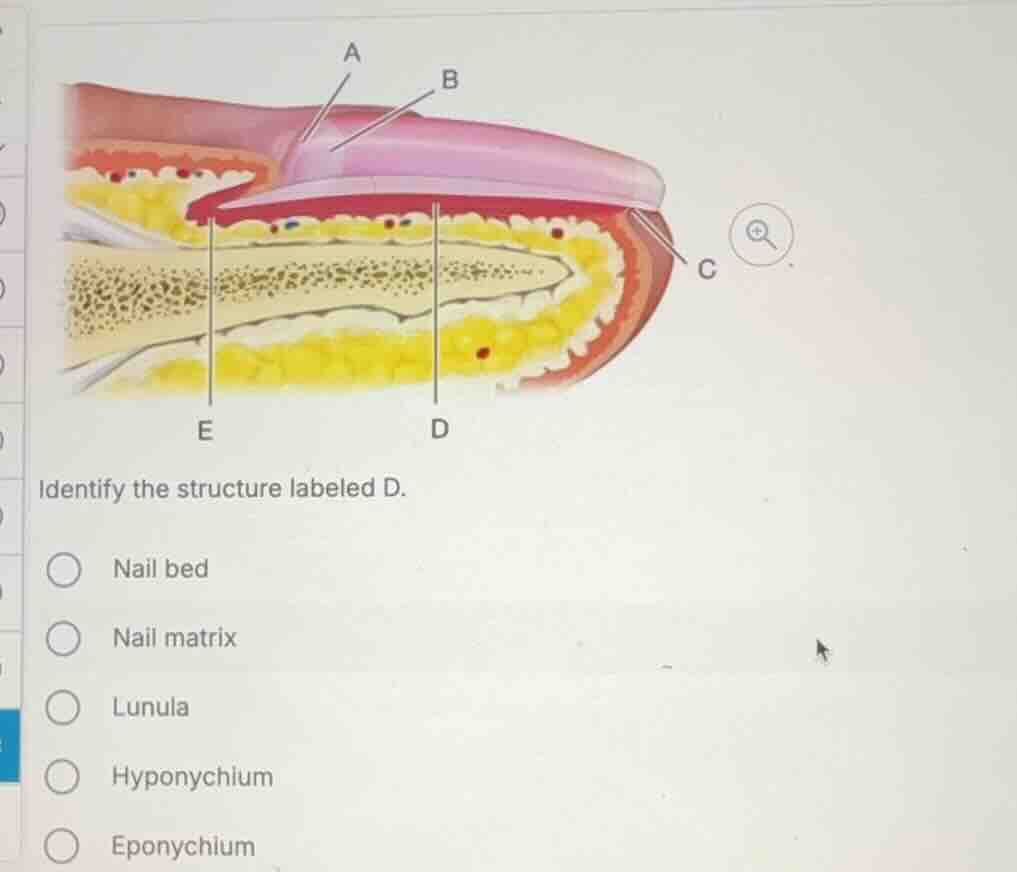
identify the structure labeled d.

nail bed
nail matrix
lunula
hyponychium
eponychium

Explanation:

Response

<pre_analysis>
{
"quality": "clear",
"question_count": 1,
"skills_matched": [
"direct_cot",
"multiple_choice_formatter",
"explain_then_answer",
"tutor"
],
"needs_drawing": false,
"concepts_used": [
"Integumentary System Anatomy"
],
"new_concepts": [
"Nail Anatomy",
"Nail Bed"
],
"current_concepts": [
"Integumentary System Anatomy",
"Nail Anatomy",
"Nail Bed"
]
}
</pre_analysis>

<reasoning>

Analyze the anatomical diagram of the nail

The diagram shows a sagittal section of a human fingertip, highlighting the structures of the nail apparatus. Let's identify each labeled part:

  • A points to the eponychium (cuticle), which is the fold of skin at the proximal end of the nail.
  • B points to the lunula, the crescent-shaped whitish area at the base of the nail.
  • C points to the hyponychium, the thickened stratum corneum beneath the free edge of the nail.
  • D points to the nail bed, the vascular epidermis beneath the nail plate.
  • E points to the nail matrix, the thickened proximal portion of the nail bed responsible for nail growth.

Verify the label for D

Label D specifically points to the layer of skin directly beneath the nail plate (the hard part of the nail). This region is known as the nail bed.

Match with the multiple-choice options

Comparing our identification with the provided options:

  • Nail bed: Matches label D.
  • Nail matrix: Matches label E.
  • Lunula: Matches label B.
  • Hyponychium: Matches label C.
  • Eponymichium (Eponychium): Matches label A.

Therefore, the correct option is "Nail bed".
</reasoning>

<answer>
<mcq-correct>Nail bed</mcq-correct>
<mcq-option>Nail matrix</mcq-option>
<mcq-option>Lunula</mcq-option>
<mcq-option>Hyponychium</mcq-option>
<mcq-option>Eponychium</mcq-option>
</answer>

<post_analysis>
{
"subject": "Natural Science",
"question_type": "Multiple Choice",
"knowledge_point": [
"Natural Science",
"Biology",
"Integumentary System Anatomy"
]
}
</post_analysis>

Answer:

<pre_analysis>
{
"quality": "clear",
"question_count": 1,
"skills_matched": [
"direct_cot",
"multiple_choice_formatter",
"explain_then_answer",
"tutor"
],
"needs_drawing": false,
"concepts_used": [
"Integumentary System Anatomy"
],
"new_concepts": [
"Nail Anatomy",
"Nail Bed"
],
"current_concepts": [
"Integumentary System Anatomy",
"Nail Anatomy",
"Nail Bed"
]
}
</pre_analysis>

<reasoning>

Analyze the anatomical diagram of the nail

The diagram shows a sagittal section of a human fingertip, highlighting the structures of the nail apparatus. Let's identify each labeled part:

  • A points to the eponychium (cuticle), which is the fold of skin at the proximal end of the nail.
  • B points to the lunula, the crescent-shaped whitish area at the base of the nail.
  • C points to the hyponychium, the thickened stratum corneum beneath the free edge of the nail.
  • D points to the nail bed, the vascular epidermis beneath the nail plate.
  • E points to the nail matrix, the thickened proximal portion of the nail bed responsible for nail growth.

Verify the label for D

Label D specifically points to the layer of skin directly beneath the nail plate (the hard part of the nail). This region is known as the nail bed.

Match with the multiple-choice options

Comparing our identification with the provided options:

  • Nail bed: Matches label D.
  • Nail matrix: Matches label E.
  • Lunula: Matches label B.
  • Hyponychium: Matches label C.
  • Eponymichium (Eponychium): Matches label A.

Therefore, the correct option is "Nail bed".
</reasoning>

<answer>
<mcq-correct>Nail bed</mcq-correct>
<mcq-option>Nail matrix</mcq-option>
<mcq-option>Lunula</mcq-option>
<mcq-option>Hyponychium</mcq-option>
<mcq-option>Eponychium</mcq-option>
</answer>

<post_analysis>
{
"subject": "Natural Science",
"question_type": "Multiple Choice",
"knowledge_point": [
"Natural Science",
"Biology",
"Integumentary System Anatomy"
]
}
</post_analysis>