QUESTION IMAGE
Question
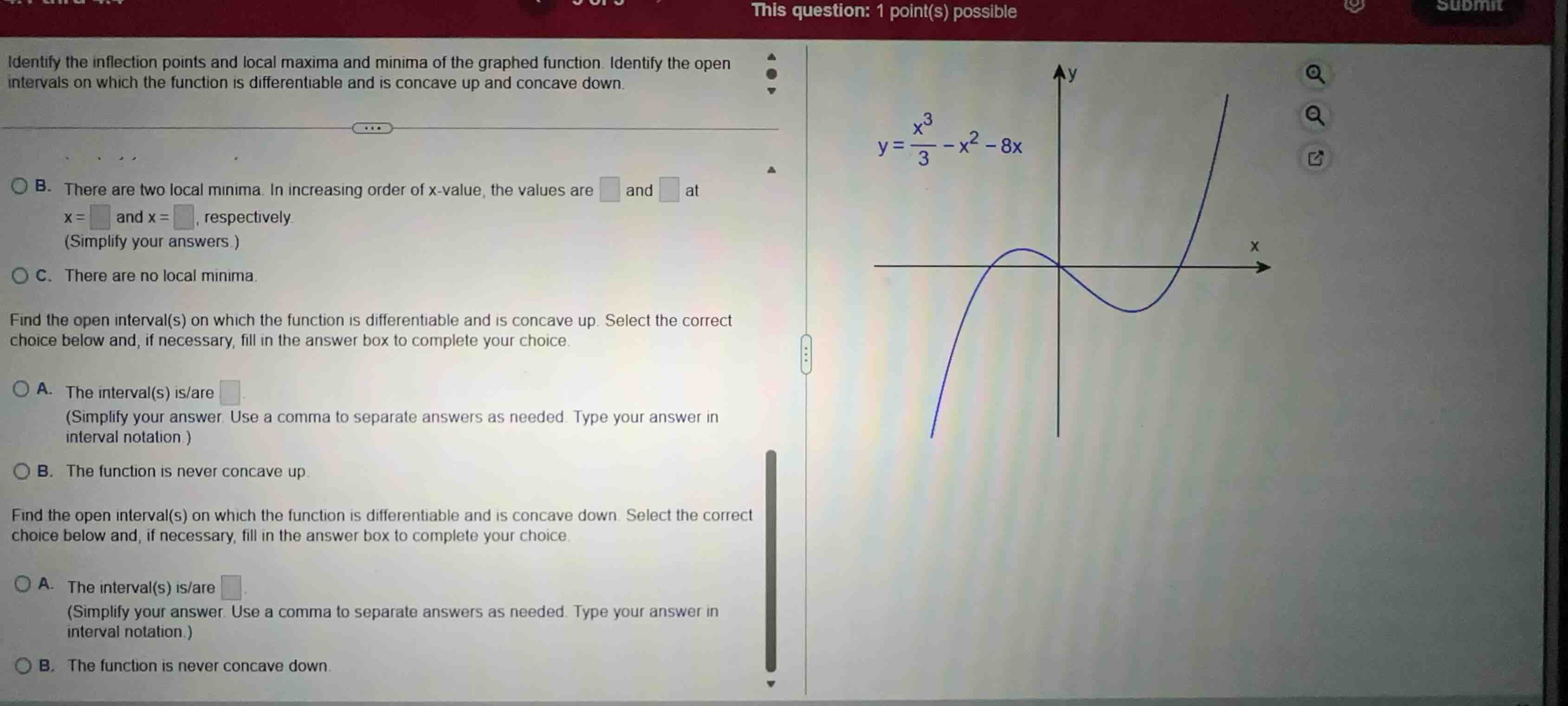
identify the inflection points and local maxima and minima of the graphed function. identify the open intervals on which the function is differentiable and is concave up and concave down.
(y = \frac{x^3}{3} - x^2 - 8x)
b. there are two local minima. in increasing order of x-value, the values are and at (x = ) and (x = ), respectively.
(simplify your answers.)
c. there are no local minima.
find the open interval(s) on which the function is differentiable and is concave up. select the correct choice below and, if necessary, fill in the answer box to complete your choice.
a. the interval(s) is/are
(simplify your answer. use a comma to separate answers as needed. type your answer in interval notation.)
b. the function is never concave up.
find the open interval(s) on which the function is differentiable and is concave down. select the correct choice below and, if necessary, fill in the answer box to complete your choice.
a. the interval(s) is/are
(simplify your answer. use a comma to separate answers as needed. type your answer in interval notation.)
b. the function is never concave down.
Find the second derivative of the function
Determine the interval of concavity up
Determine the interval of concavity down

Snap & solve any problem in the app
Get step-by-step solutions on Sovi AI
Photo-based solutions with guided steps
Explore more problems and detailed explanations
Question 1
Find the open interval(s) on which the function is differentiable and is concave up. Select the correct choice below and, if necessary, fill in the answer box to complete your choice.
- A. The interval(s) is/are <blank>\((1, \infty)\)</blank> (Correct answer)
- B. The function is never concave up.
Question 2
Find the open interval(s) on which the function is differentiable and is concave down. Select the correct choice below and, if necessary, fill in the answer box to complete your choice.
- A. The interval(s) is/are <blank>\((-\infty, 1)\)</blank> (Correct answer)
- B. The function is never concave down.