QUESTION IMAGE
Question
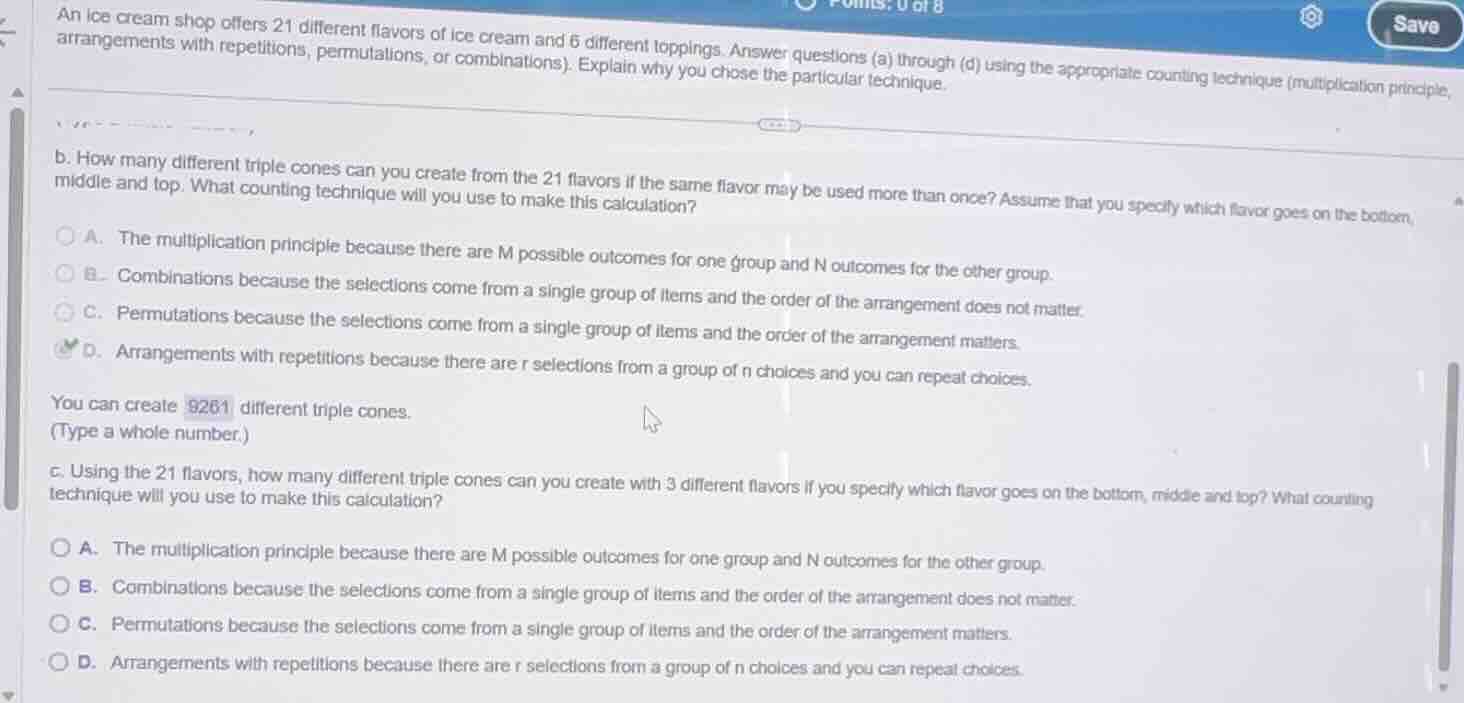
an ice cream shop offers 21 different flavors of ice cream and 6 different toppings. answer questions (a) through (d) using the appropriate counting technique (multiplication principle, arrangements with repetitions, permutations, or combinations). explain why you chose the particular technique.
b. how many different triple cones can you create from the 21 flavors if the same flavor may be used more than once? assume that you specify which flavor goes on the bottom, middle and top. what counting technique will you use to make this calculation?
a. the multiplication principle because there are m possible outcomes for one group and n outcomes for the other group.
b. combinations because the selections come from a single group of items and the order of the arrangement does not matter.
c. permutations because the selections come from a single group of items and the order of the arrangement matters.
d. arrangements with repetitions because there are r selections from a group of n choices and you can repeat choices.
you can create 9261 different triple cones.
(type a whole number.)
c. using the 21 flavors, how many different triple cones can you create with 3 different flavors if you specify which flavor goes on the bottom, middle and top? what counting technique will you use to make this calculation?
a. the multiplication principle because there are m possible outcomes for one group and n outcomes for the other group.
b. combinations because the selections come from a single group of items and the order of the arrangement does not matter.
c. permutations because the selections come from a single group of items and the order of the arrangement matters.
d. arrangements with repetitions because there are r selections from a group of n choices and you can repeat choices.
Analyze part (b) counting technique
Using the Arrangements with Repetitions knowledge point
Calculate part (b) total arrangements
Using the Arrangements with Repetitions knowledge point
Analyze part (c) counting technique
Using the Permutations knowledge point
Calculate part (c) total permutations
Using the Permutations knowledge point

Snap & solve any problem in the app
Get step-by-step solutions on Sovi AI
Photo-based solutions with guided steps
Explore more problems and detailed explanations
Question b
- A. The multiplication principle because there are M possible outcomes for one group and N outcomes for the other group.
- B. Combinations because the selections come from a single group of items and the order of the arrangement does not matter.
- C. Permutations because the selections come from a single group of items and the order of the arrangement matters.
- D. Arrangements with repetitions because there are r selections from a group of n choices and you can repeat choices. (Correct answer)
You can create <blank>9261</blank> different triple cones.
Question c
- A. The multiplication principle because there are M possible outcomes for one group and N outcomes for the other group.
- B. Combinations because the selections come from a single group of items and the order of the arrangement does not matter.
- C. Permutations because the selections come from a single group of items and the order of the arrangement matters. (Correct answer)
- D. Arrangements with repetitions because there are r selections from a group of n choices and you can repeat choices.
You can create <blank>7980</blank> different triple cones.