QUESTION IMAGE
Question
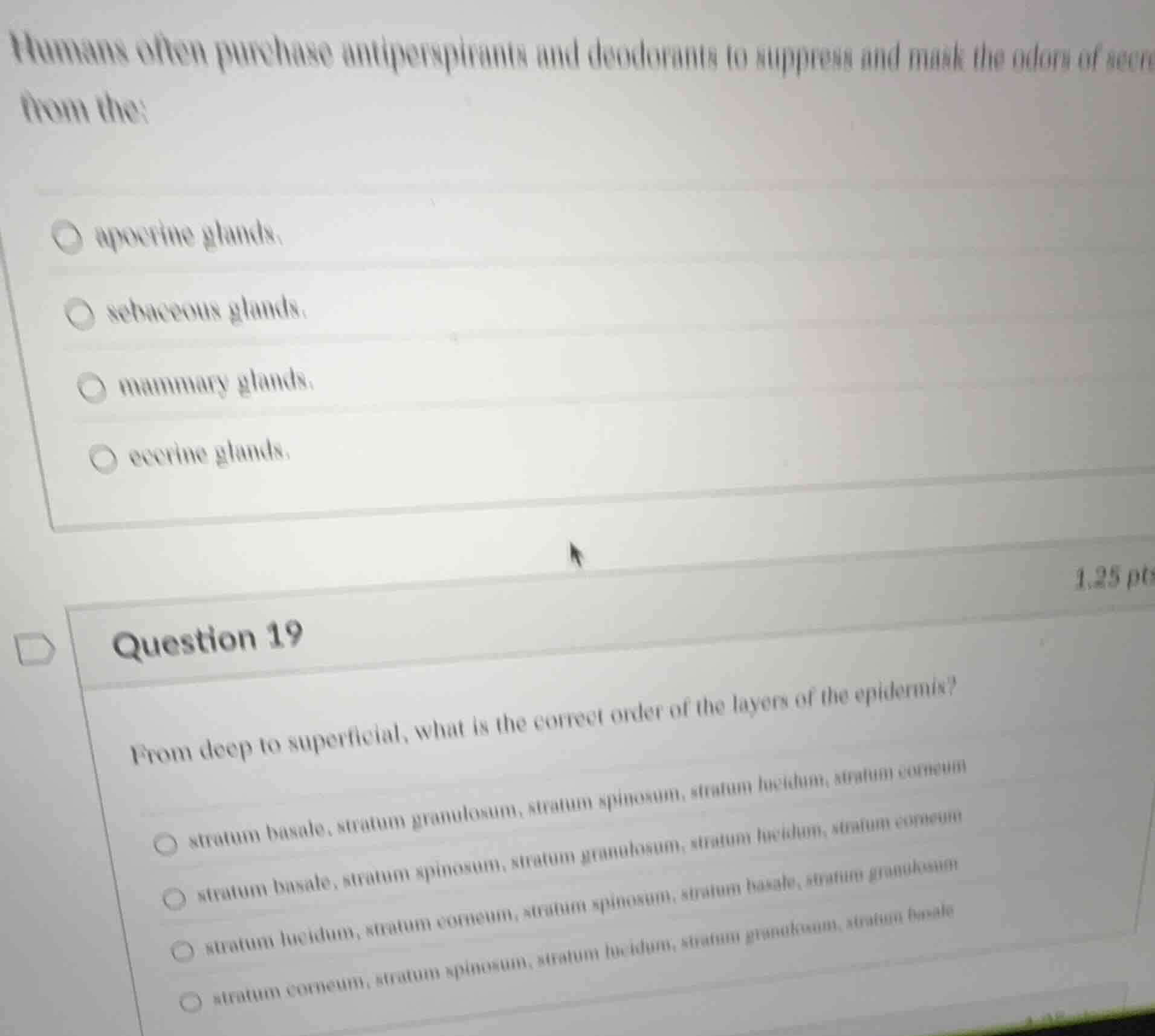
humans often purchase antiperspirants and deodorants to suppress and mask the odors of secretions from the:
apocrine glands.
sebaceous glands.
mammary glands.
eccrine glands.
question 19
from deep to superficial, what is the correct order of the layers of the epidermis?
stratum basale, stratum granulosum, stratum spinosum, stratum lucidum, stratum corneum
stratum basale, stratum spinosum, stratum granulosum, stratum lucidum, stratum corneum
stratum lucidum, stratum corneum, stratum spinosum, stratum basale, stratum granulosum
stratum corneum, stratum spinosum, stratum lucidum, stratum granulosum, stratum basale
Identify the source of body odor
The first question asks about the secretions that humans purchase antiperspirants and deodorants to suppress and mask. Antiperspirants and deodorants target sweat glands that produce secretions prone to bacterial breakdown, which causes body odor.
Using the Sebaceous Glands knowledge point, we know sebaceous glands secrete sebum (an oily substance), not watery sweat.
Among the sweat glands:
- Eccrine glands produce a watery sweat used primarily for thermoregulation, which is mostly odorless.
- Apocrine glands, located mainly in the axillary (armpit) and anogenital regions, secrete a thicker sweat containing lipids and proteins. When bacteria on the skin break down these organic compounds, it produces characteristic body odor. Therefore, antiperspirants and deodorants are designed to suppress and mask secretions from apocrine glands.
Determine the order of epidermal layers
The second question asks for the correct order of the layers of the epidermis from deep to superficial.
Using the Epidermal Layers knowledge point, we recall the layers of the epidermis from the deepest layer (resting on the dermis) to the most superficial layer (outer surface):
- Stratum basale (deepest)
- Stratum spinosum
- Stratum granulosum
- Stratum lucidum (found only in thick skin)
- Stratum corneum (most superficial)
Comparing this sequence to the given choices:
- The second option lists: "stratum basale, stratum spinosum, stratum granulosum, stratum lucidum, stratum corneum". This matches our deep-to-superficial sequence perfectly.

Snap & solve any problem in the app
Get step-by-step solutions on Sovi AI
Photo-based solutions with guided steps
Explore more problems and detailed explanations
Question 1
- (A) apocrine glands. (Correct answer)
- (B) sebaceous glands.
- (C) mammary glands.
- (D) eccrine glands.
Question 2
- (A) stratum basale, stratum granulosum, stratum spinosum, stratum lucidum, stratum corneum
- (B) stratum basale, stratum spinosum, stratum granulosum, stratum lucidum, stratum corneum (Correct answer)
- (C) stratum lucidum, stratum corneum, stratum spinosum, stratum basale, stratum granulosum
- (D) stratum corneum, stratum spinosum, stratum lucidum, stratum granulosum, stratum basale