QUESTION IMAGE
Question
Question was provided via image upload.
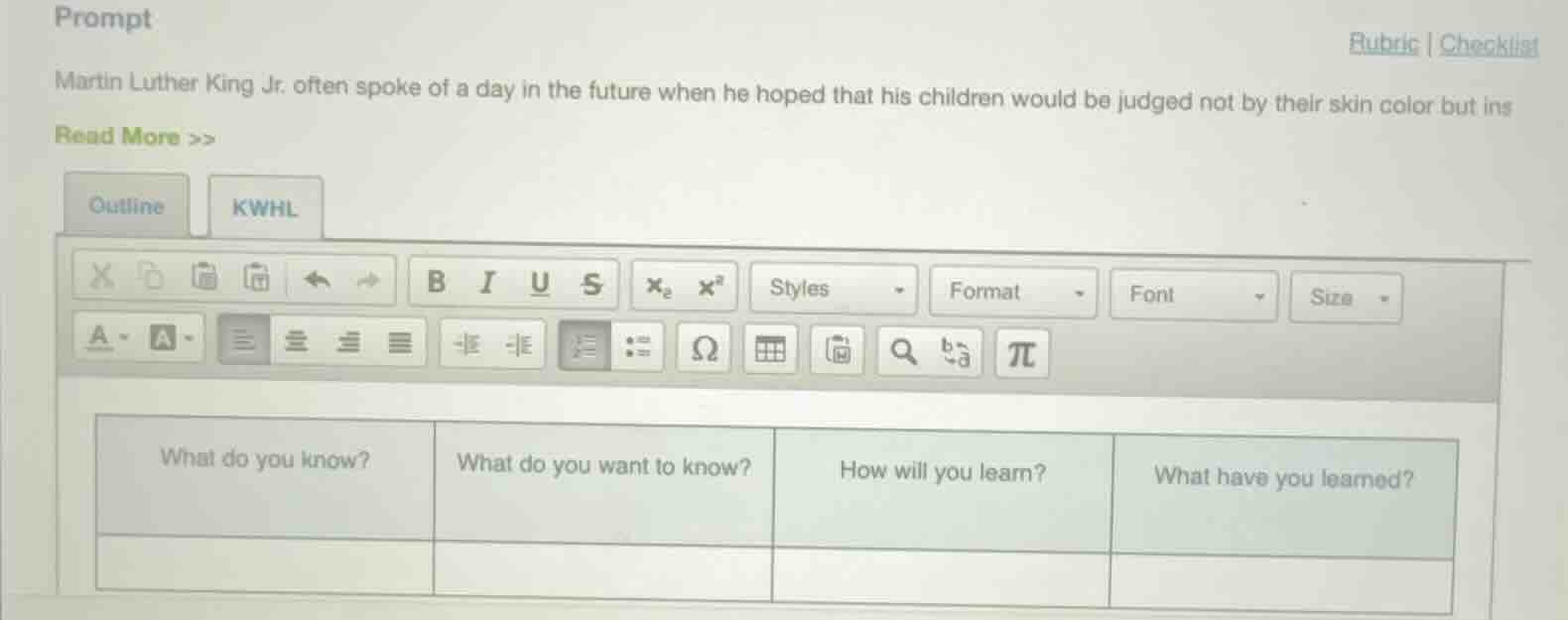
Identify the purpose of a KWHL chart
A KWHL chart is an active learning tool designed to guide research and reading comprehension. It helps organize thoughts before, during, and after exploring a topic. The acronym stands for:
- K: What do you Know? (Activating prior knowledge)
- W: What do you Want to know? (Setting learning goals and questions)
- H: How will you learn? (Identifying research methods and sources)
- L: What have you Learned? (Reflecting on new information)
Analyze the prompt context
The prompt mentions: "Martin Luther King Jr. often spoke of a day in the future when he hoped that his children would be judged not by their skin color but ins[tead by the content of their character]."
This refers to his famous "I Have a Dream" speech delivered during the March on Washington in 1963. To fill out the KWHL chart for this topic, we must structure ideas around MLK Jr., the Civil Rights Movement, and his vision of equality.
Formulate the "K" and "W" columns
- What do you know? (K):
- Martin Luther King Jr. was a prominent leader in the American Civil Rights Movement.
- He advocated for nonviolent protest and racial equality.
- He delivered the "I Have a Dream" speech in Washington, D.C.
- What do you want to know? (W):
- What specific historical events led up to this speech?
- How did the public and the government react immediately after the speech?
- In what ways did his speech influence civil rights legislation, such as the Civil Rights Act of 1964?
Formulate the "H" and "L" columns
- How will you learn? (H):
- Read the full text and listen to audio recordings of the "I Have a Dream" speech.
- Consult primary sources from the Civil Rights Movement, such as newspaper articles from 1963.
- Read secondary sources, including historical biographies of Martin Luther King Jr. and academic articles on civil rights history.
- What have you learned? (L):
- Note: This column is typically filled out after completing the research. We can provide a representative summary of what a student would discover.
- The speech was delivered to over 250,000 civil rights supporters from the steps of the Lincoln Memorial.
- It played a crucial role in facilitating the passage of the Civil Rights Act of 1964.
- King's use of biblical, constitutional, and literary references helped unite a diverse audience.

Snap & solve any problem in the app
Get step-by-step solutions on Sovi AI
Photo-based solutions with guided steps
Explore more problems and detailed explanations
To complete the KWHL chart based on the prompt about Martin Luther King Jr.'s vision, you can organize your ideas into the four columns as follows:
| What do you know? (K) | What do you want to know? (W) | How will you learn? (H) | What have you learned? (L) |
|---|