QUESTION IMAGE
Question
Question was provided via image upload.
Identify the given side lengths
The image shows a geometry problem involving two triangles, \(\Delta ABC\) and \(\Delta EDC\). Although the diagram is partially cut off at the top, we can infer the side lengths from the options:
- For \(\Delta ABC\), the side lengths are \(15\), \(12\), and \(9\).
- For \(\Delta EDC\), the corresponding side lengths are \(5\), \(4\), and \(3\).
Check the ratios of corresponding sides
Using Triangle Similarity Statements, we compare the ratios of the corresponding sides of \(\Delta ABC\) and \(\Delta EDC\):
- Ratio of longest sides: \(\frac{AB}{ED} = \frac{15}{5} = 3\)
- Ratio of middle sides: \(\frac{BC}{DC} = \frac{12}{4} = 3\)
- Ratio of shortest sides: \(\frac{AC}{EC} = \frac{9}{3} = 3\)
Since \(\frac{15}{5} = \frac{12}{4} = \frac{9}{3} = 3\), all three pairs of corresponding sides are proportional.
Apply the similarity postulate
Using Geometric Proofs, when all three pairs of corresponding sides of two triangles are proportional, the triangles are similar by the Side-Side-Side (SSS) Similarity Postulate.
Therefore, \(\Delta ABC \sim \Delta EDC\) by the SSS Similarity Postulate.
Evaluate the given options
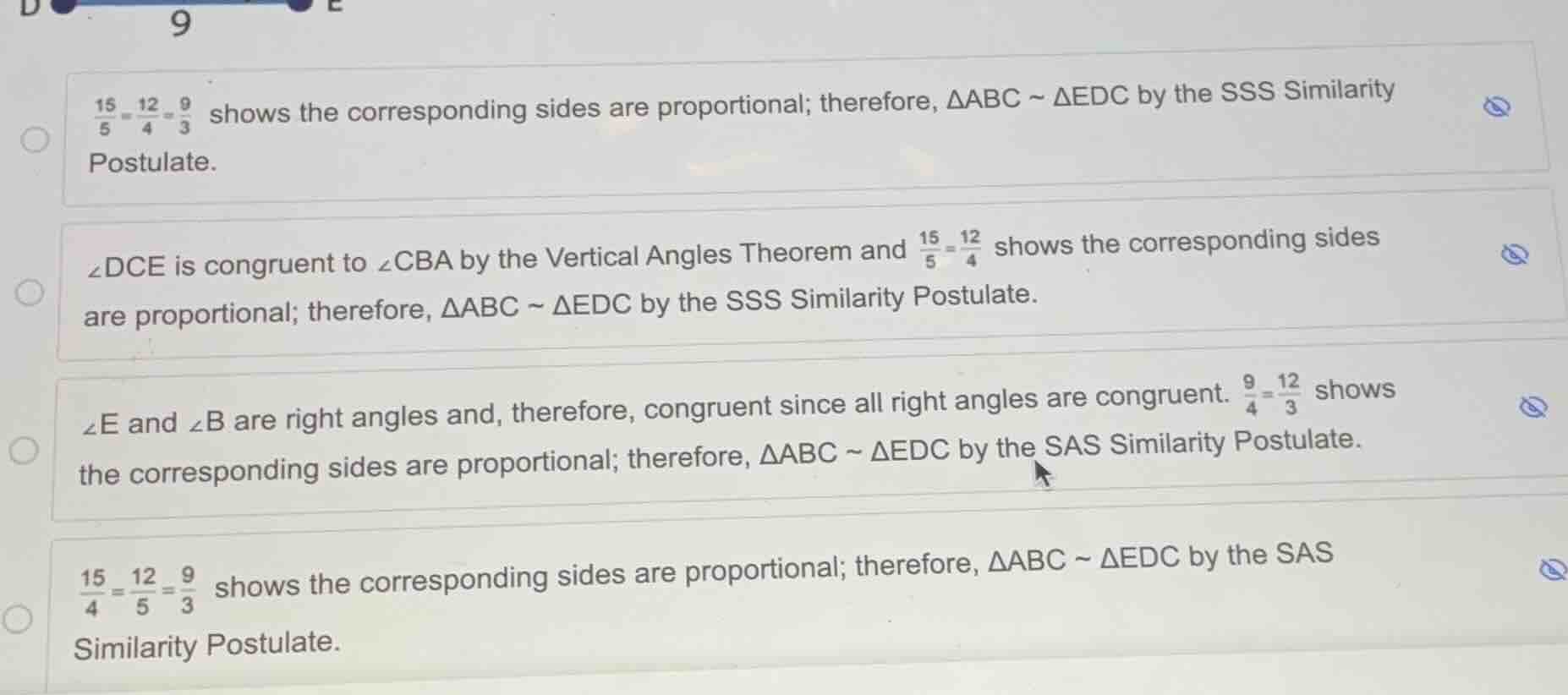
- Option 1 states: "\(\frac{15}{5} = \frac{12}{4} = \frac{9}{3}\) shows the corresponding sides are proportional; therefore, \(\Delta ABC \sim \Delta EDC\) by the SSS Similarity Postulate." This matches our derivation perfectly.
- Option 2 incorrectly mentions the Vertical Angles Theorem and SSS with only two ratios.
- Option 3 incorrectly assumes right angles and uses the SAS Similarity Postulate.
- Option 4 sets up incorrect ratios: \(\frac{15}{4} = \frac{12}{5} = \frac{9}{3}\), which are not equal.

Snap & solve any problem in the app
Get step-by-step solutions on Sovi AI
Photo-based solutions with guided steps
Explore more problems and detailed explanations
- (A) \(\frac{15}{5} = \frac{12}{4} = \frac{9}{3}\) shows the corresponding sides are proportional; therefore, \(\Delta ABC \sim \Delta EDC\) by the SSS Similarity Postulate. (Correct answer)
- (B) \(\angle DCE\) is congruent to \(\angle CBA\) by the Vertical Angles Theorem and \(\frac{15}{5} = \frac{12}{4}\) shows the corresponding sides are proportional; therefore, \(\Delta ABC \sim \Delta EDC\) by the SSS Similarity Postulate.
- (C) \(\angle E\) and \(\angle B\) are right angles and, therefore, congruent since all right angles are congruent. \(\frac{9}{4} = \frac{12}{3}\) shows the corresponding sides are proportional; therefore, \(\Delta ABC \sim \Delta EDC\) by the SAS Similarity Postulate.
- (D) \(\frac{15}{4} = \frac{12}{5} = \frac{9}{3}\) shows the corresponding sides are proportional; therefore, \(\Delta ABC \sim \Delta EDC\) by the SAS Similarity Postulate.