QUESTION IMAGE
Question
Question was provided via image upload.
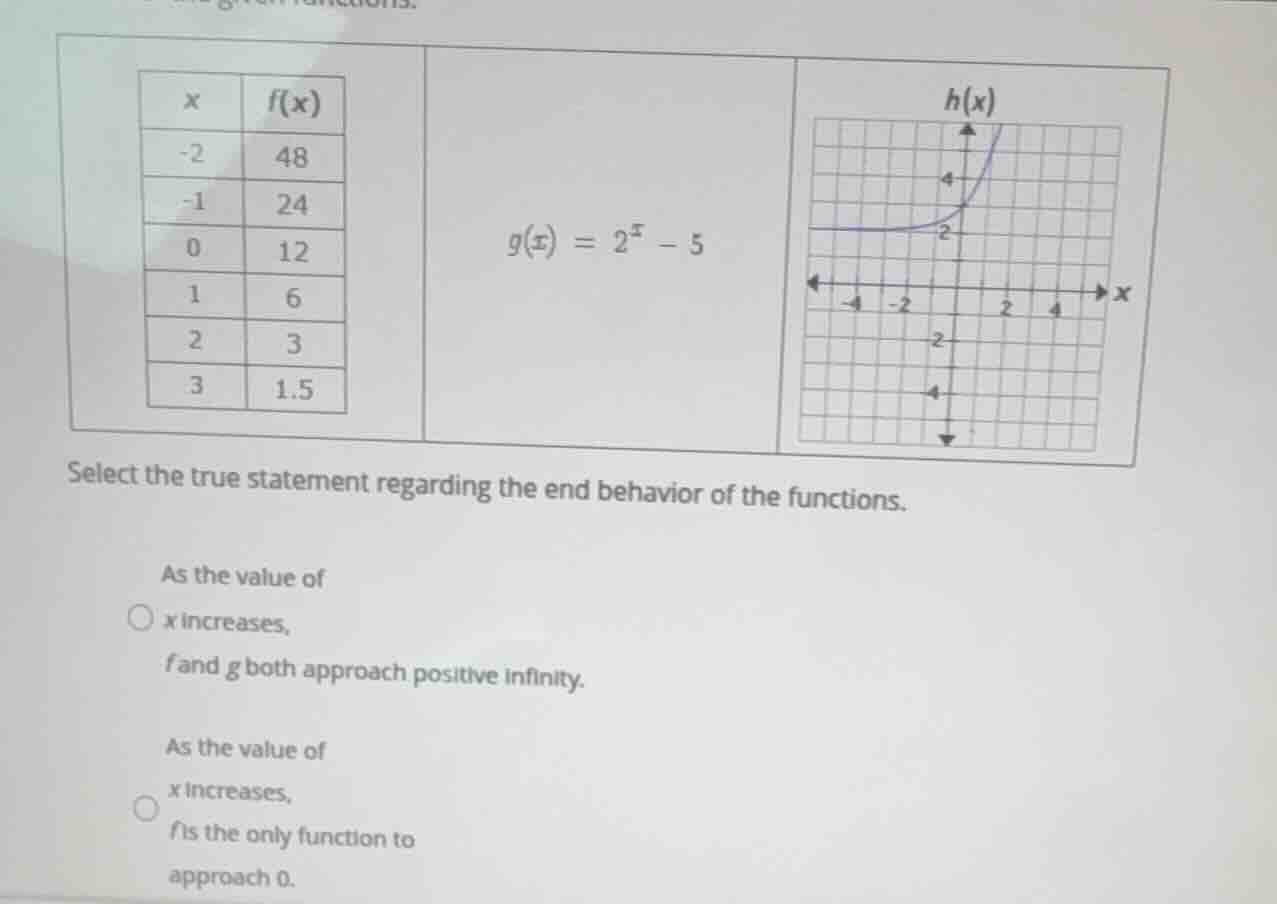
Analyze the end behavior of each function as \(x \to \infty\)
- For \(f(x)\): As \(x\) increases (\(-2 \to -1 \to 0 \to 1 \to 2 \to 3\)), the values of \(f(x)\) are halved (\(48 \to 24 \to 12 \to 6 \to 3 \to 1.5\)). This is an exponential decay function of the form \(f(x) = 12 \cdot (0.5)^x\). As \(x \to \infty\), \(f(x) \to 0\).
- For \(g(x) = 2^x - 5\): As \(x \to \infty\), \(2^x \to \infty\), so \(g(x) \to \infty\).
- For \(h(x)\): The graph shows an exponential growth function with a horizontal asymptote at \(y = 2\). As \(x \to -\infty\), \(h(x) \to 2\). As \(x \to \infty\), \(h(x) \to \infty\).
Evaluate the visible options
- Option 1: "As the value of \(x\) increases, \(f\) and \(g\) both approach positive infinity." This is false because \(f(x) \to 0\).
- Option 2: "As the value of \(x\) increases, \(f\) is the only function to approach 0." Let's check if this is true. As \(x \to \infty\), \(f(x) \to 0\), \(g(x) \to \infty\), and \(h(x) \to \infty\). Thus, \(f(x)\) is indeed the only function among the three that approaches 0 as \(x\) increases.

Snap & solve any problem in the app
Get step-by-step solutions on Sovi AI
Photo-based solutions with guided steps
Explore more problems and detailed explanations
- (A) As the value of x increases, f and g both approach positive infinity.
- (B) As the value of x increases, f is the only function to approach 0. (Correct answer)