QUESTION IMAGE
Question
Question was provided via image upload.
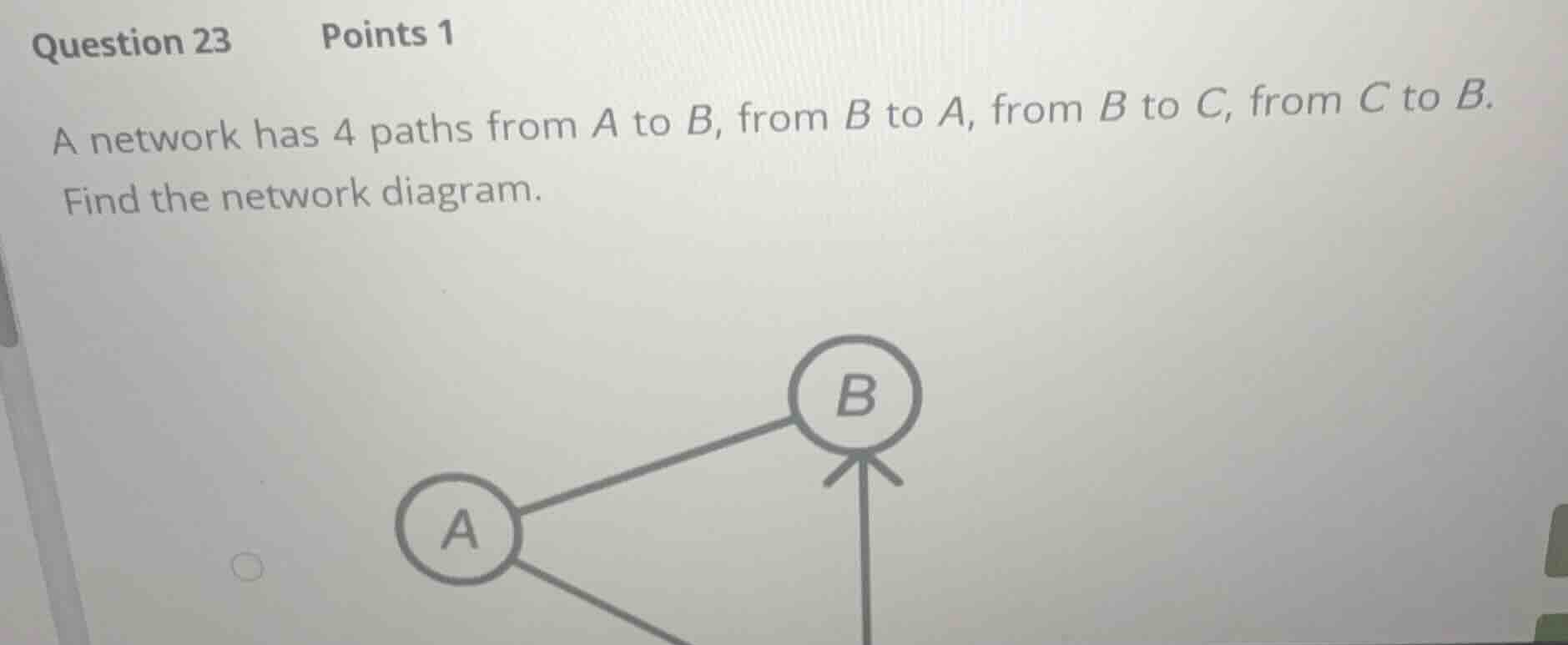
Identify the network vertices and directed paths
Using the Graph Terminology and Graph Theory knowledge points:
- The network contains three vertices: \(A\), \(B\), and \(C\).
- The directed paths (edges with direction) are:
- From \(A\) to \(B\)
- From \(B\) to \(A\)
- From \(B\) to \(C\)
- From \(C\) to \(B\)
Construct the network diagram representation
Using the Network Representation knowledge point:
- Draw three nodes labeled \(A\), \(B\), and \(C\).
- Connect \(A\) and \(B\) with two directed arrows: one pointing from \(A\) to \(B\), and one pointing from \(B\) to \(A\).
- Connect \(B\) and \(C\) with two directed arrows: one pointing from \(B\) to \(C\), and one pointing from \(C\) to \(B\).
- No paths exist between \(A\) and \(C\), and no self-loops exist.

Snap & solve any problem in the app
Get step-by-step solutions on Sovi AI
Photo-based solutions with guided steps
Explore more problems and detailed explanations
The network diagram consists of three vertices, \(A\), \(B\), and \(C\), connected by the following directed edges:
- A bidirectional connection between \(A\) and \(B\) (one arrow pointing from \(A\) to \(B\), and another pointing from \(B\) to \(A\)).
- A bidirectional connection between \(B\) and \(C\) (one arrow pointing from \(B\) to \(C\), and another pointing from \(C\) to \(B\)).
- No edges connecting \(A\) and \(C\) directly.