QUESTION IMAGE
Question
Question was provided via image upload.
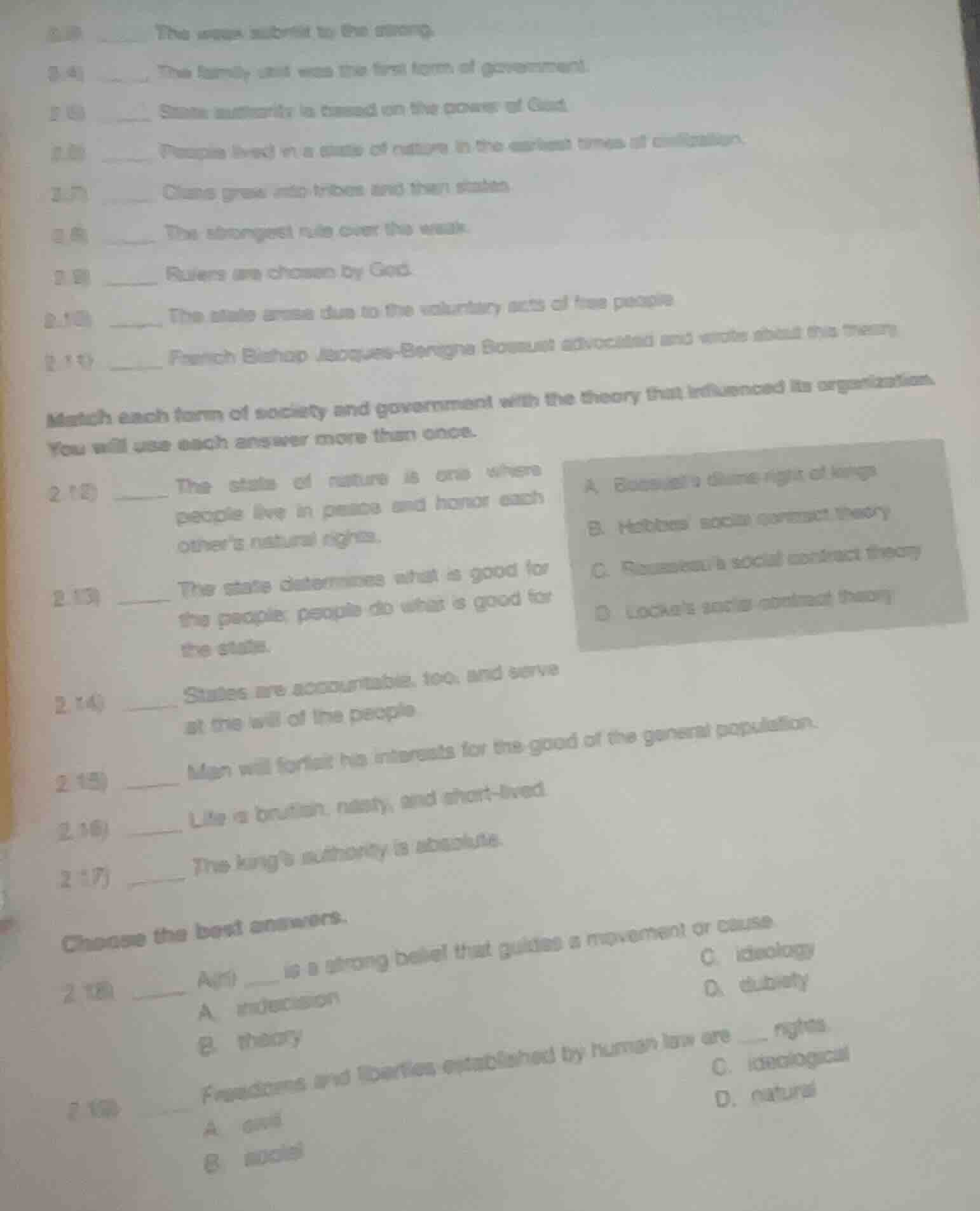
Analyze matching questions 2.12 to 2.17
- 2.12) "The state of nature is one where people live in peace and honor each other's natural rights." -> This represents John Locke's optimistic view of the state of nature. Answer: D.
- 2.13) "The state determines what is good for the people; people do what is good for the state." -> This aligns with Jean-Jacques Rousseau's concept of the general will and collective sovereignty. Answer: C.
- 2.14) "States are accountable, too, and serve at the will of the people." -> This is Locke's theory of popular consent and right to revolution. Answer: D.
- 2.15) "Man will forfeit his interests for the good of the general population." -> This represents Rousseau's social contract where individuals surrender rights to the community/general will. Answer: C.
- 2.16) "Life is brutish, nasty, and short-lived." -> This is Thomas Hobbes's famous description of the state of nature. Answer: B.
- 2.17) "The king's authority is absolute." -> This represents Jacques-Bénigne Bossuet's divine right of kings. Answer: A.
Analyze multiple choice question 2.18
- Question: "A(n) ______ is a strong belief that guides a movement or cause."
- Options: A. indecision, B. theory, C. ideology, D. dubiety.
- Analysis: An "ideology" is a system of ideas and ideals, especially one that forms the basis of economic or political theory and policy. Answer: C.
Analyze multiple choice question 2.19
- Question: "Freedoms and liberties established by human law are ______ rights."
- Options: A. civil, B. social, C. ideological, D. natural.
- Analysis: Rights established by human positive law (government/statutes) are civil rights, as opposed to natural rights which exist prior to government. Answer: A.

Snap & solve any problem in the app
Get step-by-step solutions on Sovi AI
Photo-based solutions with guided steps
Explore more problems and detailed explanations
Question 2.12
<blank>D</blank>
Question 2.13
<blank>C</blank>
Question 2.14
<blank>D</blank>
Question 2.15
<blank>C</blank>
Question 2.16
<blank>B</blank>
Question 2.17
<blank>A</blank>
Question 2.18
- (A) indecision
- (B) theory
- (C) ideology (Correct answer)
- (D) dubiety
Question 2.19
- (A) civil (Correct answer)
- (B) social
- (C) ideological
- (D) natural