QUESTION IMAGE
Question
Question was provided via image upload.
Analyze the incomplete context
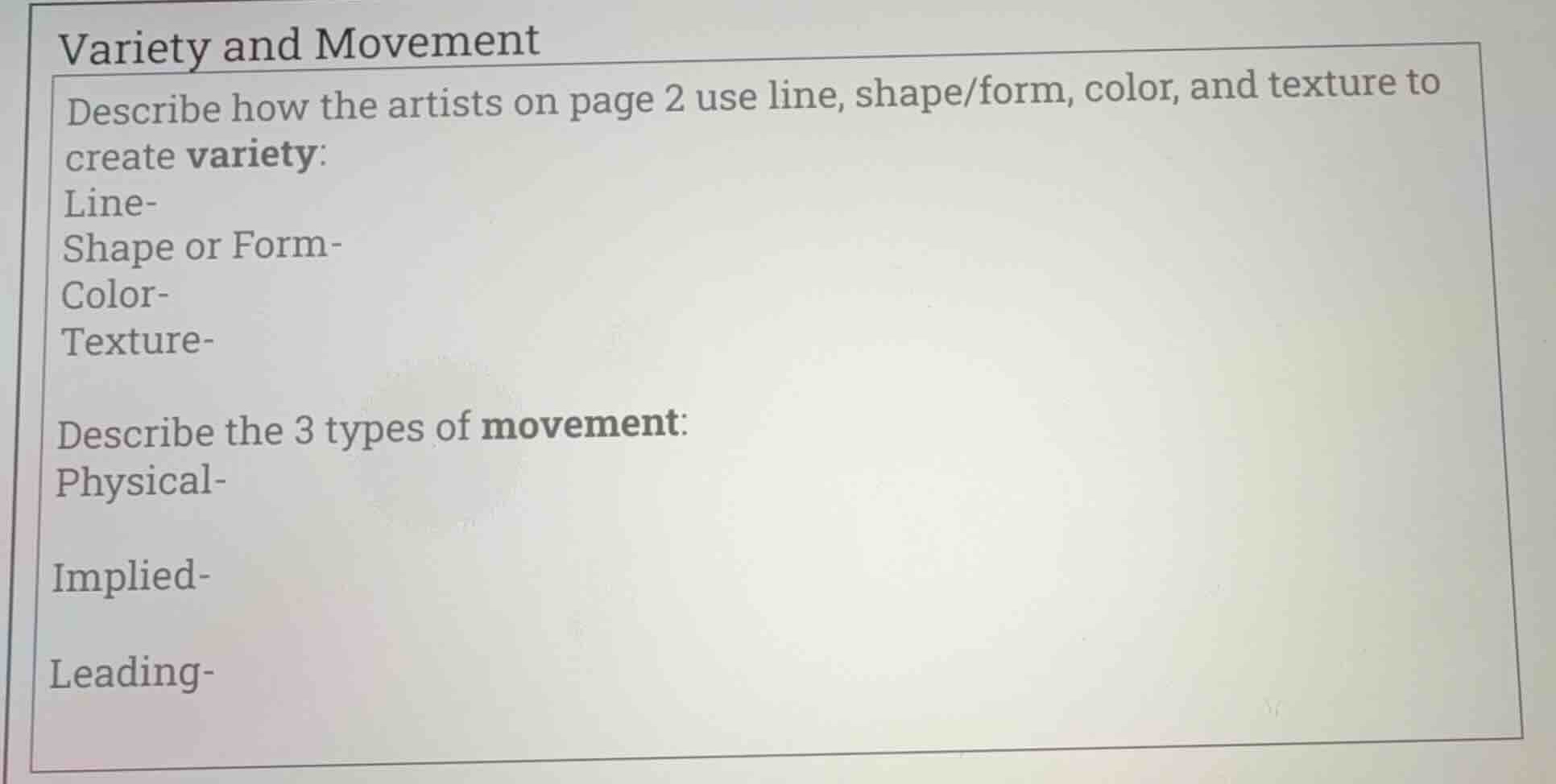
The first question asks to describe how artists on "page 2" use elements of art (line, shape/form, color, texture) to create variety. Because "page 2" is not provided in the image, we must explain the general principles of how these elements are used to create variety in art.
Define variety using elements of art
Variety is a principle of design that refers to the use of different qualities or instances of the visual elements to guide the viewer's eye and keep the artwork engaging.
- Line: Artists use lines of varying thickness, direction (horizontal, vertical, diagonal), and character (curved, jagged, organic, geometric) to create contrast and interest.
- Shape or Form: Combining different geometric shapes (like circles and squares) with organic shapes (free-form, natural shapes), or mixing flat 2D shapes with 3D forms.
- Color: Utilizing contrasting colors (complementary pairs, warm vs. cool tones) or varying values (lightness/darkness) and intensities (brightness/dullness).
- Texture: Juxtaposing different tactile qualities, such as rough vs. smooth surfaces, or using implied visual textures alongside flat areas.
Define the three types of movement
Movement is the principle of design used to create the look and feel of action and to guide the viewer’s eye throughout the work of art.
- Physical Movement: Actual kinetic movement found in three-dimensional art, such as mobiles, kinetic sculptures, or performance art, where parts of the artwork physically change position over time.
- Implied Movement: The illusion of movement in a static, two-dimensional artwork. This is achieved through dynamic poses, blurred edges, or capturing a figure mid-action to suggest that motion is occurring.
- Leading Movement (Optical/Visual Path): The path the artist creates to guide the viewer's eye through the composition. This is achieved using lines, shapes, colors, or repeating patterns that direct attention from one focal point to another.

Snap & solve any problem in the app
Get step-by-step solutions on Sovi AI
Photo-based solutions with guided steps
Explore more problems and detailed explanations
Question 1
Describe how the artists on page 2 use line, shape/form, color, and texture to create variety:
- Line: Artists use lines of different weights (thick and thin), directions (vertical, horizontal, diagonal), and styles (curved, straight, jagged) to create visual interest and contrast.
- Shape or Form: Artists combine different types of shapes, such as geometric (structured, mathematical) and organic (free-form, natural), or mix flat two-dimensional shapes with three-dimensional forms.
- Color: Artists use contrasting colors (such as complementary colors or warm and cool tones), varying values (lights and darks), and different intensities (vibrant vs. dull colors) to make elements stand out.
- Texture: Artists contrast different textures, such as rough and smooth surfaces, or combine actual tactile textures with simulated (implied) visual textures.
Question 2
Describe the 3 types of movement:
- Physical: Actual kinetic movement in three-dimensional artworks (like mobiles or kinetic sculptures) where parts of the piece physically move through space.
- Implied: The illusion of motion captured in a static, two-dimensional artwork, often shown through dynamic poses, action lines, or blurred elements.
- Leading: The visual path created by the artist using lines, shapes, or colors to guide the viewer's eye sequentially through the composition.