QUESTION IMAGE
Question
Question was provided via image upload.
Analyze the given alleles
The problem states:
- \(T\) represents the dominant allele for a tall stem.
- \(t\) represents the recessive allele for a short stem.
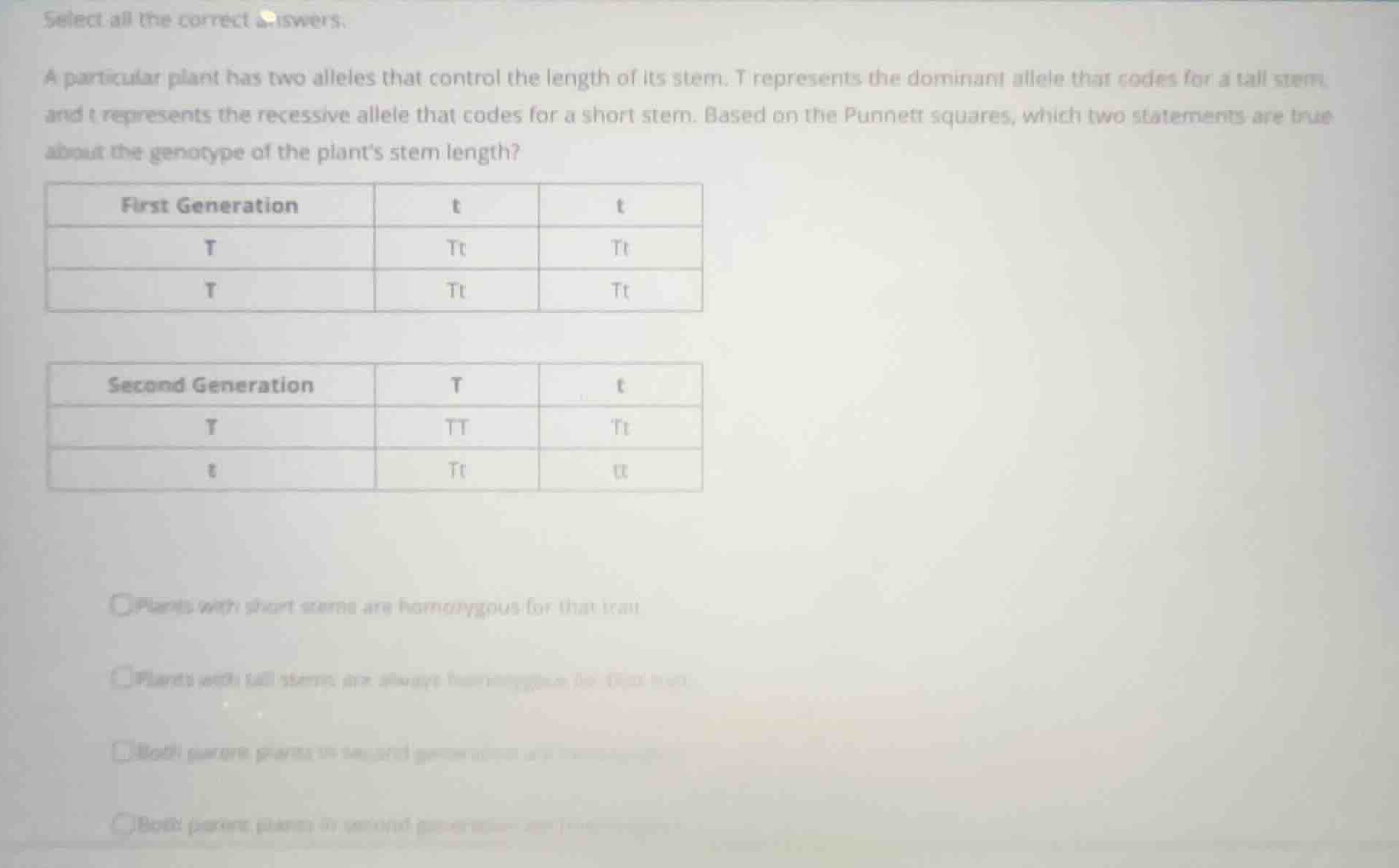
Analyze the Punnett squares
- First Generation Cross:
- Parent 1: \(T\) and \(T\) (homozygous dominant, \(TT\))
- Parent 2: \(t\) and \(t\) (homozygous recessive, \(tt\))
- Offspring: All are \(Tt\) (heterozygous, tall phenotype).
- Second Generation Cross:
- Parent 1: \(T\) and \(t\) (heterozygous, \(Tt\))
- Parent 2: \(T\) and \(t\) (heterozygous, \(Tt\))
- Offspring: \(TT\) (homozygous dominant), \(Tt\) (heterozygous), \(tt\) (homozygous recessive).
Evaluate the statements
Let's read the visible parts of the options:
- "Plants with short stems are homozygous for that trait."
- Short stem is recessive (\(tt\)). Recessive traits only express when homozygous. This statement is true.
- "Plants with tall stems are always homozygous for that trait."
- Tall plants can be \(TT\) (homozygous) or \(Tt\) (heterozygous). This statement is false.
- "Both parent plants in second generation are homozygous."
- The parents in the second generation are \(Tt\) and \(Tt\), which are heterozygous. This statement is false.
- "Both parent plants in second generation are heterozygous."
- The parents in the second generation are both \(Tt\). This statement is true.
Select the two correct statements
The two true statements are:
- Plants with short stems are homozygous for that trait.
- Both parent plants in the second generation are heterozygous.

Snap & solve any problem in the app
Get step-by-step solutions on Sovi AI
Photo-based solutions with guided steps
Explore more problems and detailed explanations
- Plants with short stems are homozygous for that trait. (Correct answer)
- Plants with tall stems are always homozygous for that trait.
- Both parent plants in second generation are homozygous.
- Both parent plants in second generation are heterozygous. (Correct answer)