QUESTION IMAGE
Question
Question was provided via image upload.
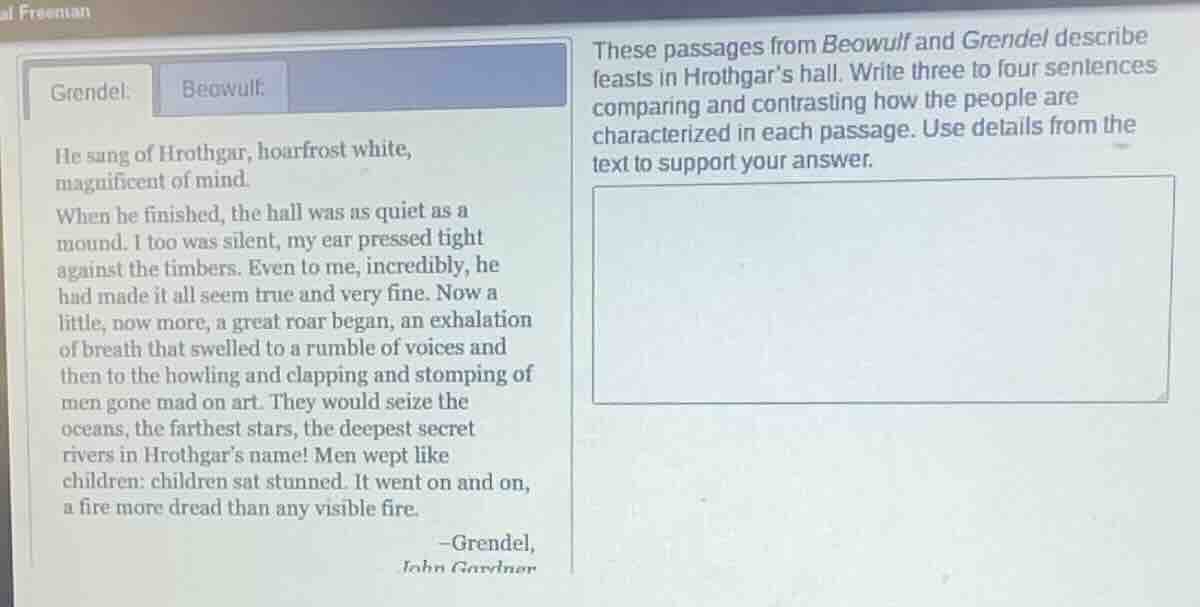
Analyze the characterization in the Grendel passage
In John Gardner's Grendel, the Danes are characterized through Grendel's perspective as deeply emotional, impressionable, and easily swayed by art. The Shaper's song moves them to a collective frenzy, described as "men gone mad on art" who "wept like children" and are inspired to conquer "in Hrothgar's name!" This highlights their vulnerability to narrative manipulation and their passionate, almost unstable nature.
Analyze the characterization in the Beowulf passage
In the epic poem Beowulf, the people at the feast are characterized through a traditional epic lens, emphasizing order, community, heroic comitatus, and dignified celebration. The warriors and nobility participate in structured rituals of sharing mead, boasting, and receiving gifts, which portrays them as honorable, unified, and bound by duty and loyalty to their king.
Synthesize the comparison and contrast
Both passages depict the people in Hrothgar's hall during a feast, showing their shared devotion to Hrothgar and the power of song/storytelling to unite them. However, they contrast sharply in tone and perspective: Beowulf characterizes the people objectively as noble, orderly, and heroic, whereas Grendel uses a subjective, critical first-person perspective to characterize them as volatile, easily manipulated, and driven to a wild, emotional frenzy by the Shaper's art.

Snap & solve any problem in the app
Get step-by-step solutions on Sovi AI
Photo-based solutions with guided steps
Explore more problems and detailed explanations
In both passages, the people in Hrothgar's hall are united by their devotion to their king and the power of song, but they are characterized through contrasting lenses. In the epic Beowulf, the Danes are characterized as noble, orderly, and heroic warriors participating in structured, dignified community rituals. Conversely, in John Gardner's Grendel, the people are characterized from Grendel's critical perspective as volatile and easily manipulated, described as "men gone mad on art" who weep like children and are driven to a wild, emotional frenzy by the Shaper's performance.