QUESTION IMAGE
Question
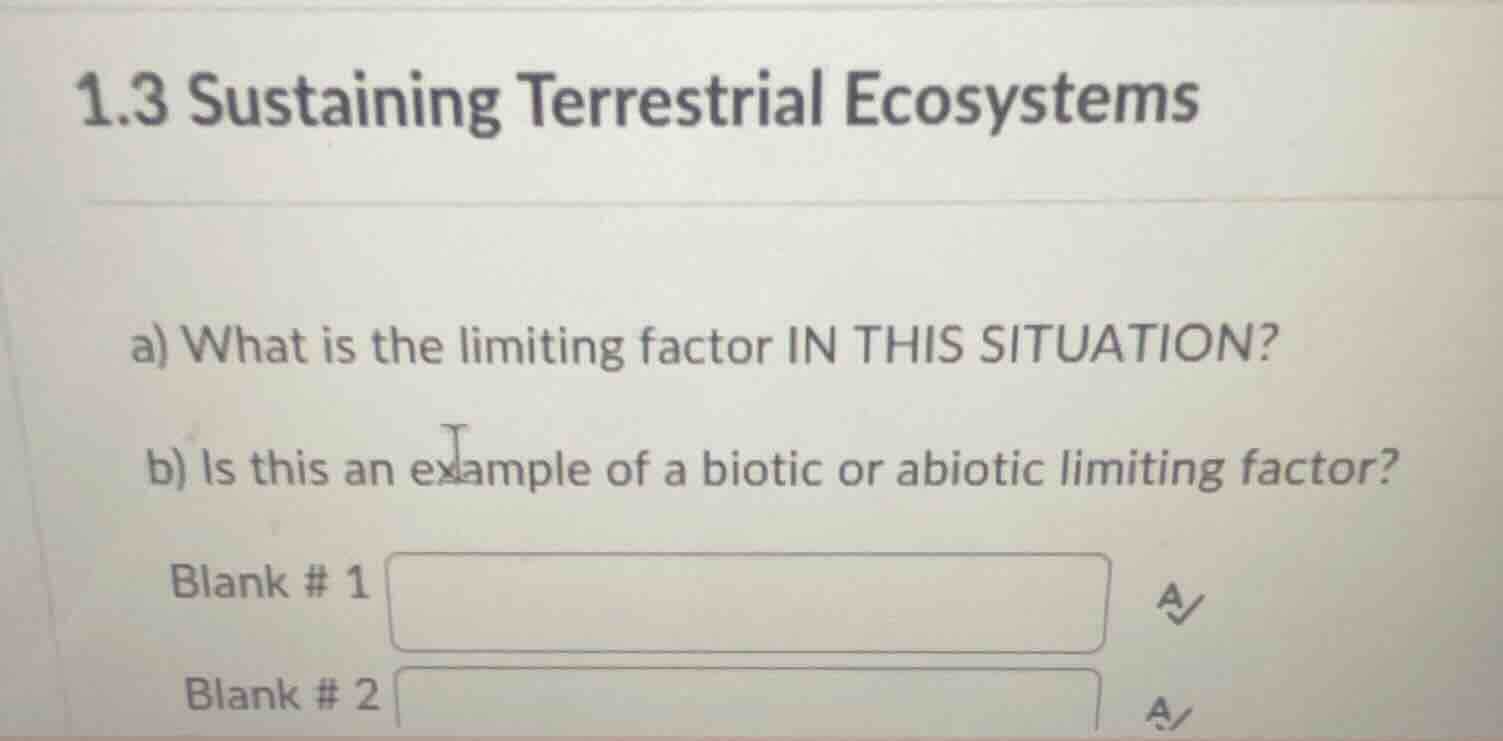
Question was provided via image upload.
Identify the missing context
The image asks two questions about a specific "situation" that is not visible in the cropped image. However, the heading is "1.3 Sustaining Terrestrial Ecosystems". In high school biology and environmental science curricula, typical terrestrial limiting factors include water, temperature, light, nutrients, or space. Without the specific scenario text, we must provide a conditional explanation that helps the student identify the correct answers based on their specific worksheet text.
Define limiting factors
We apply the concept of Terrestrial Ecosystems to understand how resources restrict population growth. A limiting factor is any resource or environmental condition that limits the growth, abundance, or distribution of an organism or a population of organisms in an ecosystem.
Distinguish biotic and abiotic factors
To answer part (b), we define the two categories:
- Abiotic factors are non-living chemical and physical parts of the environment (e.g., sunlight, temperature, wind, water, soil nutrients).
- Biotic factors are living or once-living components of an ecosystem (e.g., predators, prey, pathogens, competitors).
Provide guidance for Blank 1 and Blank 2
- For Blank 1: The student should look at the preceding text or diagram in their assignment. If the text describes a drought, the limiting factor is water. If it describes a cold winter, it is temperature. If it describes overcrowding or lack of prey, it is food/space.
- For Blank 2: If the factor identified in Blank 1 is non-living (like water, sunlight, or temperature), the answer is "abiotic". If the factor is living (like competition, disease, or predation), the answer is "biotic".

Snap & solve any problem in the app
Get step-by-step solutions on Sovi AI
Photo-based solutions with guided steps
Explore more problems and detailed explanations
Because the specific scenario text is cut off from the image, please use the following guide to fill in your blanks:
Question a (Blank # 1)
Identify the resource or environmental condition described in your lesson's text that is in short supply or restricting growth (common examples include water, temperature, sunlight, or nutrients).
Question b (Blank # 2)
Determine if your limiting factor is non-living or living:
- If the factor is non-living (such as water, temperature, or sunlight), write abiotic.
- If the factor is living (such as predators, disease, or food organisms), write biotic.