QUESTION IMAGE
Question
Question was provided via image upload.
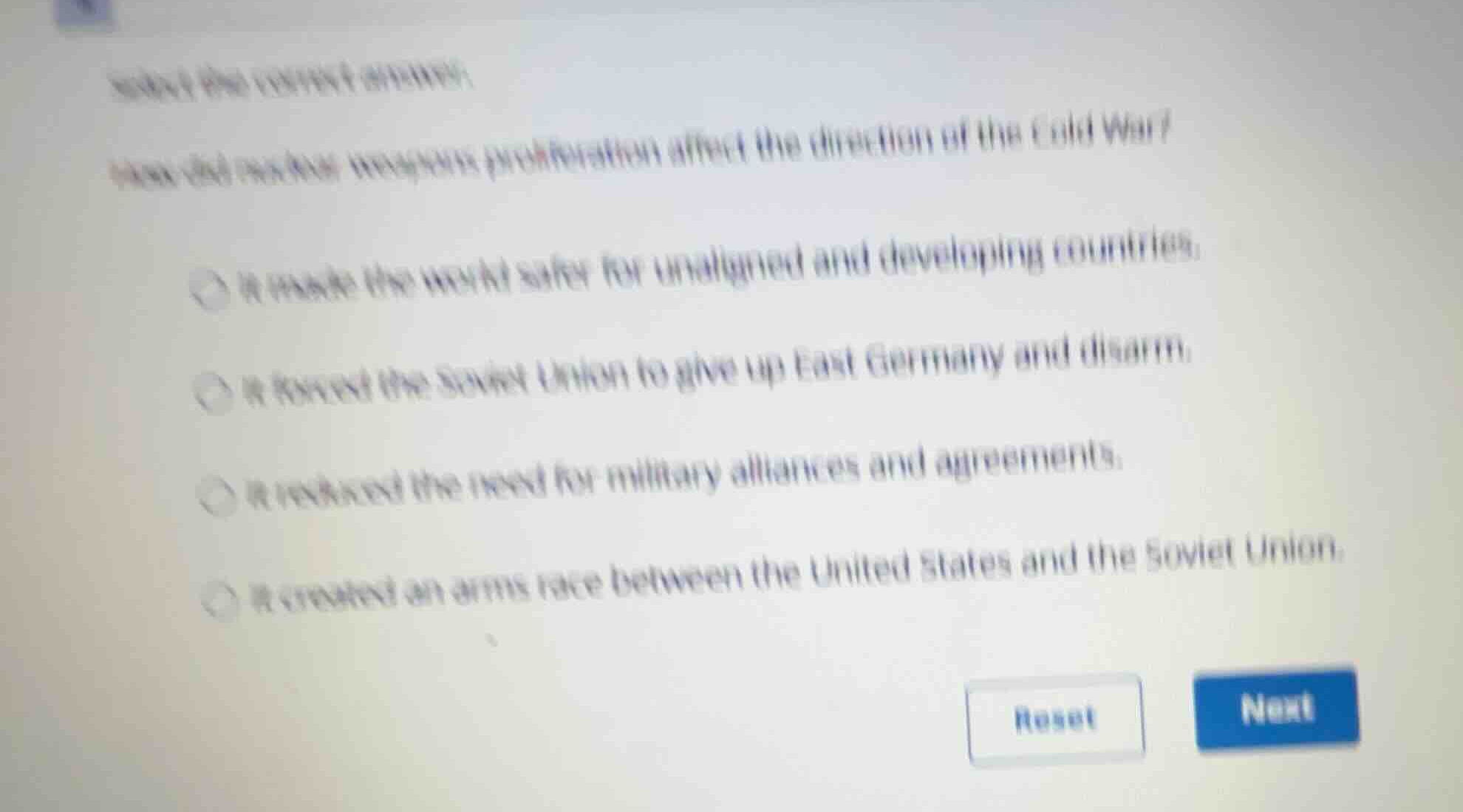
Analyze the question stem
The question asks: "How did nuclear weapons proliferation affect the direction of the Cold War?" This requires understanding the geopolitical consequences of the spread and accumulation of nuclear weapons during the mid-to-late 20th century.
Evaluate the first option
The first option states: "It made the world safer for unaligned and developing countries." This is historically inaccurate. The proliferation of nuclear weapons and the global competition between superpowers often led to proxy wars, instability, and heightened anxiety in developing and non-aligned nations.
Evaluate the second option
The second option states: "It forced the Soviet Union to give up East Germany and disarm." This is incorrect. The Soviet Union did not give up East Germany or disarm due to nuclear proliferation; rather, the division of Germany persisted until the collapse of the Soviet bloc in 1989–1990, and both sides maintained massive nuclear stockpiles throughout the Cold War.
Evaluate the third option
The third option states: "It reduced the need for military alliances and agreements." This is incorrect. Nuclear proliferation actually intensified the creation of military alliances (such as NATO and the Warsaw Pact) and led to numerous bilateral and multilateral treaties and agreements to manage or limit nuclear arsenals.
Evaluate the fourth option
The fourth option states: "It created an arms race between the United States and the Soviet Union." This is historically accurate. The development and proliferation of nuclear technology led directly to a massive, competitive buildup of nuclear warheads, delivery systems, and military technology as each superpower sought to maintain strategic deterrence.

Snap & solve any problem in the app
Get step-by-step solutions on Sovi AI
Photo-based solutions with guided steps
Explore more problems and detailed explanations
- (A) It made the world safer for unaligned and developing countries.
- (B) It forced the Soviet Union to give up East Germany and disarm.
- (C) It reduced the need for military alliances and agreements.
- (D) It created an arms race between the United States and the Soviet Union. (Correct answer)