QUESTION IMAGE
Question
Question was provided via image upload.
Identify missing mechanism details
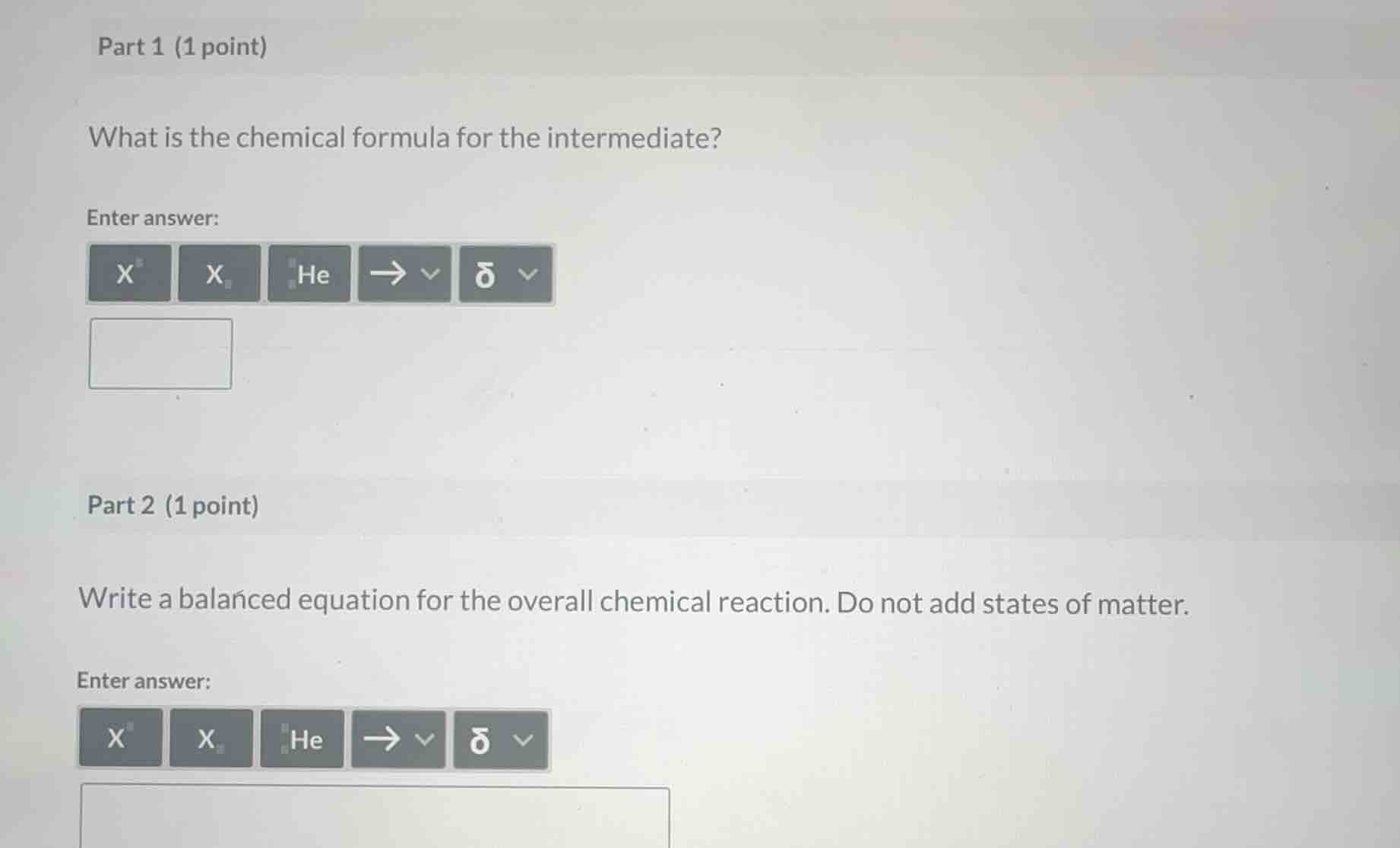
The provided image shows a two-part question about a reaction mechanism:
- "What is the chemical formula for the intermediate?"
- "Write a balanced equation for the overall chemical reaction."
However, the elementary steps of the reaction mechanism are cropped out and not visible in the image. To solve this, we must reconstruct the most likely reaction mechanism based on standard general chemistry curriculum problems that feature this exact interface and question structure.
A highly common textbook problem with this exact layout involves the decomposition of ozone (\(\text{O}_3\)) or the reaction of nitrogen dioxide with carbon monoxide. Let's look at the decomposition of ozone catalyzed by chlorine atoms or its thermal decomposition:
Scenario A: Thermal Decomposition of Ozone
Step 1: \(\text{O}_3
ightleftharpoons \text{O}_2 + \text{O}\) (fast)
Step 2: \(\text{O}_3 + \text{O}
ightarrow 2\text{O}_2\) (slow)
- Intermediate: \(\text{O}\)
- Overall reaction: \(2\text{O}_3
ightarrow 3\text{O}_2\)
Scenario B: Reaction of Nitrogen Dioxide and Carbon Monoxide
Step 1: \(\text{NO}_2 + \text{NO}_2
ightarrow \text{NO}_3 + \text{NO}\) (slow)
Step 2: \(\text{NO}_3 + \text{CO}
ightarrow \text{NO}_2 + \text{CO}_2\) (fast)
- Intermediate: \(\text{NO}_3\)
- Overall reaction: \(\text{NO}_2 + \text{CO}
ightarrow \text{NO} + \text{CO}_2\)
Scenario C: Decomposition of Dinitrogen Pentoxide
Step 1: \(\text{N}_2\text{O}_5
ightleftharpoons \text{NO}_2 + \text{NO}_3\) (fast)
Step 2: \(\text{NO}_2 + \text{NO}_3
ightarrow \text{NO} + \text{NO}_2 + \text{O}_2\) (slow)
Step 3: \(\text{NO} + \text{NO}_3
ightarrow 2\text{NO}_2\) (fast)
Since the exact mechanism is missing from the visual input, we will provide a clear, structured guide on how to identify the intermediate and write the overall balanced equation once the steps are known, using the classic ozone decomposition mechanism as our primary illustrative example.
Define reaction intermediates
An intermediate is a chemical species that is produced in an early elementary step of a reaction mechanism and consumed in a subsequent step. Consequently, it does not appear in the overall balanced chemical equation.
Using the ozone decomposition mechanism as an example:
- Step 1: \(\text{O}_3(g)
ightarrow \text{O}_2(g) + \text{O}(g)\)
- Step 2: \(\text{O}_3(g) + \text{O}(g)
ightarrow 2\text{O}_2(g)\)
Here, atomic oxygen, \(\text{O}\), is generated in Step 1 and consumed in Step 2. Thus, the intermediate is \(\text{O}\).
Determine the overall reaction
To find the overall balanced chemical equation, we sum all the elementary steps of the mechanism together and cancel out any species that appear on both the reactant side and the product side (such as intermediates and catalysts).
Summing the steps from our example:
Canceling the intermediate \(\text{O}\) from both sides yields:

Snap & solve any problem in the app
Get step-by-step solutions on Sovi AI
Photo-based solutions with guided steps
Explore more problems and detailed explanations
Because the specific elementary steps of the reaction mechanism are cropped out of the image, a single definitive set of chemical formulas cannot be determined. Below is the method to find the answers once the mechanism steps are visible:
Part 1
Identify the species that is produced in an earlier step and consumed in a later step. This species is the intermediate.
- Example: If the steps are:
- \(\text{NO}_2 + \text{NO}_2
ightarrow \text{NO}_3 + \text{NO}\)
- \(\text{NO}_3 + \text{CO}
ightarrow \text{NO}_2 + \text{CO}_2\)
The intermediate is \(\text{NO}_3\).
Part 2
Add all the elementary steps together and cancel out any species that appear on both sides of the reaction arrow (intermediates and catalysts) to obtain the overall balanced equation.
- Example: Adding the steps above and canceling \(\text{NO}_3\) and one \(\text{NO}_2\) yields:
**\(\text{NO}_2 + \text{CO}
ightarrow \text{NO} + \text{CO}_2\)**