QUESTION IMAGE
Question
Question was provided via image upload.
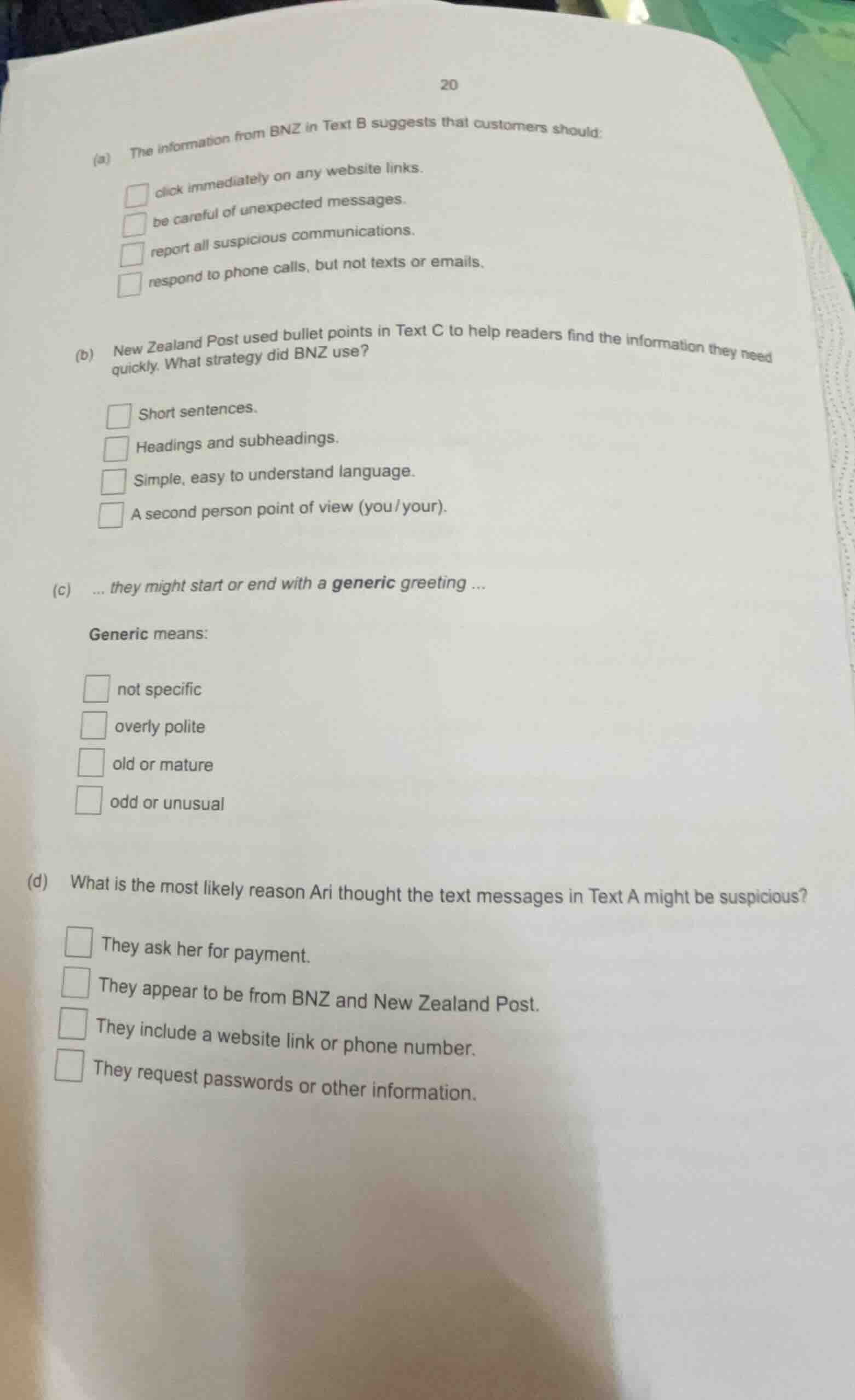
Analyze question (a)
The question asks what BNZ suggests customers should do based on Text B. In standard digital safety and scam awareness contexts, banks (like BNZ) advise customers to "be careful of unexpected messages" and "report all suspicious communications," while explicitly warning against clicking links immediately. Since multiple-choice questions in this format typically have a single primary correct option or a main advice, we evaluate the options:
- "click immediately on any website links" is incorrect (dangerous).
- "be careful of unexpected messages" is a standard safety guideline.
- "report all suspicious communications" is the most active, direct action recommended by banks to handle scam attempts.
- "respond to phone calls, but not texts or emails" is incorrect.
Comparing standard bank safety texts, the primary recommendation is to report suspicious communications.
Analyze question (b)
The question asks what formatting/structural strategy BNZ used in Text B, compared to New Zealand Post's use of bullet points in Text C.
- "Short sentences"
- "Headings and subheadings"
- "Simple, easy to understand language"
- "A second person point of view (you/your)"
Without the full Text B, we look at common document design strategies. Banks typically structure safety alerts using clear "Headings and subheadings" to organize different types of advice (e.g., "What to look out for", "How to report").
Analyze question (c)
The question asks for the meaning of "generic" in the context of "... they might start or end with a generic greeting ...".
- "not specific" directly defines "generic" (e.g., "Dear Customer" instead of a personalized name).
- "overly polite", "old or mature", and "odd or unusual" do not define generic.
Analyze question (d)
The question asks why Ari thought the text messages in Text A might be suspicious.
In phishing and SMS scams (smishing), messages are highly suspicious because they contain links or phone numbers designed to harvest credentials or personal details. Therefore, "They include a website link or phone number" is the most direct indicator of a suspicious phishing text message.

Snap & solve any problem in the app
Get step-by-step solutions on Sovi AI
Photo-based solutions with guided steps
Explore more problems and detailed explanations
Question (a)
- click immediately on any website links.
- be careful of unexpected messages.</mcq-correct>
- report all suspicious communications. (Correct answer)
<mcq-option>respond to phone calls, but not texts or emails.
Question (b)
- Short sentences.
- Headings and subheadings. (Correct answer)
- Simple, easy to understand language.
- A second person point of view (you/your).
Question (c)
- not specific (Correct answer)
- overly polite
- old or mature
- odd or unusual
Question (d)
- They ask her for payment.
- They appear to be from BNZ and New Zealand Post.
- They include a website link or phone number. (Correct answer)
- They request passwords or other information.