QUESTION IMAGE
Question
Question was provided via image upload.
Analyze the Indian Removal Act of 1830
The Indian Removal Act was signed into law by President Andrew Jackson in 1830. Its primary purpose was to grant the president the authority to negotiate removal treaties with Indigenous tribes living in the southeastern United States, exchanging their ancestral lands for federal territory west of the Mississippi River.
Evaluate the options based on historical context
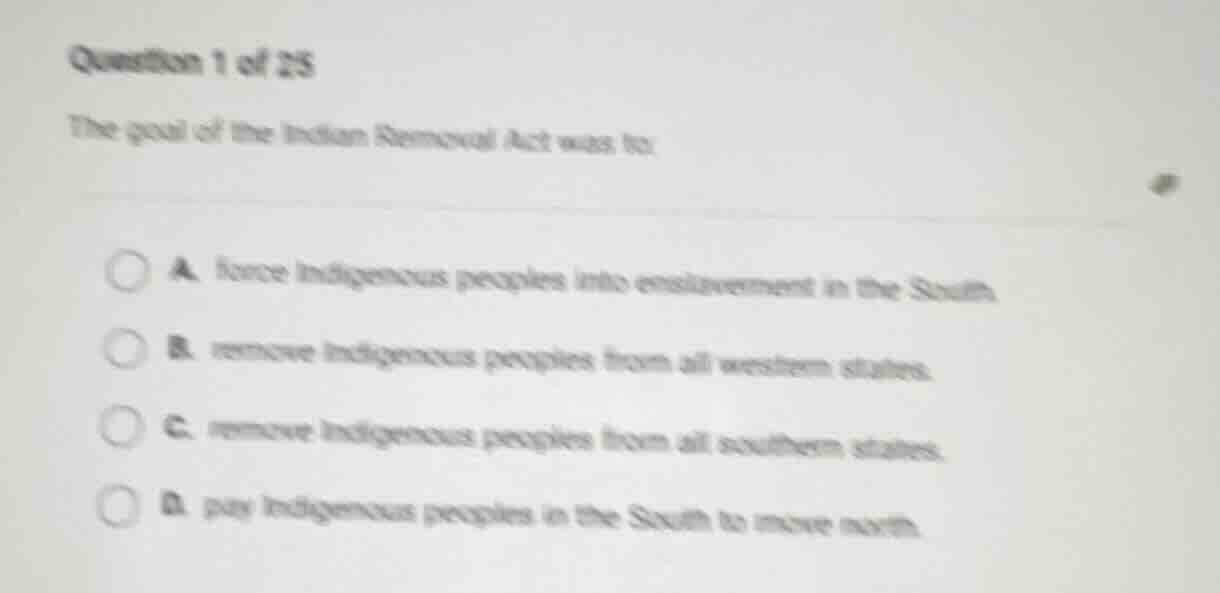
- Option A suggests forcing Indigenous peoples into enslavement. This is historically incorrect; the act focused on land acquisition and relocation, not enslavement.
- Option B mentions removing Indigenous peoples from all western states. This is incorrect because the target populations were located in the East (specifically the Southeast), and they were being moved to the West (Indian Territory, modern-day Oklahoma).
- Option C states the goal was to remove Indigenous peoples from all southern states. This aligns with the historical reality of clearing fertile lands in southern states (such as Georgia, Alabama, and Mississippi) for white settlement and cotton cultivation.
- Option D suggests paying Indigenous peoples in the South to move north. This is incorrect; they were forced or pressured to move west of the Mississippi River, not north.
Determine the correct choice
Based on the analysis, the primary goal of the Indian Removal Act was to relocate Indigenous nations from their ancestral lands in the southern states to federal territory west of the Mississippi River. Therefore, Option C is the correct answer.

Snap & solve any problem in the app
Get step-by-step solutions on Sovi AI
Photo-based solutions with guided steps
Explore more problems and detailed explanations
- (A) force Indigenous peoples into enslavement in the South
- (B) remove Indigenous peoples from all western states
- (C) remove Indigenous peoples from all southern states (Correct answer)
- (D) pay Indigenous peoples in the South to move north