QUESTION IMAGE
Question
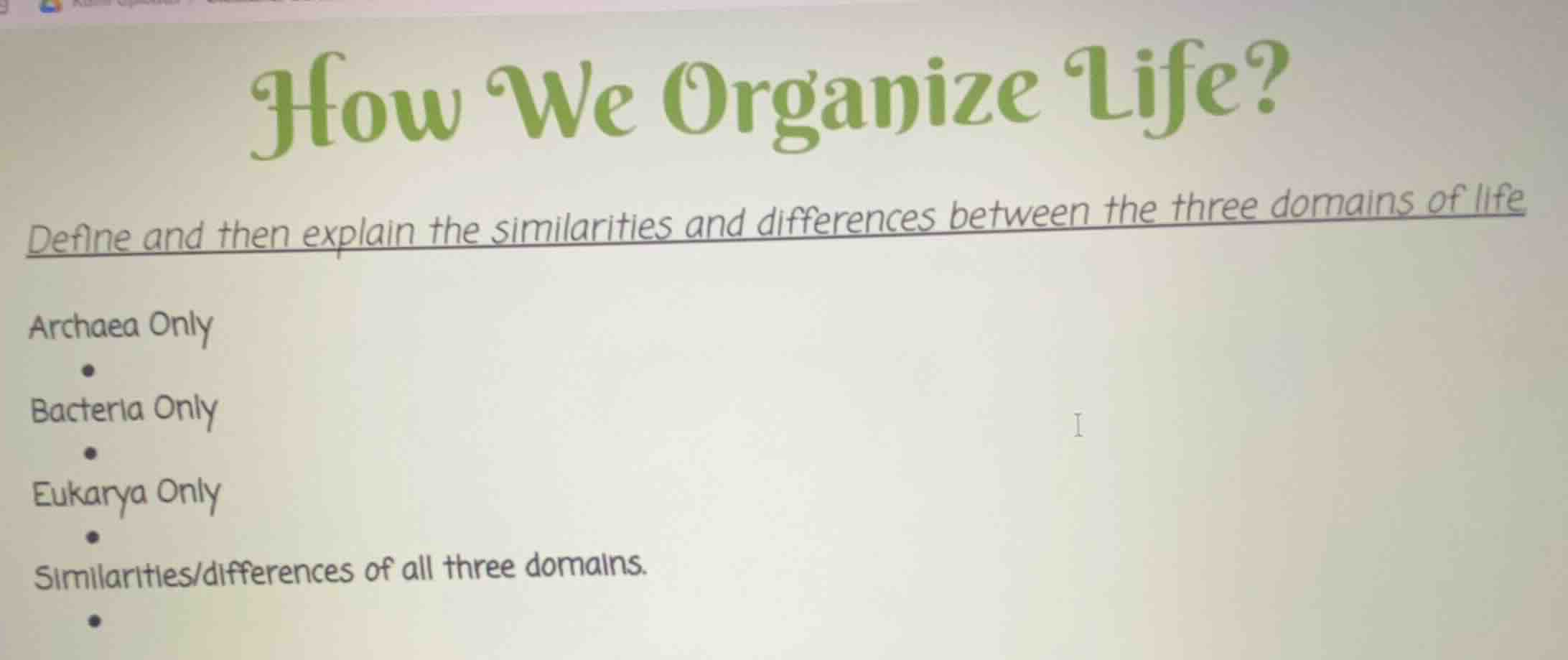
how we organize life?
define and then explain the similarities and differences between the three domains of life
archaea only
bacteria only
eukarya only
similarities/differences of all three domains.
Define the three domains of life
Using the Domains of Life knowledge point, we define the three primary evolutionary branches:
- Archaea: Single-celled prokaryotic organisms lacking a nucleus, often living in extreme environments.
- Bacteria: Single-celled prokaryotic organisms lacking a nucleus, with peptidoglycan cell walls, found everywhere.
- Eukarya: Organisms containing complex cells with a membrane-bound nucleus and organelles.
Identify characteristics unique to Archaea
Using the Domains of Life and Prokaryotic Cells knowledge points:
- Archaea possess unique membrane lipids with ether linkages instead of ester linkages.
- Their cell walls lack peptidoglycan.
- They have unique ribosomal RNA (rRNA) sequences and RNA polymerases that resemble eukaryotic machinery.
Identify characteristics unique to Bacteria
Using the Domains of Life and Prokaryotic Cells knowledge points:
- Bacteria have cell walls containing peptidoglycan.
- They possess membrane lipids with ester linkages.
- They have unique RNA polymerases and are sensitive to traditional antibacterial antibiotics.
Identify characteristics unique to Eukarya
Using the Eukaryotic Cells knowledge point:
- Eukarya possess a membrane-bound nucleus and membrane-bound organelles (e.g., mitochondria, chloroplasts).
- They can be multicellular (animals, plants, fungi) or unicellular (protists).
- They have linear chromosomes and undergo mitosis and meiosis.
Compare similarities and differences of all three
Using the Domains of Life knowledge point:
- Similarities: All three domains share a common ancestor, use DNA as genetic material, have ribosomes for protein synthesis, and possess a cell membrane.
- Differences: Archaea and Bacteria are prokaryotic (no nucleus), while Eukarya are eukaryotic. Archaea share more molecular and genetic similarities (like transcription machinery) with Eukarya than with Bacteria.

Snap & solve any problem in the app
Get step-by-step solutions on Sovi AI
Photo-based solutions with guided steps
Explore more problems and detailed explanations
Archaea Only
- Cell walls lack peptidoglycan.
- Membrane lipids contain ether linkages with branched hydrocarbons.
- Genetically and biochemically more similar to Eukarya (e.g., translation and transcription machinery).
- Often inhabit extreme environments (extremophiles).
Bacteria Only
- Cell walls contain peptidoglycan.
- Membrane lipids contain ester linkages with unbranched hydrocarbons.
- Possess unique RNA polymerase distinct from Archaea and Eukarya.
- Sensitive to traditional antibiotics.
Eukarya Only
- Cells contain a membrane-bound nucleus and membrane-bound organelles.
- Genetically organized into linear chromosomes.
- Includes multicellular organisms (Fungi, Plantae, Animalia) as well as unicellular protists.
Similarities and Differences of All Three Domains
- Similarities: All three domains share a common evolutionary origin, use double-stranded DNA as their genetic material, utilize ribosomes to synthesize proteins, and possess a plasma membrane.
- Differences: Archaea and Bacteria are prokaryotic (lacking a nucleus and membrane-bound organelles), whereas Eukarya are eukaryotic. Archaea and Eukarya share a more recent common ancestor with each other than either does with Bacteria, as evidenced by their similar replication, transcription, and translation machinery.