QUESTION IMAGE
Question
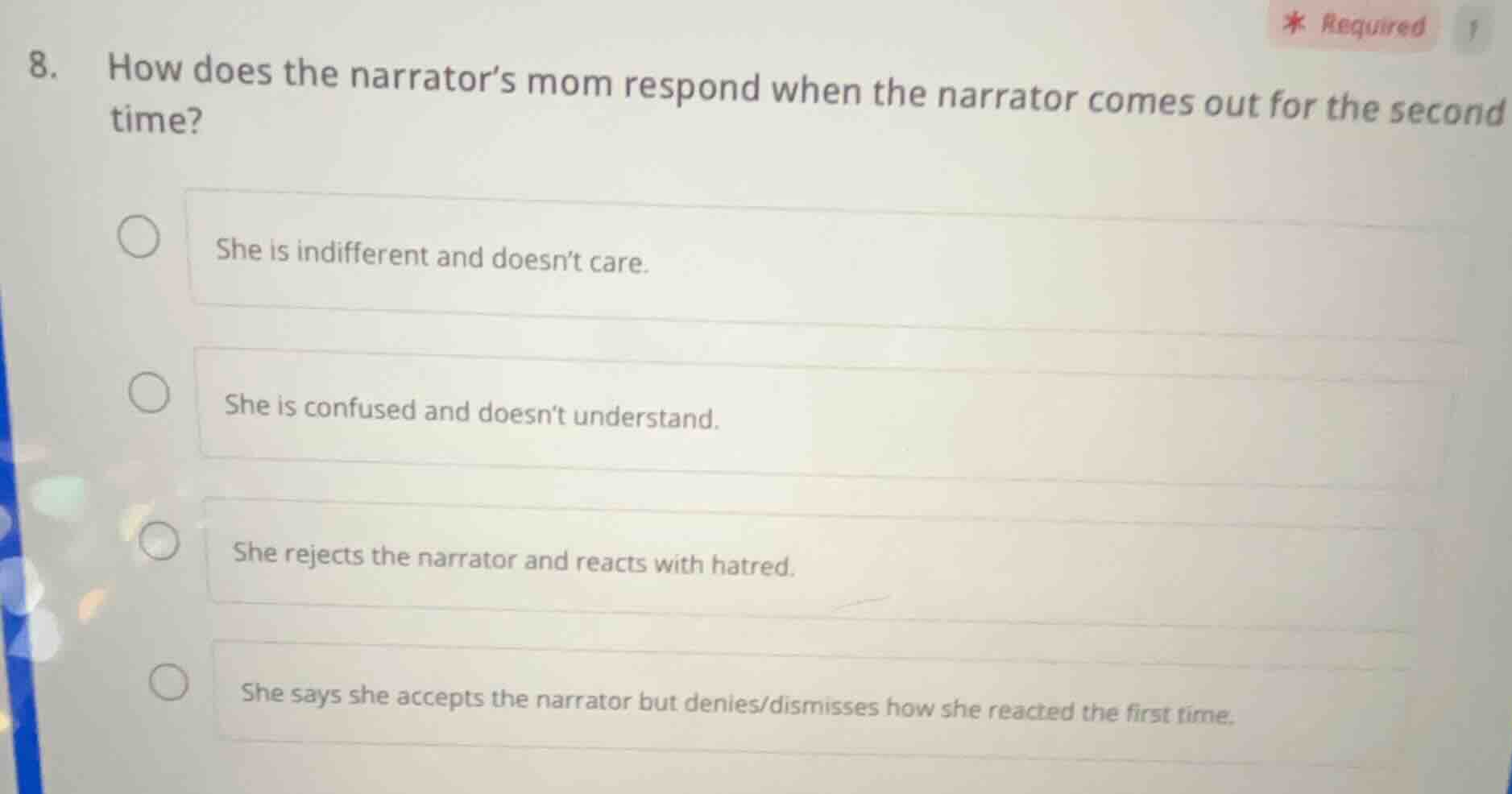
- how does the narrators mom respond when the narrator comes out for the second time?
she is indifferent and doesnt care.
she is confused and doesnt understand.
she rejects the narrator and reacts with hatred.
she says she accepts the narrator but denies/dismisses how she reacted the first time.
<pre_analysis>
{
"quality": "clear",
"question_count": 1,
"skills_matched": [
"direct_cot",
"multiple_choice_formatter",
"explain_then_answer",
"tutor",
"mastery_adaptive_brevity"
],
"needs_drawing": false,
"concepts_used": [
"LGBTQ Literature Analysis",
"Identity Acceptance Analysis"
],
"new_concepts": [],
"current_concepts": [
"LGBTQ Literature Analysis",
"Identity Acceptance Analysis",
"Reading Comprehension"
]
}
</pre_analysis>
<reasoning>
Analyze the narrative context
Using the LGBTQ Literature Analysis and Identity Acceptance Analysis knowledge points, we examine the dynamics of coming out narratives. Often, a protagonist's initial coming out is met with a complex or negative reaction, while a subsequent conversation or "coming out for the second time" involves the parent attempting to reconcile their feelings.
Evaluate the options
- Option 1 ("She is indifferent..."): Highly unlikely in a coming-out narrative involving a maternal relationship.
- Option 2 ("She is confused..."): Confusion usually characterizes the very first reaction rather than a secondary, reflective coming-out event.
- Option 3 ("She rejects..."): While some narratives feature ongoing rejection, a "second time" coming out often highlights the parent's defensive adjustment or revision of history.
- Option 4 ("She says she accepts..."): This option accurately captures a common psychological defense mechanism where a parent claims acceptance in the present while minimizing, denying, or dismissing their initial negative reaction. This aligns with standard literary themes of complex familial acceptance.
</reasoning>
<answer>
<mcq-option>She is indifferent and doesn't care.</mcq-option>
<mcq-option>She is confused and doesn't understand.</mcq-option>
<mcq-option>She rejects the narrator and reacts with hatred.</mcq-option>
<mcq-correct>She says she accepts the narrator but denies/dismisses how she reacted the first time.</mcq-correct>
</answer>
<post_analysis>
{
"subject": "Others",
"question_type": "Multiple Choice",
"knowledge_point": [
"Others",
"Literature",
"LGBTQ Literature Analysis"
]
}
</post_analysis>
Snap & solve any problem in the app
Get step-by-step solutions on Sovi AI
Photo-based solutions with guided steps
Explore more problems and detailed explanations
<pre_analysis>
{
"quality": "clear",
"question_count": 1,
"skills_matched": [
"direct_cot",
"multiple_choice_formatter",
"explain_then_answer",
"tutor",
"mastery_adaptive_brevity"
],
"needs_drawing": false,
"concepts_used": [
"LGBTQ Literature Analysis",
"Identity Acceptance Analysis"
],
"new_concepts": [],
"current_concepts": [
"LGBTQ Literature Analysis",
"Identity Acceptance Analysis",
"Reading Comprehension"
]
}
</pre_analysis>
<reasoning>
Analyze the narrative context
Using the LGBTQ Literature Analysis and Identity Acceptance Analysis knowledge points, we examine the dynamics of coming out narratives. Often, a protagonist's initial coming out is met with a complex or negative reaction, while a subsequent conversation or "coming out for the second time" involves the parent attempting to reconcile their feelings.
Evaluate the options
- Option 1 ("She is indifferent..."): Highly unlikely in a coming-out narrative involving a maternal relationship.
- Option 2 ("She is confused..."): Confusion usually characterizes the very first reaction rather than a secondary, reflective coming-out event.
- Option 3 ("She rejects..."): While some narratives feature ongoing rejection, a "second time" coming out often highlights the parent's defensive adjustment or revision of history.
- Option 4 ("She says she accepts..."): This option accurately captures a common psychological defense mechanism where a parent claims acceptance in the present while minimizing, denying, or dismissing their initial negative reaction. This aligns with standard literary themes of complex familial acceptance.
</reasoning>
<answer>
<mcq-option>She is indifferent and doesn't care.</mcq-option>
<mcq-option>She is confused and doesn't understand.</mcq-option>
<mcq-option>She rejects the narrator and reacts with hatred.</mcq-option>
<mcq-correct>She says she accepts the narrator but denies/dismisses how she reacted the first time.</mcq-correct>
</answer>
<post_analysis>
{
"subject": "Others",
"question_type": "Multiple Choice",
"knowledge_point": [
"Others",
"Literature",
"LGBTQ Literature Analysis"
]
}
</post_analysis>