QUESTION IMAGE
Question
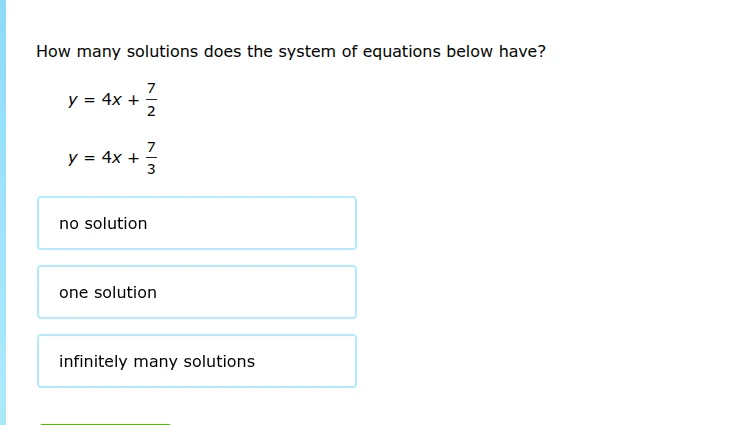
how many solutions does the system of equations below have?
y = 4x + \frac{7}{2}
y = 4x + \frac{7}{3}
no solution
one solution
infinitely many solutions
Step1: Analyze the equations' slopes and y-intercepts
The two equations are in slope - intercept form \(y = mx + b\), where \(m\) is the slope and \(b\) is the y - intercept. For the first equation \(y=4x+\frac{7}{2}\), the slope \(m_1 = 4\) and the y - intercept \(b_1=\frac{7}{2}\). For the second equation \(y = 4x+\frac{7}{3}\), the slope \(m_2=4\) and the y - intercept \(b_2=\frac{7}{3}\).
Step2: Determine the relationship between the lines
Since the slopes of the two lines (\(m_1 = m_2 = 4\)) are equal and the y - intercepts (\(b_1=\frac{7}{2}\) and \(b_2=\frac{7}{3}\)) are different (\(\frac{7}{2}
eq\frac{7}{3}\)), the two lines are parallel. Parallel lines in a plane never intersect.
Step3: Relate the intersection of lines to the number of solutions
A system of linear equations represents the intersection of two lines. If two lines are parallel and do not intersect, then the system of equations has no solution.

Snap & solve any problem in the app
Get step-by-step solutions on Sovi AI
Photo-based solutions with guided steps
Explore more problems and detailed explanations
no solution